

Egg freezing in Mexico can be one way to improve your chances of a biological child later, often for less than in the U.S., when a few things are settled before you pay a deposit: a fertility specialist has tested you and explained what your age and egg supply suggest; you know the plan if one cycle isn’t enough; the clinic has shared its results with eggs it froze and later thawed, or told you it has none yet; and the storage terms are in writing.
A frozen egg is a chance at a pregnancy, not a promise of one. Using it later means thawing it, fertilizing it in the lab and transferring an embryo to the uterus, which is IVF (in vitro fertilization), so choose the clinic for the storage years as well as for the two or three weeks of treatment.
At a glance
- Price
- Below the U.S. range in Tijuana; see the price table
- One cycle
- About 10 to 12 days of hormone injections, then an egg retrieval of typically 15 to 30 minutes under light anesthesia
- Time per cycle
- Usually around 2 to 3 weeks
- Using the eggs later
- Thawing, fertilizing them in the lab and transferring an embryo, which is in vitro fertilization
- Check first
- The clinic’s license to store eggs, and its own results with eggs it has thawed
Key takeaways
- See a fertility specialist for tests before you book, and ask how many eggs, and how many cycles, your age and results may call for.
- Ask each clinic how many patients have come back to thaw their eggs, and how many of those eggs survived and led to births.
- Before retrieval, get the yearly storage fee, the rules for late payments, the clinic’s age limit for using eggs and the steps for moving them in writing.
- Book travel that can shift with your cycle, and ask when you can go home after retrieval and whom to call in the week after.
- Before you choose where to freeze, ask a U.S. clinic you might use later whether it would accept and warm eggs frozen in Mexico.
In this guide
- How egg freezing works
- Who considers egg freezing, and when
- What the numbers mean: age, egg count and the chance of a baby
- Planning the trip: your cycle, monitoring and the days after retrieval
- Risks of egg freezing, and what you can do about each
- How much does egg freezing in Mexico cost?
- Choosing a clinic for egg freezing
- Storing your eggs, and moving them later
- Questions to ask an egg freezing clinic
- Before you go: checklist
- Warning signs after egg retrieval
- Frequently asked questions
- Sources
How egg freezing works
Egg freezing, or oocyte cryopreservation, collects your eggs, freezes them and stores them for possible use later. The treatment is like the first part of an IVF cycle, according to the American Society for Reproductive Medicine (ASRM), a U.S. professional society (ASRM); the IVF cycle, step by step covers the shared ground. The freezing cycle, and why each step happens:
| Step | What happens and why |
|---|---|
| Hormone injections | About 10 to 12 days of hormone injections, which you give yourself daily, help more than one egg mature at once |
| Monitoring | Blood tests and ultrasounds track how your ovaries respond, so the dose can be adjusted and the doctor can check that the ovaries aren’t over-responding |
| Retrieval | A brief outpatient procedure, typically 15 to 30 minutes, under light anesthesia |
| Checking | An embryologist, a trained scientist, examines the eggs; not all are mature enough to freeze |
| Freezing | Mature eggs are frozen the same day, usually by vitrification, a rapid cooling that limits ice crystals forming inside the egg, so more eggs survive warming than with slow freezing |
| Storage | Tanks of liquid nitrogen keep the eggs, usually at -196°C, until you use, move or discard them |
Sources: ASRM fact sheet, ASRM, fertility preservation, SART, MedlinePlus, ASRM 2021 guideline, HFEA, ASRM storage opinion.
One cycle usually takes around 2 to 3 weeks to complete, according to the Human Fertilisation and Embryology Authority (HFEA), the UK’s fertility regulator (HFEA).
Who considers egg freezing, and when
Why it matters: your reason for freezing shapes the timing, since fertility declines with age and urgent medical treatment may call for a fast-tracked cycle (ASRM).
People consider egg freezing when they don’t have a partner, for personal or religious reasons, before gender-affirming treatment, or before medical treatment that could affect their ability to have children (ASRM). Planned egg freezing, before any medical need, responds to the effect of age on fertility: the risk of difficulty getting pregnant rises with age, as both the number and the quality of eggs decline, and lower quality may raise the risk of miscarriage and chromosomal abnormalities (ASRM).
Before medical treatment. Cancer treatment can harm the reproductive organs, so discuss fertility options as early as possible, before it starts. It may not be able to wait the 2 to 3 weeks a cycle takes, and in some cases the hormone medicines can raise estrogen levels, which may not be safe with certain cancers; for people facing cancer treatment, freezing embryos, which requires sperm, has a higher success rate than freezing eggs (ASRM). Some U.S. states require insurers to cover fertility preservation when medical treatment could affect fertility (ASRM), so check your plan at home first.
Planned freezing: the best age. Most experts agree that planned egg freezing is most likely to succeed when the eggs are frozen before 38, and it typically works best in your 20s to early 30s, according to ASRM’s patient fact sheet (ASRM). ASRM’s 2021 guideline for doctors is more cautious: it found too little data to advise on the best age, and it makes only a weak recommendation, based on limited data, that patients be told live birth rates per embryo transfer are better when eggs are frozen younger (ASRM guideline). If you have no health or fertility concerns, you shouldn’t feel compelled to freeze, in the HFEA’s view, since its UK data show far fewer people come back to use their eggs than store them (HFEA factsheet).
How to check: before you book, see a fertility specialist (a reproductive endocrinologist) for the blood work and ultrasound that show whether egg freezing is appropriate for you (ASRM). Ovarian reserve tests, which gauge the supply of eggs you have left, help predict how many eggs a cycle may produce, but there’s too little evidence that they predict a live birth independently of age (ASRM guideline). Share the results with each clinic you’re considering.
What the numbers mean: age, egg count and the chance of a baby
Why it matters: the chance that frozen eggs later lead to a baby depends on your age when you freeze them and on how many you freeze (ASRM).
For a sense of scale, here are figures for groups of patients; they aren’t a prediction for you. Each frozen egg has about a 2% to 12% chance of becoming a baby, and the pregnancy rate per frozen egg drops further with age; more eggs may mean more tries at a pregnancy later (ASRM). Not every egg survives thawing: in a pooled analysis of 10 studies of spare eggs frozen after IVF cycles, cited in ASRM’s 2021 guideline, 85% of vitrified eggs survived (ASRM guideline).
A study at one fertility center estimated how many mature eggs patients would need to freeze for a 70% chance of one live birth:
| Age when eggs are frozen | Mature eggs needed (estimate) |
|---|---|
| 30 to 34 | 14 |
| 35 to 37 | 15 |
| 38 to 40 | 26 |
Source: one center’s study of 128 cycles using vitrified eggs, most of them from patients having fertility treatment rather than planned freezing, as summarized in ASRM’s 2021 guideline. These are estimates from one group of patients, not a prediction for you, and the guideline found too little evidence to tell patients of any age exactly how many eggs they need. Your fertility doctor can help you read them for your situation.
At 38, about 25 to 30 frozen eggs are needed for a reasonable chance of one child, according to ASRM’s Ethics Committee, and planned egg freezing will often take more than one cycle (ASRM Ethics Committee). In the UK, most patients under 38 have around 7 to 14 eggs collected in a cycle, though this isn’t always possible when ovarian reserve is low (HFEA). The data are still incomplete, because most eggs frozen for patients’ own use haven’t yet been thawed and used (ASRM Ethics Committee), and we found no public, clinic-by-clinic results for frozen eggs in Mexico; how to read a clinic’s success rates explains how clinics count theirs.
How to check: ask your fertility doctor how many eggs they’d aim for at your age and test results, how many cycles that might take, and what you’d do if the first cycle falls short. Then ask each clinic for its own results with thawed eggs, using the questions in choosing a clinic.
Planning the trip: your cycle, monitoring and the days after retrieval
Why it matters: your period usually sets the start date, the monitoring visits set the pace, and how you recover after retrieval affects when you can travel home.
Your clinic sets the schedule; how long to stay for IVF explains what decides it, including monitoring near home. For egg freezing:
- Starting. Stimulation generally begins after your period starts; some patients take birth control pills the month before to help with timing, and if the ultrasound around your expected period finds a cyst, treatment may wait until it resolves, according to the Society for Assisted Reproductive Technology (SART), a U.S. professional society (SART). Book travel you can change.
- Monitoring. Scans and blood tests are frequent, and your dose may change with the results (SART). We found no official count of visits, so ask for your clinic’s plan.
- Retrieval day. An anesthesiologist usually gives medicines through a vein, most patients sleep through the procedure, and you’re watched until the medicines wear off (SART). The eggs are frozen the same day, so there’s no embryo transfer to stay for.
- The days after. Some spotting and lower belly discomfort for several days is not uncommon, and patients generally feel completely recovered within 1 to 2 days (SART). Strong symptoms of ovarian hyperstimulation syndrome (OHSS), a reaction to the fertility medicines, generally appear in the week after egg collection (HFEA), so plan how you’ll reach your clinic that week, wherever you are.
- Medicines and the border. If you’ll carry injections home, see fertility medicines bought in Mexico and medicine prescribed after a procedure; if you’ll cross on foot after retrieval, see crossing back into the U.S.
How to check: ask your clinic which day of your cycle you start and whether the first injections can be done at home, how many monitoring visits you’ll need and whether any could happen near home, whether someone should stay with you after the anesthesia, and when you can travel after retrieval.
Risks of egg freezing, and what you can do about each
Why it matters: each risk below comes with a step you can take, and some of those steps shape your plans for the days after retrieval.
For how often OHSS occurs and the main risks of egg retrieval, see your safety during the cycle. For egg freezing:
| Risk | What it is | What you can do |
|---|---|---|
| OHSS | The ovaries over-respond to the medicines, becoming very large and painful. Mild OHSS can usually be treated at home with pain relief; moderate or severe OHSS is less common, and in very rare cases severe OHSS can be life-threatening (HFEA). It’s the most common risk of planned egg freezing, though reduced, not absent, as no embryo transfer follows (ASRM Ethics Committee); it’s more likely under 35, with polycystic ovary syndrome, very high estrogen, low body weight or an unusually large number of follicles (MedlinePlus) | Ask how the clinic will lower your risk, including its trigger shot: leuprolide (Lupron) is less likely to cause OHSS than human chorionic gonadotropin (SART). For mild symptoms, rest with your legs raised but stay lightly active unless told otherwise, drink at least 10 to 12 glasses (1.5 to 2 liters) of fluid a day, skip alcohol, caffeine, intense exercise and sex, and weigh yourself daily (MedlinePlus) |
| Egg retrieval | Reactions to anesthesia, bleeding, infection, or damage to structures near the ovaries, such as the bowel and bladder (MedlinePlus) | Ask who gives the anesthesia and how you’ll be checked before you leave; keep the clinic’s after-hours number and the warning signs with you |
| Medicine side effects | Bloating, belly pain, mood swings, headaches and bruising from repeated injections; so far, research has found fertility medicines aren’t linked to ovarian cancer (MedlinePlus) | Ask for a written schedule of each medicine and dose, and report side effects to the clinic |
| It may not work | Freezing doesn’t guarantee a baby; the largest risk is that it won’t work (HFEA factsheet) | Agree an egg target with your doctor, and know the other routes if the eggs don’t lead to a pregnancy, such as trying to conceive, IVF with donor eggs or adoption (HFEA) |
| Pregnancy at an older age | The older you get, the higher the risk of pregnancy complications and health problems for you and your baby (HFEA) | Ask whether the clinic has an upper age limit for using stored eggs, which consent forms should state (ASRM Ethics Committee), and plan the timing with your doctor |
| Regret and stress | In one study of 201 patients who froze eggs, almost half later felt some regret about it, more often when they had fewer eggs than expected or too little information or emotional support (ASRM Ethics Committee) | Set a realistic target first, and consider a therapist who specializes in reproductive health, who can help with the emotional side of fertility preservation (ASRM) |
| Long-term unknowns | Short-term reports show no rise in birth defects among babies from frozen eggs compared with other IVF babies, but long-term data are incomplete (ASRM Ethics Committee) | Ask your doctor what is known now, and read what your consent form says about the safety data |
How to check: give the clinic your full medical history and medicine list, and ask which of these risks matter most for you and how each would be treated, including once you’re home.
How much does egg freezing in Mexico cost?
Why it matters: the costs of egg freezing typically fall into three stages: the cycle, storage until you use the eggs, and the later attempt at pregnancy (ASRM).
| Treatment | Tijuana (USD) | United States (USD) |
|---|---|---|
| Egg freezing | $4,500 – $7,000 | $11,000 – $18,000 |
Uriym’s indicative ranges from its fertility price catalog, reviewed September 7, 2026. They are not quotes and cover the listed treatment only, without taxes, travel or third-party charges.
The first stage covers the consultation, tests, medicines, stimulation and retrieval, and storage is usually a yearly fee (ASRM). Planned egg freezing is usually self-pay in the U.S. (ASRM Ethics Committee), though some insurance plans cover it, so check your benefit and its conditions (ASRM). For care in Mexico, see does U.S. health insurance cover care in Mexico, health savings and flexible spending accounts abroad and travel and recovery costs.
How to check: ask each clinic for a written, itemized quote, and go through these lines:
| Line | What to ask |
|---|---|
| Tests | Which blood tests, scans and infection tests are included, and will the clinic accept recent results from home? |
| Medicines | Are the stimulation injections and trigger shot included? If not, what’s the estimate for your doses? |
| Monitoring | How many scans and blood tests are included, and what does each extra one cost? |
| Retrieval and freezing | Are the anesthesia and the freezing included, and is freezing priced per cycle or per egg? |
| Storage | Is the first year included, and from which date? What is the yearly fee after that, and can it rise? |
| A second cycle | What would another cycle cost if one isn’t enough? |
| A cancelled cycle | What do you pay if the cycle stops before retrieval? |
| Moving your eggs | What does the clinic charge to release them and prepare them for shipping? |
| Using the eggs later | What would thawing and fertilizing the eggs, growing embryos and a transfer cost here? |
Choosing a clinic for egg freezing
Why it matters: freezing and warming eggs takes experience to do well (ASRM Ethics Committee), and the clinic you choose may hold your eggs for years.
Start with checking the clinic and doctor, which covers the clinic’s license and the doctor’s credentials; two checks are specific to egg freezing.
A license that covers storage. COFEPRIS, Mexico’s Federal Commission for Protection against Health Risks, lists assisted reproduction among the surgical activities a health license can cover, and separately a germ-cell bank for assisted reproduction (banco de células germinales para reproducción asistida), defined as an authorized establishment that collects, processes, preserves, stores and, in some cases, distributes eggs and sperm (COFEPRIS license form instructions, September 2026, in Spanish). Not every clinic offering egg freezing may be licensed to store eggs at the address where yours will stay, so ask to see the license itself.
Experience with thawed eggs. A clinic should tell you its own survival rate for thawed eggs and its pregnancy and live birth rates, or that it doesn’t have them yet, and whether it has only recently started freezing eggs, according to ASRM’s Ethics Committee (ASRM Ethics Committee). Published results mostly come from high-volume centers, and it’s uncertain whether lower-volume centers achieve the same (ASRM guideline).
How to check:
- Ask for photos of the clinic’s licencias sanitarias (health licenses), since the license form lists assisted reproduction and a germ-cell bank under different license types, and check that they cover egg storage and assisted reproduction at the address where you’ll be treated and your eggs kept; checking a clinic’s health license shows what to compare.
- Ask how long the clinic has been freezing eggs, and how many egg-freezing cycles it does a year.
- Ask how many patients have come back to thaw their eggs, what share of those eggs survived, and how many live births followed.
- Ask who will do your retrieval, and who runs the lab that freezes and stores the eggs.
Storing your eggs, and moving them later
Why it matters: your eggs stay in the clinic’s care until you use, move or discard them, so its storage terms may apply long after the trip.
How they’re kept. In U.S. practice, accredited labs must check storage tanks at least three times a week or monitor them continuously, with alarms watched around the clock and tested at least quarterly; the alarms should keep working in a power outage. Even so, a tank can, rarely, fail and lose what it holds, and patients should be told of that risk (ASRM storage opinion). Ask how the clinic monitors its tanks and what its policy is if eggs are lost, destroyed or stolen (ASRM Ethics Committee).
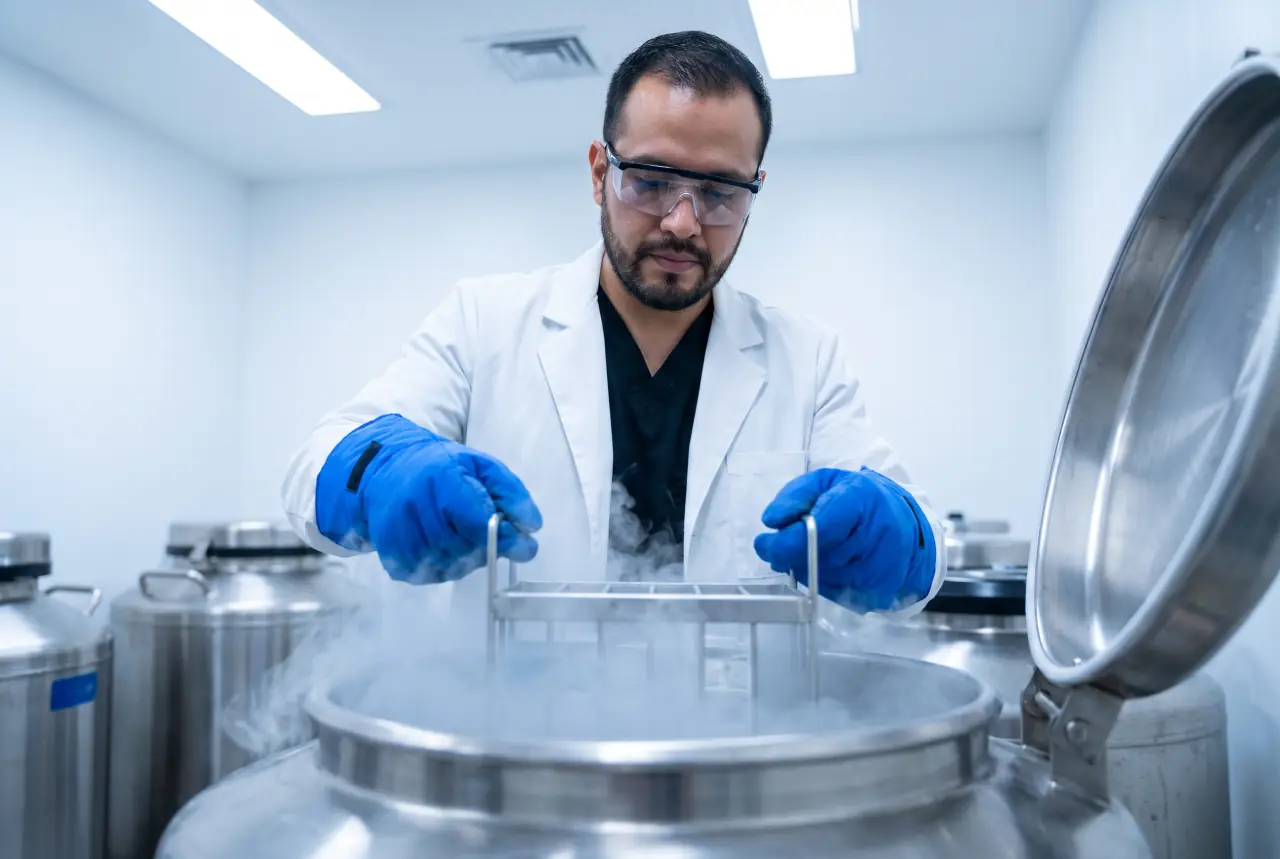
How long. In the UK, the law since July 2022 allows eggs to be stored for up to 55 years if consent is renewed every 10 years, and there isn’t enough evidence to say whether longer storage harms them (HFEA). When we checked in October 2026, we found no Mexican federal rule on how long eggs can be stored, so ask the clinic for its own limit.
Missed payments and contact details. The UK position on unpaid storage is in storing eggs or embryos. Facilities that store eggs should tell you their policies on unpaid storage fees, according to ASRM’s Ethics Committee (ASRM Ethics Committee). Out-of-date patient contact details and embryos wrongly discarded as abandoned both appear on ASRM’s list of known storage errors (ASRM storage opinion), so keep your phone, email and address current with the clinic.
If the clinic moves or closes. We found no official Mexican guidance on what happens to stored eggs then, though a licensed clinic that moves must apply for a new health license (COFEPRIS, in Spanish). Ask what notice you’d get, where your eggs would go and who would pay to move them, and put the answers in your contract.
Moving your eggs to the U.S. The same IVF guide section covers the import rule and shipping. For eggs, ask any U.S. clinic you might use later, before you freeze, whether it would accept and warm eggs frozen in Mexico. Mislabeled samples, counts that don’t match the records, lost shipments and missing warming instructions are among the shipping errors ASRM lists (ASRM storage opinion), so make sure the egg count, labels, freezing method and warming instructions travel with your eggs.
How to check: before retrieval, get these in writing:
- The yearly fee after any included period, how to pay it from the U.S., and what happens if a payment is late
- The clinic’s storage limit, and any age after which it won’t use stored eggs
- What happens to your eggs if you die or become unable to make decisions for yourself, and your options for eggs you don’t use
- The plan if the clinic moves, closes or changes owners
- The fee and steps for releasing your eggs to another clinic
Questions to ask an egg freezing clinic
- How many eggs might one cycle give me, given my test results, and how many cycles would you plan for my age?
- How will you lower my risk of OHSS, and when can I travel home after retrieval?
- How long have you frozen eggs, and how many patients have thawed theirs here, with what survival and live birth results?
- Which license covers storing eggs at the address where mine will be kept, and may I see it?
- What does storage cost each year, what if a payment is late, and how are your tanks monitored at night and in a power outage?
- What happens to my eggs if you move, close or change owners?
- Is there an age after which you won’t use stored eggs, and how would you release them to a U.S. clinic?
Before you go: checklist
- Fertility tests done, and the results discussed with a fertility specialist
- An egg target agreed, with a plan if one cycle falls short
- The clinic’s license for storing eggs seen, and the doctor’s credentials checked
- The clinic’s thaw results received, or its answer that it has none yet
- Itemized quote reviewed, including medicines, anesthesia, storage and a second cycle
- Storage contract and consent forms read, with copies kept
- A U.S. clinic asked whether it would accept eggs frozen in Mexico
- Travel booked so it can move with your cycle, and the clinic’s after-hours contact saved
- The State Department’s current advisory for your destination read; see what it says for Tijuana and Guadalajara
Warning signs after egg retrieval
In an emergency, call 911, which works in the U.S. and Mexico, then tell your fertility clinic. Keep these signs, and your clinic’s after-hours number, with you through the week after retrieval, whether you’re in Mexico or back home. The rows come from different sources and some signs appear in more than one, so as a practical rule of our own, not a source’s, follow the more urgent advice.
| What you notice | What to do |
|---|---|
| Difficulty breathing; pain in your chest or upper back; being very thirsty while peeing less than usual; swelling in any part of your body; belly pain low down on one side; or pain in the tip of your shoulder | Call 911, and don’t drive yourself (NHS, adapted; see the note) |
| Pain and bloating in your belly, nausea and vomiting, feeling faint, coughing up blood, vaginal bleeding or a brown watery discharge, or pain or discomfort when you pee or poop | Contact your fertility clinic as soon as possible (NHS) |
| A swollen stomach and stomach pain, nausea and vomiting, shortness of breath, faintness, or passing less urine | Contact your clinic immediately; never feel you’re wasting its time (HFEA) |
| Weight gain of more than 2 lb (1 kg) a day, dizziness, nausea so bad you can’t keep food or liquids down, or severe belly pain | Contact your provider (MedlinePlus) |
| A fever over 100.5°F (38°C), pelvic pain, heavy bleeding from the vagina, or blood in your urine | Contact your provider right away (MedlinePlus) |
England’s National Health Service (NHS) gives the first two rows for IVF, whose medicines and egg collection egg freezing shares. It lists the first row under calling 999 or going to A&E, the UK’s emergency number and emergency department, and says those signs could mean severe OHSS or an ectopic pregnancy (one growing outside the uterus). MedlinePlus, the U.S. National Library of Medicine’s health site, gives the last row for anyone who has had IVF.
If symptoms start after you’re home, tell whoever treats you that you’ve just had fertility medicines and an egg retrieval, and when.
Frequently asked questions
How much does egg freezing cost in Mexico?
Uriym’s indicative range for egg freezing in Tijuana is $4,500 to $7,000, compared with $11,000 to $18,000 in the U.S. These ranges are indicative, not quotes. Medicines, yearly storage and the in vitro fertilization (IVF) needed to use your eggs later may be priced separately, so ask each clinic for an itemized quote; the lines to check are in what egg freezing costs.
What is the best age to freeze your eggs?
Younger is generally better: most experts agree planned egg freezing is most likely to succeed when the eggs are frozen before 38, and it typically works best in your 20s to early 30s (ASRM). ASRM’s 2021 guideline for doctors found too little data to name an optimal age, and makes only a weak recommendation, based on limited data, that patients be told live birth rates per embryo transfer are better when eggs are frozen younger (ASRM guideline). A fertility specialist can tell you what your own tests suggest; see who considers egg freezing.
How many eggs should I freeze?
Your doctor will suggest a number for your age and test results, and reaching it may take more than one cycle (ASRM). Older patients generally need more eggs for the same chance, because each egg’s chance of becoming a baby falls with age (ASRM; ASRM guideline). What the numbers mean has published estimates by age, which are group figures, not a prediction for you.
How long do you need to stay in Mexico for egg freezing?
Your clinic sets the schedule. One cycle usually takes around 2 to 3 weeks (HFEA), and how much of it you spend in Mexico depends on where your monitoring scans happen. There’s no embryo transfer to wait for, but ask when you can travel after retrieval, since strong symptoms of ovarian hyperstimulation generally appear in the following week (HFEA). See planning the trip.
How long can frozen eggs be stored?
It depends on the rules where they’re stored and on your contract with the clinic. In the UK, eggs can be stored for up to 55 years if consent is renewed every 10 years (HFEA). We found no Mexican federal limit when we checked in October 2026, so ask the clinic for its own limit, and for any age after which it won’t use stored eggs; see storing your eggs.
Can I bring my frozen eggs from Mexico to the US?
Possibly, if you plan it before you freeze. Ask a U.S. clinic you might use whether it would accept and warm eggs frozen in Mexico, ask both clinics who ships and who pays, and make sure the egg count, labels, freezing method and warming instructions travel with them. Bringing them into the U.S. may require notifying the Food and Drug Administration; moving eggs or embryos to the U.S. explains the rule.
Is egg freezing in Mexico safe?
It depends on things you can check before you pay: whether egg freezing suits your age and health, the clinic’s licenses and its experience with thawed eggs, and its plan for the days after retrieval. Ovarian hyperstimulation syndrome is the most common risk of planned egg freezing, though it’s reduced, not absent, because no embryo transfer follows (ASRM Ethics Committee). Risks and what to do pairs each risk with a step, and whether surgery in Mexico is safe covers the travel advisory.
Does insurance cover egg freezing?
Sometimes. Some U.S. plans cover planned egg freezing and some don’t, so check your benefit and its conditions (ASRM), and some states require insurers to cover fertility preservation before medical treatment that could affect fertility (ASRM). Paying for care in Mexico is a separate question: see does U.S. health insurance cover care in Mexico and health savings and flexible spending accounts abroad.
Sources
- Can I Freeze My Eggs to Use Later if I’m Not Sick? (patient fact sheet, revised 2023) American Society for Reproductive Medicine (ReproductiveFacts.org)
- Fertility Preservation Journey American Society for Reproductive Medicine (ReproductiveFacts.org)
- Planned oocyte cryopreservation to preserve future reproductive potential: an Ethics Committee opinion (2023) American Society for Reproductive Medicine (Fertility and Sterility, 2024)
- Evidence-based outcomes after oocyte cryopreservation for donor oocyte in vitro fertilization and planned oocyte cryopreservation: a guideline (2021) American Society for Reproductive Medicine (Fertility and Sterility)
- Cryostorage of reproductive tissues in the in vitro fertilization laboratory: a committee opinion (2020) American Society for Reproductive Medicine
- ART: Step-by-Step Guide Society for Assisted Reproductive Technology (SART)
- Egg freezing Human Fertilisation and Embryology Authority (HFEA)
- Egg freezing: a factsheet (2025) Human Fertilisation and Embryology Authority (HFEA)
- Risks of fertility treatment Human Fertilisation and Embryology Authority (HFEA)
- Ovarian hyperstimulation syndrome MedlinePlus, U.S. National Library of Medicine
- In vitro fertilization (IVF) MedlinePlus, U.S. National Library of Medicine
- IVF NHS
- Instructivo de llenado para el formato FF-COFEPRIS-07, Licencias de Servicios de Salud (in Spanish; published September 11, 2026) COFEPRIS
About this guide
The Uriym editorial team researched this guide from the 13 sources above, drafted it with AI assistance, and checked it claim by claim against those sources before publishing, last on . Our editorial standards explain how we choose sources, handle prices and make corrections.
Uriym is a healthcare navigation platform, not a medical provider. Its founder, Adriana Mendez, grew up in a family that traveled to Mexico for care and has done it herself for the past ten years. How Uriym works
This is general information, not medical, legal or financial advice: your treating provider decides what care is right for you. Rules, prices and advisories change, so check the official page before you act. Found something wrong or out of date? Email support@uriym.com.