Bringing prescription drugs from Mexico into the United States is allowed only in limited cases. Whether a medicine can come home with you depends on what it is, where you got it, and how you carry and declare it. For medicine bought abroad, federal drug rules make importing it illegal in most circumstances, with exceptions decided case by case, and controlled substances such as tramadol also follow a separate rule with a limit for U.S. residents.
Whatever you carry, the same steps help: keep each medicine in its original package with a prescription in your name, declare all of it when you cross, and talk with your doctor at home before you travel about what you’ll need afterward. Officials decide at the border, one case at a time, so for a specific medicine you can ask the agencies before you go.
At a glance
- Is it legal?
- Usually not for medicine bought abroad: importing it is illegal in most circumstances, with exceptions decided case by case
- What to declare
- Every medicine you carry, in its original package, with a prescription in your name
- Controlled medicines
- For U.S. residents, no more than 50 dosage units in total of those obtained abroad; see the limit
- The “90-day supply”
- None of the official pages we checked says U.S. citizens or residents may bring home 90 days of medicine bought abroad
- What to bring home
- Original containers with pharmacy labels, prescriptions in your name, and the clinic’s written record of your care and medicines
- What to check on the box
- That its lot number and expiration date match the ones on the pen or container inside
Key takeaways
- Before you travel, ask your treating provider what they plan to prescribe, and ask your doctor at home whether a U.S. prescription is possible instead.
- Ask your doctor or a U.S. pharmacist whether any medicine you get in Mexico is a controlled substance; if so, count all of them together against the limit below.
- Keep each medicine in the container it was dispensed in, with its pharmacy label and a prescription in your name, and declare all of it when you cross.
- Ask the clinic for a written record of your care and the medicines you were given, listed by generic name, to share with your doctor at home.
- If you need medicine while in Mexico, buy it on a medical professional’s advice from a reputable pharmacy, and check that the lot number and expiration date on the box match the container inside.
In this guide
- Is it legal to bring prescription drugs from Mexico?
- How to declare medicine at the border
- Controlled substances: the 50-dosage-unit limit
- Medicine prescribed after a procedure in Mexico
- Medicine bought at a Mexican pharmacy, including antibiotics
- Checking that medicine bought in Mexico is genuine
- Taking your own medicines into Mexico
- Which rules apply to your situation
- Who decides at the border, and how to ask before you go
- Questions to ask your doctors and a pharmacist
- Before you go: checklist
- Frequently asked questions
- Sources
Is it legal to bring prescription drugs from Mexico?
Usually not, for medicine bought abroad. In most circumstances, it is illegal for individuals to import drugs into the United States for personal use (FDA; CBP), because products bought in other countries often haven’t been approved by the U.S. Food and Drug Administration (FDA). A drug approved elsewhere but not in the United States is illegal to import, and because the FDA can’t ensure the safety and effectiveness of medicine bought during trips abroad, it recommends getting medicines only from legal U.S. sources (FDA).
Guidance from U.S. Customs and Border Protection (CBP) sets out how three agencies’ rules fit together (CBP):
- Any prescription or over-the-counter medicine you carry has to comply with the laws the FDA enforces, and a controlled substance also has to meet the requirements of the Drug Enforcement Administration (DEA).
- Travel only with your own medication, prescribed to you by a licensed physician or legally obtained in the United States.
- The FDA generally considers foreign-made versions of U.S.-approved drugs unapproved, and only medications that can be legally prescribed in the United States may be imported for personal use.
- Possessing certain substances may also violate state laws.
When the FDA may allow it anyway
Products that violate FDA laws are generally not permitted, for the safety and security of Americans, but FDA staff “may consider a more permissive decision” about an unapproved drug in two situations (FDA):
- The product isn’t for treatment of a serious condition, and there’s no known significant health risk.
- The product is for a serious condition for which effective treatment may not be available in the United States, nobody is known to be marketing it to U.S. residents, and it doesn’t represent an unreasonable risk. You also affirm in writing that it’s for personal use, bring generally not more than a three-month supply, and either give the name and address of the U.S.-licensed doctor responsible for your treatment with it or provide evidence that it continues a treatment begun in another country.
These are judgment calls, not allowances. Staff may examine a product’s background, risk and purpose, and decide “on a case by case basis whether to detain, refuse, or allow entry of the product.” That discretion “should not be interpreted as a license to individuals to bring in such shipments” (FDA Regulatory Procedures Manual, the operating procedures FDA staff follow).
What “personal use” and “90-day supply” mean
In the agencies’ wording, these terms are narrower than they sound:
- Personal use: a personal importation is “a product not for further sale or distribution into U.S. commerce” (FDA).
- Three months: staff may treat an importation as commercial when “the supply exceeds what one person might take in approximately three months” (FDA manual). For U.S. citizens, the FDA’s three-month figure appears only among the discretionary conditions above, hedged with “generally.”
- 90 days: the FDA’s “90-day supply” is for foreign nationals, meaning anyone who isn’t a U.S. citizen or permanent resident, so it doesn’t cover green-card holders either (FDA). In CBP’s guidance, it’s a rule of thumb for non-U.S. citizens visiting temporarily (CBP), and the declaration rule uses it to say what must be declared. None of these pages says a U.S. citizen or resident may bring home 90 days of medicine bought abroad.
How to declare medicine at the border
Why it matters: declaring your medicines is required, and the federal exemption for controlled substances depends on it.
Medications up to a 90-day supply must be declared and should be in their original package with a prescription in your name (CBP). For medicines that contain potentially addictive drugs or narcotics, such as some cough medicines, tranquilizers, sleeping pills, antidepressants and stimulants, CBP’s guidance has four steps (CBP):
- Declare all drugs, medicinal and similar products to the appropriate CBP official.
- Carry them in their original containers.
- Carry only the quantity a person with that condition would normally carry for personal use.
- Carry a prescription or a written statement from your physician that the substances are being used under a doctor’s supervision and are necessary for your physical well-being while traveling.
Some drugs can’t come in at all. Rohypnol, GHB (gamma-hydroxybutyrate), Fen-Phen and certain other drugs with a high potential for abuse may not be brought into the United States, and there are severe penalties for trying. If the FDA hasn’t approved such drugs for use in the United States, they “will be confiscated, even if they are prescribed by a foreign physician.” The FDA also prohibits importing fraudulent or counterfeit drugs, by mail or in person, including unorthodox “cures” for conditions such as cancer, AIDS (acquired immunodeficiency syndrome), arthritis or multiple sclerosis (CBP).
Keep every medicine, its label and its paperwork together in one bag you can hand over, so declaring takes a minute rather than a search through your luggage.
How to check: before you reach the officer, have every medicine you carry, including any bought over the counter, ready to declare in its original package with a prescription in your name or a physician’s written statement. For a controlled substance, have the details the federal rule asks for; if you’re unsure whether a medicine can come in at all, ask before you travel.
Controlled substances: the 50-dosage-unit limit
Why it matters: some pain relievers and sedatives are controlled substances, and they come home under their own federal rule, with conditions and, for those obtained abroad, a limit.
The DEA sorts controlled substances into five schedules by accepted medical use and potential for abuse or dependence; Schedule V has the least potential for abuse. Examples on its lists include:
| DEA schedule | Examples the DEA lists |
|---|---|
| Schedule II | Combination products with less than 15 milligrams of hydrocodone per dosage unit (Vicodin), oxycodone (OxyContin), hydromorphone (Dilaudid), meperidine (Demerol), methadone, fentanyl, Adderall, Ritalin |
| Schedule III | Products containing less than 90 milligrams of codeine per dosage unit (Tylenol with codeine), ketamine, anabolic steroids, testosterone |
| Schedule IV | Xanax, Soma, Valium, Ativan, Ambien, tramadol |
| Schedule V | Cough preparations with less than 200 milligrams of codeine per 100 milliliters (Robitussin AC), Lomotil, Motofen, Lyrica |
Source: DEA drug scheduling. The DEA’s lists are general references, not complete listings of every controlled substance.
The rule for bringing them in is section 1301.26 of title 21 of the Code of Federal Regulations (21 CFR 1301.26). It lets you enter the United States with a Schedule II to V controlled substance “which he/she has lawfully obtained for his/her personal medical use” on two conditions, which are there to make sure the drugs are actually used by the traveler for legitimate personal medical use (2004 final rule):
- Original container: “The controlled substance is in the original container in which it was dispensed to the individual.”
- Declaration: you tell an appropriate customs officer that it’s for your personal use and give its trade or chemical name and the symbol for its schedule, if they appear on the container label; if the name doesn’t, you give the name and address of the pharmacy or practitioner who dispensed it and the prescription number.
Schedule I, which the DEA defines as drugs with no currently accepted medical use and a high potential for abuse, and which includes marijuana (cannabis), is outside this exemption.
Paragraph (c) then sets the limit: “a United States resident may import into the United States no more than 50 dosage units combined of all such controlled substances in the individual’s possession that were obtained abroad for personal medical use.” A U.S. resident is defined by where you actually live: a person whose principal, actual dwelling place is in the United States. The limit “does not apply to controlled substances lawfully obtained in the United States pursuant to a prescription issued by a DEA registrant,” meaning a prescriber registered with the DEA.
The DEA set the combined limit in 2004 to curb misuse of the exemption while still letting travelers carry small quantities, lawfully obtained abroad for legitimate medical use, until they can get the medicine at home (2004 final rule). Four details decide how it applies to you:
- It’s 50 in total, not 50 per drug. A dosage unit is a “tablet, capsule, or teaspoonful (5 ml),” and the 2004 rule rejects 50 units of each of several drugs. It also rejects limits that vary by schedule, since importing for personal medical use “is based on medical need and not on the schedule.”
- It applies whether you walk, drive or fly. To promote uniform enforcement, the 2004 rule applies it to residents returning “at any location and by any means,” a flight home from Guadalajara included; CBP’s guidance describes only the land-border case (CBP).
- A Mexican prescription doesn’t lift it. The regulation’s only exception is for controlled substances lawfully obtained in the United States on a DEA registrant’s prescription. Nor does the 2004 rule let residents travel abroad just to obtain controlled substances to bring home (2004 final rule).
- It has to be lawfully obtained in Mexico. Controlled substances obtained abroad may be carried in only if they were dispensed in full compliance with the laws of the country where they were obtained, and Mexico has laws that govern prescribing and dispensing them. Knowing and following those laws is your duty (2004 final rule).
Shipping isn’t covered: the exemption doesn’t apply to controlled substances shipped into the United States from abroad, even with a valid prescription from a U.S. practitioner (2004 final rule).
How to check: ask your doctor or a U.S. pharmacist whether each medicine you’ve been given is controlled in the United States. Then count the dosage units of all your controlled medicines from abroad together, keep each in the container it was dispensed in, and declare each one as being for your personal use, with the details above.
Medicine prescribed after a procedure in Mexico
Why it matters: medicine your treating provider gives you in Mexico counts as obtained abroad, so the general rule, declaring it and, for controlled medicines, the 50-unit limit all apply.
The controlled-substance rule doesn’t require a U.S. prescription for medicine obtained abroad: in 2004 the DEA declined to require one, noting that travelers may legitimately need to see a foreign doctor and be given a controlled substance, and may still need it until they can see their own doctors (2004 final rule). The FDA’s phrase “continuation of a treatment begun in a foreign country” can look as if it covers medicine prescribed in Mexico, but it belongs to the narrower second situation, and the FDA’s page doesn’t say it covers routine prescriptions after a procedure.
How to check: plan it in two stages.
Before you travel
- Ask your treating provider which medicines they expect to prescribe after the procedure, and whether any of them is a controlled substance. Our guides to plastic surgery in Tijuana and the gastric sleeve in Mexico put take-home medicines among the lines to check in a quote.
- Share that list with your doctor at home, who can decide whether a U.S. prescription is possible or appropriate for you, in line with the FDA’s advice to use legal U.S. sources.
- Planning IVF (in vitro fertilization), IUI (intrauterine insemination) or egg freezing? Our guides to IVF in Mexico, IUI in Mexico and egg freezing in Mexico cover the fertility medicines a quote may price separately and what to ask before carrying them home.
Before you leave Mexico
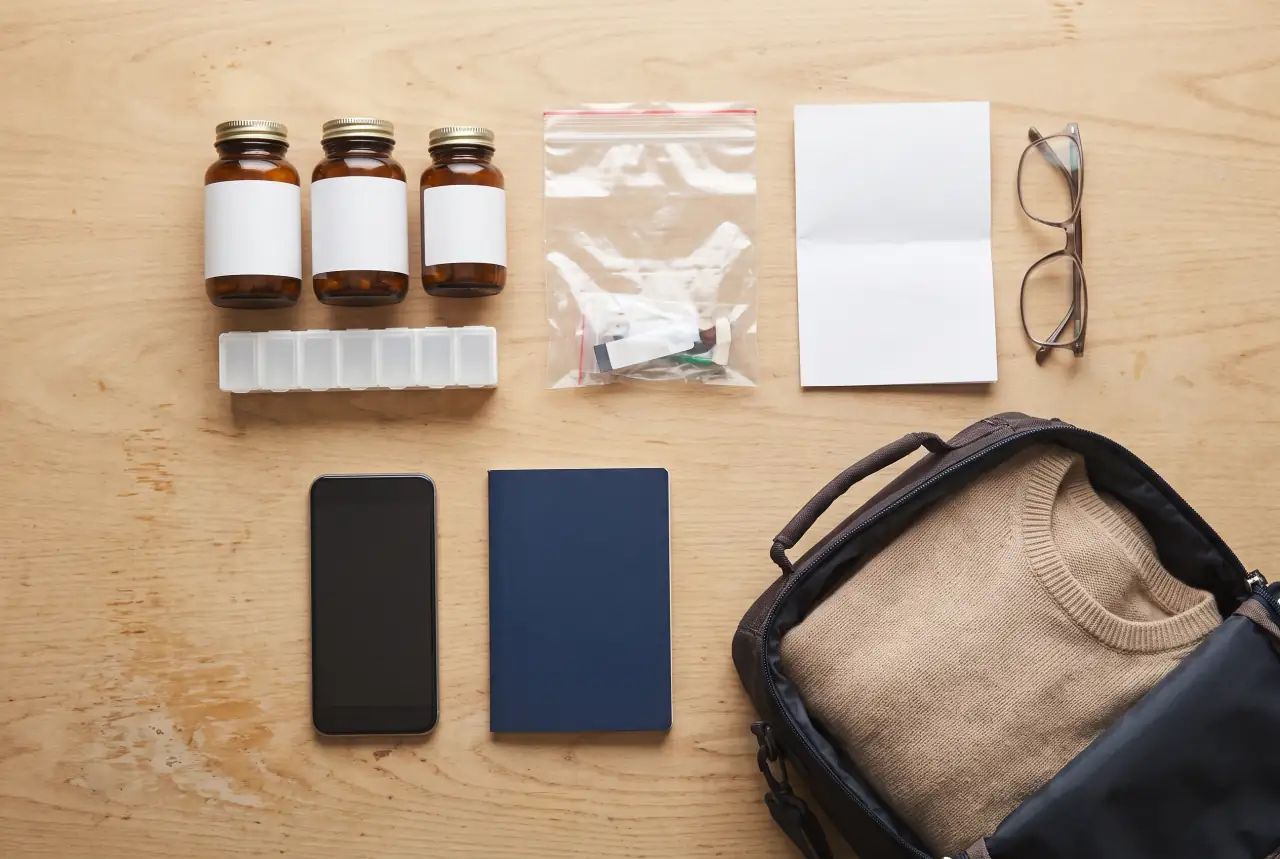
- Keep each medicine in the container it was dispensed in, with the pharmacy label and a prescription in your name.
- Ask the clinic for written documentation of the care you received, including the medicines you were given, listed by generic name because trade names vary widely, and share it with your doctor at home and any specialist who’ll continue your care (CDC Yellow Book).
- Pain relievers on the DEA’s lists include tramadol, Tylenol with codeine and hydrocodone combination products such as Vicodin, so count the dosage units of any controlled medicine you’re given (schedules above).
- For the trip itself, see crossing the border to Tijuana for documents and lanes, and how soon you can fly after surgery for the flight.
Medicine bought at a Mexican pharmacy, including antibiotics
Why it matters: buying a medicine without a prescription in Mexico doesn’t change how it’s treated at the U.S. border.
Pharmaceuticals, including ones that need a prescription in the United States, are often readily available in Mexico “with little regulation” (U.S. Embassy in Mexico, March 2023). The federal rules above cover over-the-counter products too.

Antibiotics are one case where Mexico’s own rules call for a prescription. A 2013 pharmacy guide from COFEPRIS, Mexico’s Federal Commission for Protection against Health Risks, sets out a 2010 agreement under which pharmacies must sell antibiotics only when the customer shows a prescription, and its inspection checklist has the pharmacy stamp the prescription with the quantity sold and the date each time one is dispensed (COFEPRIS guide, in Spanish). The rule’s purpose is to avoid self-medication, and the guide counts a proper diagnosis and a lower risk of bacterial resistance from inappropriate medication among its benefits.
How to check: if you think you need a medicine while in Mexico, see a doctor there first; medication should be bought in consultation with a medical professional and from reputable establishments (U.S. Embassy alert). Keep the prescription, the receipt and the original package together, and declare the medicine with everything else when you cross.
Checking that medicine bought in Mexico is genuine
Why it matters: counterfeit medicine may be ineffective, the wrong strength or contain dangerous ingredients, and where you buy and what you check before using a medicine are the parts you control.
Counterfeit medication is common in Mexico (U.S. Embassy alert). Counterfeit pills sold as OxyContin, Percocet, Xanax and others “may contain deadly doses of fentanyl,” and they can be bought at “small, non-chain pharmacies in Mexico along the border and in tourist areas,” according to Drug Enforcement Administration reports cited in the same alert. Counterfeit or substandard medications are prevalent in many international destinations, “even in pharmacies” (CDC Yellow Book). Before you buy, see the checks below.
Falsified Ozempic pens found in Mexico
Ozempic, an injectable form of semaglutide, needs a prescription in Mexico, and COFEPRIS reported falsified pens there in March and May 2026:
- March 26, 2026: Ozempic 1 mg pens with no active ingredient, lot JS7A925 on the box (06/2026 expiration) and MP5E511 on the pen. The pen had been relabeled, the text was in a language other than Spanish, and the lot numbers on the box and the pen didn’t match (COFEPRIS alert, in Spanish).
- May 25, 2026: Ozempic 0.25 mg to 0.5 mg pens, lot PP5K617 with an 08/2026 expiration date, whose pen differed from Novo Nordisk’s FlexTouch pen (COFEPRIS alert, in Spanish).
The falsified pens’ origin, manufacture, storage and transport are unknown, including whether they were kept at the right temperature, so their safety, effectiveness and quality can’t be assured. If you’ve used a pen with the problems the alerts describe, stop using it right away and see a health professional, and report any side effects to COFEPRIS through its VigiRam system (March and May alerts). In an emergency, call 911.
Counterfeit Ozempic has also turned up in the legitimate U.S. drug supply chain, with FDA warnings in December 2023, April 2025 and December 2025; in 2023 the needles were counterfeit too, so their sterility couldn’t be confirmed, which raises the risk of infection. In the United States, get Ozempic only with a valid prescription through state-licensed pharmacies, check it for signs of counterfeiting, and report side effects through the FDA’s MedWatch program (FDA).
If you need to buy medicine in Mexico
How to check: before you buy or use a medicine in Mexico (CDC Yellow Book, except where noted):
- Use a trustworthy pharmacy; the U.S. embassy or consulate may help you find one.
- Skip open markets, street vendors and suspicious-looking pharmacies, and ask for a receipt. Avoid medicine sold online, on the street or in informal markets too, especially if it needs a prescription, costs far less than the market price or is labeled in a language other than Spanish (COFEPRIS, March 2026).
- Don’t buy medicines priced substantially lower than the typical price: many counterfeit brand names sell for much less than normal.
- If you’re handed loose pills, ask to see the original container and note the brand, batch number and expiration date.
- Check the packaging: different inks, poor printing and misspelled words are clues to a fake.
- Before using any medicine, check that the lot numbers and expiration dates on the box match the pen or container inside, and that a pen shows no signs of tampering (both COFEPRIS alerts).
Vetting the prescribing doctor and clinic is covered in how to check a doctor and clinic in Mexico. For injections given at a clinic, Botox and fillers in Tijuana explains how to see the sealed product before it’s used.
Taking your own medicines into Mexico
Why it matters: Mexico has its own rules on the way in, and a medicine sold over the counter in some U.S. states may be controlled there.
Medicines for personal use are among the things you may bring into Mexico in your baggage, and for psychotropic substances, which affect behavior, mood, thoughts or perceptions, you must show the corresponding medical prescription (Mexico’s customs agency, ANAM; CDC Yellow Book). While you’re in Mexico, you’re subject to Mexican law, and authorities can arrest people carrying substances that are illegal there. Pseudoephedrine, the active ingredient in Sudafed, is one medicine controlled in Mexico (U.S. Embassy alert).
Narcotics such as hydrocodone and oxycodone, sedatives such as alprazolam and diazepam, and zolpidem call for particular caution abroad. Don’t return to the United States with substances that are illegal here, even if they’re legal where you got them (CDC Yellow Book).
How to check: before you pack:
- Carry a copy of each prescription, or a letter from your doctor listing each medicine with its generic name, dose and the reason you take it (U.S. Embassy alert; CDC Yellow Book).
- Check whether any of your medicines is controlled in Mexico. The embassy’s alert links COFEPRIS’s list of controlled substances (in Spanish), and for a permit to import medicine into Mexico, it points to Mexico’s health department and the Embassy of Mexico in Washington, D.C.
- Pack medicines in your carry-on, in their original labeled containers rather than a pill organizer, where they often can’t be easily identified. A carry-on lowers the chance they’re lost, damaged, delayed or stolen, and means you’re present if a problem is found with one (CDC Yellow Book).
- Carry only your own: taking medicine for anyone other than family members traveling with you is often illegal, because it can count as importing or exporting, which needs a specific license (CDC Yellow Book).
Which rules apply to your situation
Why it matters: the rules that apply depend on where each medicine came from and whether it’s controlled.
| Your situation | What applies | What to have with you |
|---|---|---|
| Your own U.S. prescription, taken on the trip and back | What CBP’s guidance recommends: your own medication, legally obtained in the U.S.; the 50-unit limit doesn’t apply to controlled substances lawfully obtained here on a DEA registrant’s prescription | Original labeled container and your prescription |
| Prescription medicine obtained in Mexico, not controlled | Illegal to import in most circumstances; any entry is at the FDA’s discretion, case by case | Original package, prescription in your name, documentation of your care |
| Controlled substance obtained in Mexico, such as tramadol | The federal rule and limit, and it must be a medicine that can be legally prescribed in the U.S. | Original dispensed container with the pharmacy details and prescription number |
| Medicine bought over the counter in Mexico | Still subject to FDA law; a drug approved abroad but not in the U.S. is illegal to import | Original package and receipt |
| Medicine for someone else | CBP’s guidance and the controlled-substance exemption cover your own medication | Nothing: carry only your own |
| An unapproved “cure” | Prohibited, by mail or in person | Nothing: leave it |
How to check: find each medicine you’ll carry in the table, ask your doctor or a U.S. pharmacist if you’re unsure whether one is controlled, and in every row, declare what you carry.
Who decides at the border, and how to ask before you go
Why it matters: officials decide case by case at the border, so for a specific medicine, the agencies themselves are the ones to ask before you travel.
FDA staff don’t examine personal baggage; that’s CBP’s job. CBP officers refer certain items to the FDA, such as ones that appear to be health fraud or an unknown risk to health, and FDA staff decide case by case (FDA manual). For controlled substances, the DEA generally decides whether they may be imported for personal use, coordinating with the FDA when both have jurisdiction (FDA).
A personal importation would be refused, among other cases, if the product is on an FDA import alert for previous violations, or if it appears intended for commercial distribution, to present a serious risk to health or to be health fraud (FDA). This guide can’t tell you in advance what will happen to a particular medicine; for that, ask the offices below.
We checked these pages on October 7, 2026: CBP’s two Info Center answers were published in February 2026, and the FDA’s personal importation page is marked current as of August 18, 2025. CBP’s Info Center answers are for general information only.
How to check: for questions about a specific medicine, CBP points travelers to these offices (CBP):
- The FDA’s Division of Import Operations: Imports@fda.hhs.gov or 301-796-0356.
- For controlled substances, the DEA’s Office of Diversion Control.
Questions to ask your doctors and a pharmacist
Your treating provider in Mexico:
- Which medicines will you prescribe after my procedure, and is any of them a controlled substance?
- Will each one come in its original container, with a pharmacy label and a prescription in my name?
- Can I have a written record of my care and the medicines I was given, listed by generic name?
Your doctor at home:
- Can you prescribe what I’ll need after the procedure here instead?
- Can you write a letter listing my current medicines, with generic names, doses and what each is for?
A U.S. pharmacist:
- Is this medicine a controlled substance in the United States?
- Can it be legally prescribed in the United States?
Before you go: checklist
- Planned medicines discussed with your treating provider and your doctor at home
- A letter from your doctor listing your current medicines by generic name, dose and purpose
- Every medicine in its original labeled container, with a prescription in your name or a written statement from your physician
- Written documentation from the clinic of your care and the medicines you were given
- Receipts for anything bought at a pharmacy
- Controlled substances obtained abroad counted against the 50-unit limit
- Medicines in your carry-on, not in checked luggage or a pill organizer
- Nothing carried for anyone else
- Every medicine declared when you cross
Frequently asked questions
Can you bring medicine from Mexico to the U.S.?
Sometimes, but not as a right. For individuals, importing drugs bought abroad is illegal in most circumstances, and the FDA lets some in only at its discretion, one case at a time. If you carry any, declare it, keep each medicine in its original package and have a prescription in your name. Controlled substances also have a limit for U.S. residents.
How much medicine can I bring back from Mexico?
There is no single allowance. Medications up to a 90-day supply must be declared, and the FDA mentions “generally not more than a three month supply” only among the factors its staff weigh; see what those figures mean. For controlled substances obtained abroad, the federal limit for a U.S. resident is 50 dosage units across all of them, counting each tablet, capsule or 5 ml teaspoonful, not 50 of each drug.
Do I need a U.S. prescription to bring medicine back from Mexico?
None of the official pages we checked says one is required for every medicine, but they point to U.S. sources: getting medicines from legal U.S. sources is the FDA’s recommendation, and only medicines that can be legally prescribed in the U.S. may be imported for personal use. For controlled substances obtained abroad, the federal limit is 50 dosage units in total; the rule exempts only those lawfully obtained in the United States on a DEA registrant’s prescription.
Can I bring antibiotics back from Mexico?
Antibiotics bought in Mexico fall under the same FDA and CBP rules as any other drug obtained abroad, so there is no special allowance for them. In Mexico itself, according to a 2013 COFEPRIS pharmacy guide, pharmacies must sell antibiotics only when the customer shows a prescription, which is stamped each time one is dispensed; see Mexico’s antibiotic rule. If you carry them home, declare them in the original package with the prescription in your name.
Can I bring Ozempic back from Mexico?
Ozempic bought in Mexico is a drug obtained abroad, so the FDA’s personal importation rules apply, and foreign-made versions of U.S.-approved drugs are generally considered unapproved. It also needs a prescription in Mexico, where falsified pens were found in March and May 2026, one kind with no active ingredient; see how to check a pen. In the U.S., get it only with a valid prescription through state-licensed pharmacies.
Is tramadol a controlled substance at the U.S. border?
Yes. Tramadol is on the DEA’s Schedule IV list, along with Xanax, Valium and Ambien, so the controlled-substance rule applies: it must have been dispensed lawfully under Mexican law, stay in the container it was dispensed in, and be declared with its name and schedule or the pharmacy details and prescription number. As a U.S. resident who got it abroad, you may bring no more than 50 dosage units of all controlled medicines combined.
Can I bring medicine back from Mexico for a family member?
The official pages we checked don’t describe any allowance for it. CBP’s guidance is to travel with your own medication, and the controlled-substance exemption covers a traveler’s own personal medical use or an animal traveling with them. Carrying medicine for anyone other than family members traveling with you is often illegal and should be avoided; see taking your own medicines.
Do I have to declare prescription medication when crossing from Mexico?
Yes. Medications up to a 90-day supply must be declared, and travelers who need medicines with potentially addictive drugs or narcotics should declare all drugs, medicinal and similar products; see how to declare. The controlled-substance exemption also depends on a declaration to a customs officer. Declaring doesn’t mean a medicine will be let in; officials still decide case by case.
Sources
- Traveling with Medication to the United States (Info Center article 1444) U.S. Customs and Border Protection
- When entering the United States, what items must I declare? (Info Center article 1909) U.S. Customs and Border Protection
- Personal Importation U.S. Food and Drug Administration
- Regulatory Procedures Manual, Chapter 9: Import Operations and Actions (subchapter 9-2, Coverage of Personal Importations) U.S. Food and Drug Administration
- 21 CFR 1301.26: Exemptions from import or export requirements for personal medical use Electronic Code of Federal Regulations (eCFR)
- Exemption From Import/Export Requirements for Personal Medical Use (final rule, 69 FR 55343, September 14, 2004) U.S. Drug Enforcement Administration, via GovInfo
- Drug Scheduling U.S. Drug Enforcement Administration
- Traveling with Prohibited or Restricted Medications (CDC Yellow Book 2026) U.S. Centers for Disease Control and Prevention
- What To Do When Sick Abroad (CDC Yellow Book 2026) U.S. Centers for Disease Control and Prevention
- Health Alert: Counterfeit Pharmaceuticals (March 17, 2023) U.S. Embassy and Consulates in Mexico
- FDA warns consumers not to use counterfeit Ozempic (semaglutide) found in U.S. drug supply chain U.S. Food and Drug Administration
- Alerta sanitaria: falsificación de OZEMPiC 1 mg (semaglutida), March 26, 2026 (in Spanish) COFEPRIS (Mexico)
- Alerta sanitaria: falsificación de OZEMPiC 0.25 mg-0.5 mg/dosis (semaglutida), May 25, 2026 (in Spanish) COFEPRIS (Mexico)
- Guía para las buenas prácticas sanitarias en farmacias y consultorios (2013, in Spanish) COFEPRIS (Mexico)
- Information About Your Rights and Obligations When You Go Through Customs Agencia Nacional de Aduanas de México (ANAM)
About this guide
The Uriym editorial team researched this guide from the 15 sources above, drafted it with AI assistance, and checked it claim by claim against those sources before publishing, last on . Our editorial standards explain how we choose sources, handle prices and make corrections.
Uriym is a healthcare navigation platform, not a medical provider. Its founder, Adriana Mendez, grew up in a family that traveled to Mexico for care and has done it herself for the past ten years. How Uriym works
This is general information, not medical, legal or financial advice: your treating provider decides what care is right for you. Rules, prices and advisories change, so check the official page before you act. Found something wrong or out of date? Email support@uriym.com.