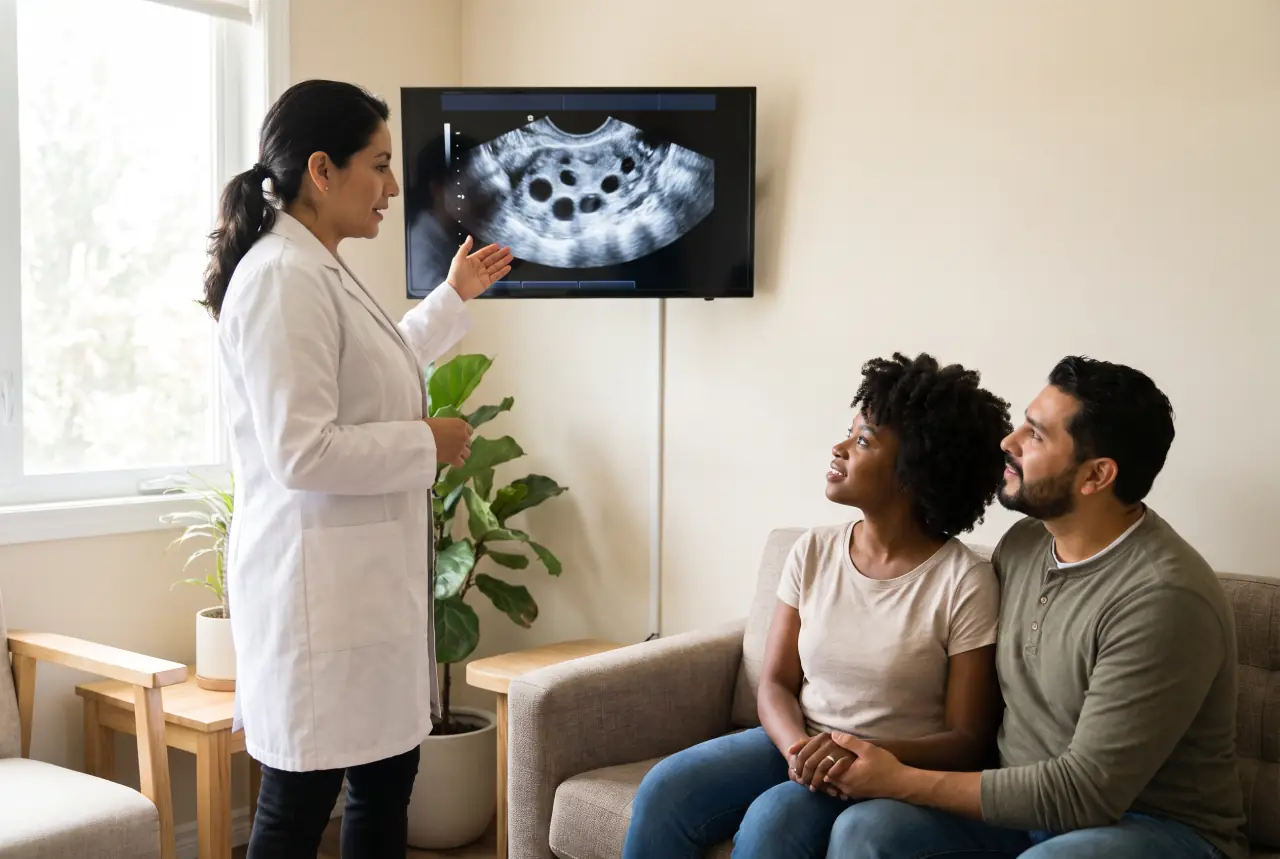

Fertility treatment in Mexico can be a good option if four things are in place before you pay a deposit: tests near home have shown you and a fertility specialist which treatment fits, whether IUI (intrauterine insemination), IVF (in vitro fertilization), egg freezing or donor eggs; the clinic is licensed for assisted reproduction and can show live-birth results for patients your age; a written, costed plan lists every visit and medicine; and your travel can shift with your cycle.
Your cycle, not a booking calendar, sets the dates, and your fertility doctor decides what suits you. This guide compares the options and their trips, explains what you can check about a clinic, and points to our guides to IVF, IUI and egg freezing for the detail.
At a glance
- Main options
- IUI, IVF, egg freezing, and IVF with donor eggs or donor sperm
- When to see a specialist
- After 12 months of trying if the person with ovaries is under 35, or 6 months at 35 or older, and possibly sooner with some risk factors
- Tests first
- A semen analysis, ovarian reserve tests and a check of the tubes and uterus, done near home
- Trips
- Set by the treatment and your monitoring; see the comparison table
- Check first
- The clinic’s health license for assisted reproduction and each doctor’s professional license numbers
- Price
- Below U.S. ranges for IVF and egg freezing; see the price table
Key takeaways
- Get a semen analysis, ovarian reserve tests and a tube check near home first, and let a fertility specialist match the treatment to your results and age.
- Ask each clinic for live births for patients your age, and ask how it counts them: per cycle, per retrieval, per transfer or per patient.
- Before any deposit, see the clinic’s health license for assisted reproduction, look up each doctor’s license numbers and ask who runs the lab.
- Get a written, costed plan that marks which visits happen in Mexico and which near home, and book travel that can move with your cycle.
- Settle donor, storage and embryo-transfer terms in writing, and line up a doctor at home for scans and early pregnancy care.
In this guide
- When should you see a fertility specialist, and which tests come first?
- IVF vs IUI, egg freezing or donor eggs: which fertility treatment fits?
- What are fertility treatment success rates, and how should you read them?
- How to choose a fertility clinic in Mexico: what you can and can’t check
- Monitoring near home, medicines and timing your trips
- Risks of fertility treatment, and what you can do about each
- Donors, frozen embryos and the border: legal points to settle first
- How much does fertility treatment cost in Mexico?
- How to plan fertility treatment in Mexico, step by step
- Questions to ask a fertility clinic in Mexico
- Before you go: checklist
- Warning signs during and after fertility treatment
- Frequently asked questions
- Sources
When should you see a fertility specialist, and which tests come first?
Why it matters: your test results decide which treatments can work for you, and having them before you contact clinics lets you compare their plans on the same facts.
See a fertility specialist after 12 months of trying to get pregnant if the person with ovaries is under 35, or after 6 months at 35 or older (American Society for Reproductive Medicine, ASRM, a U.S. professional society); over 40, consider going sooner still (U.S. Centers for Disease Control and Prevention, CDC). Those times are for heterosexual couples; infertility also covers needing donor eggs, embryos or sperm (ASRM).
Consider going earlier with irregular periods, endometriosis, more than one miscarriage, a family history of early menopause, past cancer treatment, possible tube damage, or, for a partner with sperm, testicle problems, chemotherapy or difficulty with sexual function (ASRM; CDC). Start with a reproductive endocrinologist, a doctor who specializes in fertility, and, for the partner with sperm, a reproductive urologist, especially after an abnormal semen analysis (ASRM).
| Test | What it shows |
|---|---|
| Semen analysis | The number, movement and shape of the sperm (CDC) |
| Ovarian reserve tests | Hormones such as FSH (follicle-stimulating hormone) and AMH (anti-müllerian hormone), and an antral follicle count, which assess how your ovaries may respond to fertility medicines (ASRM) |
| Tubes and uterus | A hysterosalpingogram (HSG) or an ultrasound (CDC); fibroids, polyps or fluid-filled tubes may need treating before IVF (ASRM) |
Smoking reduces IVF success rates by up to 50%, reaching a healthier weight is advised for people with obesity, and a prenatal vitamin with at least 400 mcg of folic acid is recommended (ASRM). For a sense of scale, a healthy person in their 20s or early 30s has a 25% to 30% chance of conceiving each month, and at 40 it’s 10% or less (ASRM). These are averages, not a prediction for you.
How to check: book the tests through your own doctor or a specialist near home, keep a copy of every result, and send the same set to each clinic you’re considering, asking which results it accepts and for how long. See tests before IUI for the tubal check.
IVF vs IUI, egg freezing or donor eggs: which fertility treatment fits?
Why it matters: the options differ in what they involve, whom they help and how many visits they take, so the right one depends on your results, your age and whose eggs and sperm you’ll use.
IUI puts washed sperm into the uterus around ovulation; it’s most often used when no cause of infertility is found, and it’s also used with donor sperm. IVF fertilizes eggs in a lab and is used for many causes, including blocked tubes. Egg freezing stores your eggs for an IVF attempt later, and donor eggs make IVF possible when you can’t get pregnant with your own eggs.
| Treatment | What it involves | Who it may suit | Trips and time in Mexico |
|---|---|---|---|
| IUI | Washed sperm placed in the uterus around ovulation, with or without fertility medicines (ASRM) | Unexplained infertility, a cervix that blocks sperm, ejaculation problems or donor sperm; not severe tube disease or moderate to severe endometriosis (ASRM) | Short with scans near home, otherwise from the first scan to the insemination, often over several cycles (trip timing) |
| IVF | About 8 to 14 days of medicines, then eggs collected and fertilized in a lab, and an embryo placed in the uterus (ASRM) | Blocked tubes, male infertility, endometriosis, unexplained infertility, single people and LGBTQIA+ families (ASRM) | Roughly 12 to 21 days with a fresh transfer if every visit is in Mexico, or two trips with a frozen transfer (how long to stay) |
| Egg freezing | The IVF process up to egg collection, then freezing; using the eggs later means thawing and fertilizing them with ICSI, intracytoplasmic sperm injection (HFEA) | Keeping a chance of pregnancy with your own eggs for later (who considers it) | A cycle usually takes around 2 to 3 weeks (HFEA); time in Mexico depends on where your scans happen, and some patients need more than one cycle |
| Donor eggs | IVF with a donor’s eggs, while estrogen and then progesterone prepare your uterus for the transfer (ASRM) | Being born without ovaries, menopause, a poor response to medicines, poor egg or embryo quality, or a genetic disease you don’t want to pass on (ASRM) | We found no official figure; with frozen embryos, your timing needn’t match the donor’s (ASRM), so ask the clinic which visits it needs you there for |
| Donor sperm | Sperm from a donor, used with IUI or IVF (ASRM) | No usable sperm, a genetic disease in the male partner, or no male partner (ASRM) | As for IUI or IVF, once the sperm and its paperwork arrive (donor sperm) |
Trip times sum up our IUI, IVF and egg freezing guides, where each source is cited; the IVF days are our arithmetic and the IUI stay our reading, not figures any source states. Your clinic sets your schedule.
IVF or IUI? For unexplained infertility, IUI with ovulation medicine doubles the pregnancy rate compared with no treatment (ASRM). Age and some diagnoses tip the choice toward IVF; who IUI may suit sets out when.
Donor eggs. If you’re over 45, your own evaluation should go further, including heart function and the risk of pregnancy-related diseases (ASRM), so have it done near home before you commit.
How to check: ask the specialist who reviews your results which option fits and why, and how many cycles they’d try, then compare that with each clinic’s proposal.
What are fertility treatment success rates, and how should you read them?
Why it matters: success figures are how most people compare treatments and clinics, and the same results can look very different depending on what a clinic counts.
Read a success rate as live births, not pregnancies, for patients your age having your treatment, counted per cycle started, per retrieval, per transfer or per patient. With your own eggs, age has a big effect, because egg quality and number decline in the 30s and 40s (ASRM).
The published averages are in our guides: IVF live births by age, IUI results per cycle and the chance a frozen egg leads to a baby. With donor eggs, success isn’t considered related to the recipient’s age; in 2020 U.S. data compiled by SART (the Society for Assisted Reproductive Technology) and the CDC, fresh donor eggs gave an average birth rate of 53.5% per embryo transfer (ASRM). That’s an average, not a prediction for you; your doctor can help you read it.
Figures from clinics in Mexico. U.S. clinics’ success rates are published by the CDC (CDC). In Latin America, centers can report to a voluntary regional registry run by REDLARA (Red Latinoamericana de Reproducción Asistida), a network of fertility centers: for 2022, 204 accredited centers in 16 countries reported 123,265 treatment cycles, 17.1% of them in Mexico. Many small centers don’t take part, and by agreement the registry doesn’t disclose any single center’s results (registry report, 2022). We found no public, clinic-by-clinic results for Mexico, so the figures you’re shown come from the clinic.
A headline rate can look better than it is if it covers only patients under 35 or counts pregnancies instead of births, and results reflect which patients a clinic treats (Human Fertilisation and Embryology Authority, HFEA, the UK’s fertility regulator).
How to check: ask each clinic, in writing, for live births among patients your age having your treatment, the years and numbers behind them, how they’re counted, whether the eggs were the patients’ own or donated, and its twin rate.
How to choose a fertility clinic in Mexico: what you can and can’t check
Why it matters: the clinic’s license, the doctors’ credentials and the laboratory each cover a different part of your care, and most of the checks can be made before you pay.
Choose a fertility clinic in Mexico by verifying its health license for assisted reproduction, each doctor’s professional license numbers and its laboratory’s accreditation, and by asking in writing for what you can’t verify, such as results by age.
The license. In a 2016 statement, COFEPRIS, Mexico’s Federal Commission for Protection against Health Risks, said it grants the health license (licencia sanitaria) that clinics doing assisted reproduction need, and that the license vouches for the facility’s conditions, not for the medical procedures (COFEPRIS, 2016, in Spanish). The current license form’s instructions list assisted reproduction as one of the types of surgical service a license can cover, and list a germ-cell bank for assisted reproduction (banco de células germinales), which collects, processes and stores eggs and sperm, separately, among establishments that handle organs, tissues and cells (COFEPRIS, September 2026, in Spanish). Not every clinic may hold the license that matches its work, so ask to see it; checking the clinic and doctor covers specialty certification too.
The lab. For its data to count in the registry, a center must be accredited (registry report). To join REDLARA, a center must meet its country’s health rules, and one or two accreditors, a clinician and/or a biologist from another accredited center with no ties to it, check its lab’s facilities, equipment, record-keeping and quality control, its signed consent forms and the data it reports. Centers that score lower can become associates, whose data aren’t added to the registry (REDLARA, in Portuguese). Accreditation is a strong starting point, one part of a sound plan alongside the licenses and clear written terms.
What you can’t check. We found no public clinic-level results and, when we checked in November 2026, no Mexican law specific to fertility treatment, such as a limit on embryos transferred, so ask which guidelines the clinic follows.
How to check:
- Get a photo of each licencia sanitaria and check that it names assisted reproduction, plus a germ-cell bank if your eggs or sperm will be stored, at the address where you’ll be treated, and ask which license covers storing embryos (what to compare; storage checks).
- Look up each doctor’s cédulas profesionales (professional license numbers), as checking a doctor’s license explains.
- Ask whether the center is accredited by REDLARA or only an associate, and who directs its embryology lab.
- Ask which optional extras it offers, and why.
Monitoring near home, medicines and timing your trips
Why it matters: much of a cycle is medicines and scans rather than procedures, so where the scans happen decides how long you stay in Mexico and how often you travel.
Fertility treatment in Mexico can mean one stay or several shorter trips, depending on the treatment, where your monitoring happens and whether embryos are transferred fresh or frozen.
- Monitoring. Ultrasounds and blood tests track how the follicles grow and how hormone levels change, which shows when it’s time for the trigger shot (ASRM). We found no official rule on whether scans near home can replace clinic visits; that’s the clinic’s decision, so agree in writing who orders and reads them and how results reach the clinic in time.
- Travel stages. Ask how often, and at which stages, you’d need to be there (HFEA). For Tijuana, see timing appointments around the border and day trips or nights nearby; for Guadalajara, how the trip differs.
- Medicines. Get a written list of each medicine, dose and date, ask your doctor at home which can be prescribed there, and read fertility medicines bought in Mexico and medicine prescribed after a procedure before carrying any home.
- Early pregnancy. With donor eggs, hormone medicines continue until the pregnancy test and, if it’s positive, into the early weeks of the first trimester (ASRM). Agree with your doctor at home where early scans will happen, since the signs of a possible ectopic pregnancy matter until an ultrasound shows the pregnancy is in the uterus (see warning signs).
- Records. Ask for a copy of your records for your doctor at home (HFEA); see records to bring home.

How to check: before booking travel, ask for a written schedule marking which visits must happen in Mexico and which near home, then book flights or rooms you can move by a few days.
Risks of fertility treatment, and what you can do about each
Why it matters: each risk below comes with a step you can take, and the most common one, carrying twins or more, is shaped by decisions made before your cycle starts.
Serious complications from IVF medicines and procedures are rare (ASRM), and the complication assisted reproduction causes most often is a multiple pregnancy (CDC).
| Risk | What it is | What you can do |
|---|---|---|
| Twins or more | More likely when more than one embryo is transferred, or with medicines for IUI; risks include preterm birth, severe bleeding, cesarean delivery, high blood pressure and gestational diabetes (ASRM; ASRM IUI). In the Latin American registry’s 2022 data for fresh IVF with patients’ own eggs, the rate of multiple births rose from 1.9% when one embryo was transferred to 20.1% with two (registry report) | Agree the number of embryos in writing (how many to transfer); for IUI with medicines, agree when a cycle would be cancelled (scans and cancelling) |
| Ovarian hyperstimulation syndrome (OHSS) | Too many eggs developing in the ovaries in response to fertility medicines (NHS); most symptoms are mild and pass within a few days of egg collection, while severe cases bring fluid in the belly and, very rarely, in under 1% of IVF cases, blood clots and kidney failure (ASRM) | Ask how the clinic will lower and watch your risk, and stay within reach of it after retrieval (safety during the cycle) |
| Egg retrieval | Pain that usually passes in a day or two; injury to nearby organs such as the bladder or bowel, which very rarely needs emergency surgery; uncommonly, pelvic infection (ASRM) | Ask who gives the sedation and when you may travel |
| Ectopic pregnancy | A pregnancy outside the uterus, a small risk (1%) with IVF, similar to or lower than the rate for people with a history of infertility (ASRM) | Plan early scans near home, and keep the warning signs with you until one shows where the pregnancy is |
| Birth defects | 2% to 3% in the general population, slightly higher with fertility problems, mostly from later pregnancies and the cause of infertility; ICSI may raise it (ASRM) | Ask whether ICSI is needed in your case, and why |
| It may not work | Treatment may not lead to a baby; with egg freezing, that is the major risk (HFEA) | Agree with your doctor how many cycles to try and what comes next, and budget for more than one |
Figures are averages across many patients, not a prediction for you.
How to check: share your full medical history and medicines with the clinic, ask which risks weigh most in your plan and how each would be handled, and find out who would see you if a problem began at home.
Donors, frozen embryos and the border: legal points to settle first
Why it matters: choices about donors and stored embryos can outlast the treatment by years, and the rules that apply to them differ from country to country.
Settle three things in writing before treatment: the donor’s legal position and anonymity, what happens to frozen eggs or embryos in each case you can foresee, and how they’d move to a U.S. clinic.
- Donors. In the UK, donors have no rights or responsibilities toward a child born from licensed treatment, but other countries may differ, and anonymous donation may stop a child from tracing the donor (HFEA). Recipients of donor eggs are strongly encouraged to see a lawyer first, especially without anonymity safeguards, and a known donor should be screened through a third party (ASRM). See questions to settle about donors.
- Frozen embryos. Ask what happens to them if one partner changes their mind (HFEA), and get storage terms in writing before retrieval (storing eggs or embryos).
- Bringing them to the U.S. Bringing reproductive cells or tissue into the U.S. can require notifying the FDA (Food and Drug Administration) and holding the shipment until it decides whether it can come in; that requirement doesn’t apply to certain reproductive tissue donated by a sexually intimate partner of the recipient (21 CFR 1271.420). With donor eggs or sperm, ask the receiving U.S. clinic how it applies before anything is frozen.
- Surrogacy. This guide doesn’t cover it; it raises its own legal questions about parental responsibility, which differ from country to country, so get legal advice first (HFEA).
How to check: get legal advice before using a donor, keep signed copies of every consent form, and before freezing, ask both clinics who would ship and what each charges.
How much does fertility treatment cost in Mexico?
Why it matters: a headline price can leave out medicines, scans and storage, and you may need more than one cycle, so the figure to compare is the cost of the whole plan.
For IVF and egg freezing, the indicative Tijuana ranges below are well under U.S. ranges; your total depends on medicines, cycles, donor costs and what each quote includes.
| Treatment | Tijuana (USD) | United States (USD) |
|---|---|---|
| IVF cycle | $5,000 – $9,500 | $20,000 – $30,000 |
| Egg freezing | $4,500 – $7,000 | $11,000 – $18,000 |
Uriym’s indicative ranges from its fertility price catalog, reviewed September 7, 2026. They are not quotes and cover the listed treatment only, without taxes, travel or third-party charges.
Low IVF prices may leave out medicines, blood tests or consultations, so compare full packages, and budget for travel, accommodation, lost pay and a reserve for the unexpected (HFEA). Check what your health plan covers for consultations, tests, medicines and procedures such as ICSI or freezing (ASRM), then see U.S. insurance and care in Mexico and health savings accounts abroad.
How to check: ask each clinic for a costed treatment plan in writing (HFEA), and go through it with the IVF cost checklist, egg freezing quote lines, what an IUI quote should list or what a medical tourism quote should include. With donor eggs, also ask what the donor’s screening and fees add.
How to plan fertility treatment in Mexico, step by step
Why it matters: the order matters, because each answer shapes the next choice, from the tests that point to a treatment to the records you bring home.
To plan fertility treatment in Mexico, get tested and choose a treatment near home, check your benefits and the clinics, compare written plans and results, settle donor and storage terms, then book travel:
- Get tested and see a specialist near home (tests).
- Choose the treatment with that specialist (the options).
- Check your benefits at home (costs).
- Check each clinic before any deposit (checks).
- Ask for results by age in writing (success rates).
- Get a costed plan and schedule of visits in Mexico and near home (monitoring).
- Settle donor, embryo and storage terms in writing (legal points).
- Book travel you can change by a few days; medical tourism in Mexico covers the trip itself.
- Line up care at home for scans, early pregnancy and any problem after you return.
- Come home with your records and a list of your medicines.
How to check: hold your deposit until steps 1 to 7 are answered in writing; travel comes last because your cycle sets its dates.
Questions to ask a fertility clinic in Mexico
- Given my results and age, which treatment do you recommend, and why that one?
- How many patients my age, with my diagnosis, had a live birth here, how do you count it, and what is your twin rate?
- May I see your licencia sanitaria for assisted reproduction and, if you’ll store my eggs or embryos, the license that covers storing them?
- Are you accredited by REDLARA, and who directs your embryology lab?
- How many embryos would you transfer for me, and will you put that in writing?
- How do you keep my records confidential, and in which language are your consent forms?
- Which scans can I have near home, whom do I call after hours, and will you send my records to my doctor?
Before you go: checklist
- Fertility tests done near home, with copies of every result
- The treatment chosen with a specialist, and a number of cycles agreed
- The clinic’s health license seen, each doctor’s cédulas looked up and the lab’s accreditation asked about
- Live-birth figures for your age, the twin rate and a costed plan, all in writing
- Donor, storage and embryo terms in writing, with legal advice if you’re using a donor
- Monitoring near home and early pregnancy scans arranged with your doctor
- Medicine list in hand, and the rules for carrying medicines home checked
- Changeable travel booked, and the current State Department advisory read; see what it says about Tijuana and Guadalajara
- The warning signs below read, and the clinic’s after-hours number saved in your phone
Warning signs during and after fertility treatment
In an emergency, call 911, which works in the U.S. and Mexico, then tell your fertility clinic.
| What you notice | What to do |
|---|---|
| During or after IVF or egg freezing: difficulty breathing, pain in your chest or upper back, being very thirsty while peeing less than usual, swelling anywhere in your body, belly pain low down on one side, or pain in the tip of your shoulder | These could be severe symptoms of OHSS or an ectopic pregnancy: call 911, and don’t drive yourself (adapted from NHS advice for the UK, where the number is 999) |
| During or after IVF or egg freezing: pain and bloating in your belly, feeling or being sick, feeling faint, coughing up blood, vaginal bleeding or a brown watery discharge, or pain or discomfort when you pee or poop | Contact your fertility clinic as soon as possible (NHS) |
| Before an ultrasound has confirmed the pregnancy is in the uterus: sharp, stabbing pain, vaginal spotting or bleeding, dizziness or fainting, lower back pain, or low blood pressure from blood loss | These are signs of a possible ectopic pregnancy: call your doctor immediately (ASRM) |
The two NHS rows are written for IVF; egg freezing uses the same medicines and egg collection. Where a sign fits more than one row, take the more urgent step; that’s our practical rule, not a source’s.
Each treatment guide has its own list: IVF, IUI and egg retrieval. If symptoms start at home, tell whoever sees you which fertility medicines you took and when.
Frequently asked questions
How much does fertility treatment cost in Mexico?
Uriym’s indicative ranges for Tijuana are $5,000 to $9,500 for one IVF cycle and $4,500 to $7,000 for egg freezing, against $20,000 to $30,000 and $11,000 to $18,000 in the U.S. These ranges are indicative, not quotes. Your total depends on your medicines, how many cycles you need and any donor or storage fees, so ask each clinic for a written, costed treatment plan and compare plans line by line; the cost section links the lines to check.
What is the difference between IVF and IUI?
IUI places washed sperm inside the uterus around ovulation, so fertilization still happens in the body, while IVF collects eggs, fertilizes them in a lab and places an embryo in the uterus (ASRM IUI; ASRM IVF journey). The insemination itself takes a few minutes once the sample is ready, but IUI doesn’t help with severe tube disease or moderate to severe endometriosis. Your specialist weighs your results and age; see IVF vs IUI.
How many trips to Mexico does fertility treatment take?
It depends on the treatment, from one stay to several short trips. An IVF cycle can be done in one stay, or split into a trip for the egg retrieval and a later one for a frozen transfer; IUI is brief but timed to ovulation and often repeated over several cycles; and some patients need more than one egg freezing cycle. Scans near home can shorten each stay if your clinic agrees; the comparison table sums up the trips for each.
Are fertility clinics in Mexico regulated?
Yes, through licensing. In a 2016 statement, Mexico’s federal health regulator, COFEPRIS, said it grants the health license clinics need for assisted reproduction, and that the license covers the facility’s conditions rather than the doctors’ procedures (COFEPRIS, 2016, in Spanish). We found no national law with rules specific to fertility treatment when we checked in November 2026, so also look up each doctor’s license and ask which guidelines the clinic follows; see choosing a clinic.
How do I choose a fertility clinic in Tijuana?
With the same checks as anywhere in Mexico, plus a plan for the border. Ask for a photo of the clinic’s health license naming assisted reproduction at its Tijuana address, look up each doctor’s license numbers, and ask whether the lab is accredited by REDLARA, the Latin American fertility network. Then work out how you’ll cross for scans and procedures; crossing the border to Tijuana covers documents and lanes.
What is the success rate of IVF in Mexico?
We found no public figures for individual clinics. The Latin American registry, to which 47 centers in Mexico reported for 2022, publishes totals across centers, not any one center’s results (Latin American Registry, 2022), so ask each clinic for live births among patients your age, per retrieval and per transfer, and compare them with the U.S. averages in reading IVF success rates. Your fertility doctor can help you read them.
Can you use donor eggs in Mexico?
If the clinic offers IVF with donor eggs, yes, but settle the details first. Ask how its donors are screened: in U.S. professional guidance, donors are tested for infections such as HIV (human immunodeficiency virus) and hepatitis, with genetic tests based on their background (ASRM egg donation). See a lawyer before you start, and ask about anonymity and what a child could learn later; legal points has the rest.
Is fertility treatment in Mexico safe?
Much of it rests on what you settle before paying: tests that show the treatment suits you, a licensed clinic whose doctors’ licenses check out, and a monitoring plan and embryo number agreed in writing. Serious complications from IVF are rare (ASRM IVF risks); risks and what to do pairs each one with a step, and is it safe to get surgery in Mexico? covers the travel advisory.
Sources
- Defining Infertility (patient fact sheet, revised 2023) American Society for Reproductive Medicine (ReproductiveFacts.org)
- In Vitro Fertilization Treatment Journey American Society for Reproductive Medicine (ReproductiveFacts.org)
- In Vitro Fertilization (IVF): What Are the Risks? (patient fact sheet, revised 2023) American Society for Reproductive Medicine (ReproductiveFacts.org)
- Intrauterine Insemination (IUI) (patient fact sheet, revised 2021) American Society for Reproductive Medicine (ReproductiveFacts.org)
- Egg Donation (patient fact sheet, revised 2023) American Society for Reproductive Medicine (ReproductiveFacts.org)
- Infertility: Frequently Asked Questions (May 15, 2024) U.S. Centers for Disease Control and Prevention
- Fertility treatment abroad (published July 14, 2016) Human Fertilisation and Embryology Authority (HFEA)
- Egg freezing Human Fertilisation and Embryology Authority (HFEA)
- IVF (page last reviewed April 15, 2025) NHS
- Assisted reproductive technologies in Latin America: the Latin American Registry, 2022 (Zegers-Hochschild et al., 2026; full text on PubMed Central) JBRA Assisted Reproduction (peer-reviewed journal), for REDLARA
- Acreditação de centros (center accreditation, in Portuguese) Red Latinoamericana de Reproducción Asistida (REDLARA)
- Clausuran en Tabasco un consultorio ginecológico que ofrecía atención médica con reproducción asistida al margen de la legislación (January 13, 2016; in Spanish) COFEPRIS
- Instructivo de llenado para el formato FF-COFEPRIS-07, Licencias de Servicios de Salud (in Spanish; published September 11, 2026) COFEPRIS
- 21 CFR 1271.420: HCT/Ps offered for import Electronic Code of Federal Regulations (U.S. Food and Drug Administration rules)
About this guide
The Uriym editorial team researched this guide from the 14 sources above, drafted it with AI assistance, and checked it claim by claim against those sources before publishing, last on . Our editorial standards explain how we choose sources, handle prices and make corrections.
Uriym is a healthcare navigation platform, not a medical provider. Its founder, Adriana Mendez, grew up in a family that traveled to Mexico for care and has done it herself for the past ten years. How Uriym works
This is general information, not medical, legal or financial advice: your treating provider decides what care is right for you. Rules, prices and advisories change, so check the official page before you act. Found something wrong or out of date? Email support@uriym.com.