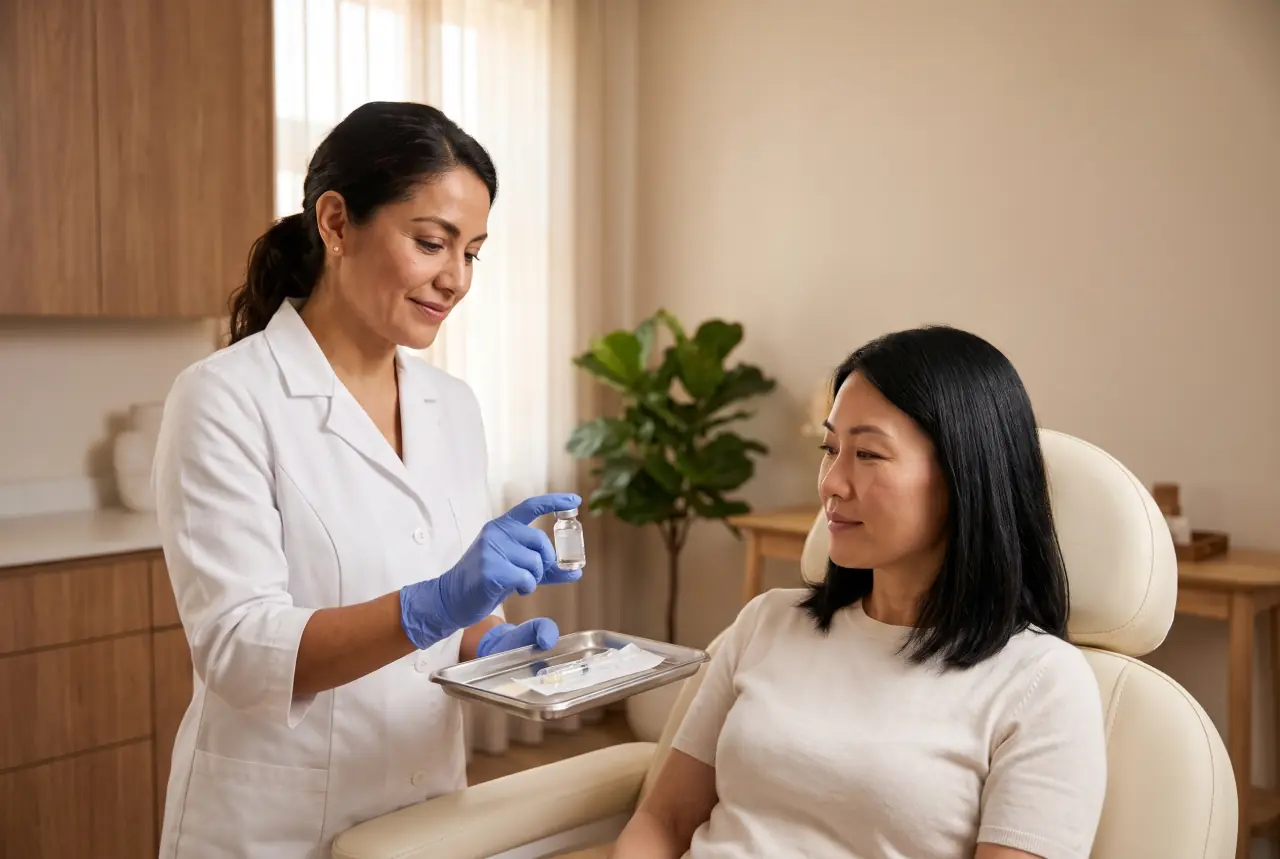
Botox in Tijuana usually costs well below U.S. prices, and so do dermal fillers. Either can be a sound choice when you know the brand and amount you’re paying for, see the sealed product before it’s used, and are treated by a licensed, trained injector. This guide walks through each of those in the order you’ll meet them: comparing quotes, checking the product, checking the injector and planning your trip.
At a glance
- Price
- Below U.S. ranges for both treatments; see the price table
- How toxin is priced
- By the unit, the “area” or the session, depending on the clinic
- How filler is priced
- By the syringe
- When Botox takes effect
- Muscles typically start to relax in 1 to 2 days, more over the first week
- How long Botox lasts
- About 3 to 4 months on frown lines
- What to look for on the box
- Spanish text, a Mexican health registration number (registro sanitario), and matching lot numbers and expiry dates
Key takeaways
- Compare toxin quotes by brand and number of units. An “area” can mean very different doses.
- Ask to see the sealed box and vial or syringe, and watch the dose drawn up in front of you.
- Look up your injector’s professional license number before your appointment; it’s free and takes a few minutes.
- Leave with the product name, lot number and dose in writing for your doctor at home.
- Arrange a ride for your return in case your eyelids or vision are affected; see Warning signs below.
In this guide
- What are Botox and dermal fillers?
- How much is Botox in Tijuana, and what do fillers cost?
- Is the product genuine? Checking Botox and fillers in Mexico
- Who may inject Botox and fillers in Mexico?
- Your health history: what to tell the injector
- When do results show, and how do touch-ups fit a short trip?
- Questions to ask before your appointment
- Before you go: checklist
- Warning signs after Botox or fillers
- Frequently asked questions
- Sources
What are Botox and dermal fillers?
Botox is one brand of botulinum toxin, a prescription drug that keeps muscles from tightening so wrinkles show less. In the U.S. it’s approved to temporarily soften frown lines, forehead lines and crow’s feet, and Botox Cosmetic also for moderate to severe vertical neck bands (FDA; Botox Cosmetic label).
People say “Botox” for every brand. The U.S.-approved cosmetic toxins as of April 2026 are Botox, Daxxify, Dysport, Jeuveau, Letybo and Xeomin (CDC). In Mexico, official alerts call the product BOTOX (toxina botulínica tipo A), and Botox Cosmetic, the brand approved in the U.S., has no Mexican registration (COFEPRIS alert, in Spanish). The doses and timings in this guide come from U.S. labels, so ask your injector what their product’s label says.
Dermal fillers are gels injected under the skin to smooth lines or add fullness. Most U.S.-approved fillers are made of materials the body absorbs over time, such as hyaluronic acid; one, made with PMMA (polymethyl methacrylate) beads, isn’t absorbed and is permanent (FDA consumer update; FDA).
| Botulinum toxin | Dermal filler | |
|---|---|---|
| U.S.-approved cosmetic uses | Frown lines, forehead lines, crow’s feet; neck bands (Botox Cosmetic) | Adults 22+: moderate to severe wrinkles and folds; fuller lips, cheeks, chin, under-eye hollows, jawline, backs of hands; facial fat loss from HIV; cheek acne scars |
| How long it lasts | Usually several months | Most are temporary; depends on material and area |
| Main safety point to discuss | Effects spreading beyond the injection site | Accidental injection into a blood vessel |
Sources: Botox Cosmetic label, CDC, FDA consumer update and FDA filler page.
Weighing surgery or a skin treatment instead? See facelift in Mexico and Morpheus8 in Mexico.
Some uses aren’t approved for any filler: body contouring, such as enlarging the breasts or buttocks, and injections into the area between the eyebrows, the nose, the forehead or the neck (FDA). For filler on your face, ask which product is planned and whether it’s approved for that spot. Approvals vary by product, and the two filler pages from the U.S. Food and Drug Administration (FDA) differ on the area around the eyes.
Injectable silicone isn’t approved for any cosmetic use. Silicone injections, and filler used for body contouring, can cause serious injury and even death, so don’t have either (FDA; FDA consumer update). Needle-free “pens” aren’t approved for injecting filler, so don’t have filler given with one (FDA consumer update).
For other skin treatments in Mexico, see our guides to Morpheus8, CO2 laser resurfacing, PRP facials and laser hair removal.
How much is Botox in Tijuana, and what do fillers cost?
Why it matters: the headline price only means something once you know how much product it buys.
| Treatment | Tijuana (USD) | United States (USD) |
|---|---|---|
| Botox, per session, full upper face | $250 – $500 | $800 – $1,500 |
| Dermal filler, per syringe | $250 – $600 | $800 – $1,800 |
Uriym’s indicative ranges from its aesthetics price catalog, reviewed September 7, 2026. They are not quotes and cover the treatment only, without taxes, travel or third-party charges.
How to check: ask each clinic to quote the same way.
- Toxin by the unit: units of one brand can’t be converted into another’s. The same frown lines take 20 units of Botox Cosmetic or 50 of Dysport (Botox Cosmetic label; Dysport label). Compare unit prices only within a brand.
- Toxin by the area or session: ask which areas are included and how many units. As a reference, the Botox Cosmetic label uses 20 units for frown lines, 24 for crow’s feet, 40 for forehead and frown lines together, and 64 for all three.
- Filler by the syringe: ask for the product name, how much each syringe holds, how many you need and where each goes.
A price far below others is worth one more question: where does the clinic buy its product? Mexico’s health regulator advises against buying medicines sold online, in apps or at street markets, especially ones that need a prescription or are priced far below market (COFEPRIS alert, in Spanish). To budget the whole trip, see medical tourism costs.
Is the product genuine? Checking Botox and fillers in Mexico
Why it matters: official warnings on both sides of the border focus on two things, not the country: where the product came from and who injects it.
In Mexico, a medicine sold legally carries a health registration (registro sanitario) from COFEPRIS, Mexico’s Federal Commission for Protection against Health Risks (COFEPRIS alert, in Spanish). Counterfeit toxin and filler have turned up on both sides of the border, often sold online or through social media, so not every product offered is registered (FDA). The checks below are the ones official alerts point to, and they take a few minutes.
What official investigations found
- United States, 2024: an investigation by the Centers for Disease Control and Prevention (CDC) counted 17 people in 9 states with harmful reactions after toxin injections; 13 were hospitalized and none died. Some products were counterfeit or came from unlicensed or unverified sources, some bought through online marketplaces, and some were injected in homes or spas or self-injected (CDC). There was no indication that the reported cases were linked to the genuine, FDA-approved product (FDA). By December 2024, similar cases were still being reported to the CDC, including at least 4 linked to counterfeit products in August and September.
- Mexico, June 2026: the importer identified two falsified lots in Mexico: Botox Cosmetic 100 U, lot HA88346, with English and Turkish text and sold on social media; and BOTOX 100 U, lot D0044C3, with the word caducidad (expiry) abbreviated (COFEPRIS, in Spanish). Because Botox Cosmetic isn’t registered in Mexico, a box labeled that way shouldn’t be bought or used there, whatever its lot number.
- Earlier alerts: Mexico has flagged falsified Botox since 2023, including lot C3709C3 (2025 update, in Spanish), and, in 2024, a falsified Restylane Kysse filler gel sold online and on social media, with spelling errors and a mismatched lot number (alert, in Spanish).
How to check: do these before anything is injected.
- Get the brand, product, units or syringes, and areas in writing.
- Ask to see the unopened box and the sealed vial or prefilled syringe.
- Check the label the Mexican way: Spanish text, a registro sanitario number, matching lot numbers and expiry dates on box and container, and no signs of tampering (COFEPRIS alert, in Spanish). In Mexico, text in another language fails this check, even on a familiar brand.
- Compare the lot number with the lots listed above.
- Look up the registration in the public drug registration viewer for toxin, or the medical device viewer for filler (both in Spanish). If you’re still unsure whether a medicine is genuine, you can ask the registration holder, shown in the drug viewer, to confirm it (COFEPRIS, in Spanish).
- Watch the toxin drawn from its labeled vial into the syringe (CDC).
- Ask for the product name, lot and dose in writing, for your doctor at home. Mexico’s self-check guide for non-surgical aesthetic clinics (in Spanish) asks clinics whether they log these details for multi-dose medicines.
- If anything doesn’t match, skip the injection and choose another licensed provider (CDC).
Toxin and filler aren’t for home use, so don’t buy them to take home or to inject yourself (CDC; FDA). For other medicines, see bringing prescription medicine from Mexico.
Who may inject Botox and fillers in Mexico?
Why it matters: a trained injector knows the right dose and placement, and what to do if something unexpected happens (CDC; FDA).
In Mexico, Botox requires a prescription, should be bought and applied only at an establishment with a notice of operation (aviso de funcionamiento) or a health license (licencia sanitaria), and should be applied under a specialist doctor’s supervision (COFEPRIS, in Spanish). Mexico’s Ministry of Public Education (SEP), which issues professional licenses, also urges the public to check that whoever performs aesthetic procedures has the training, certifications and permits for them (bulletin, in Spanish). We found no official list of which professions may inject, so check the credentials below.
A verified license and relevant training are a strong starting point. They’re one part of a safe plan, alongside a genuine product and a clear follow-up arrangement.
How to check:
- Ask for the injector’s full name, and whether a doctor will inject or supervise.
- Look up their cédula profesional (professional license number) in the free federal registry, plus any specialty cédula they mention.
- Ask about their training in these injections and in handling complications. For toxin, U.S. agencies advise a provider who is licensed and trained to give it (CDC); for filler, a licensed provider with experience in dermatology or plastic surgery who is trained to inject fillers (FDA).
- Ask to see the clinic’s notice of operation or health license.
For specialty council searches step by step, see how to check a doctor and clinic in Mexico.
Your health history: what to tell the injector
Why it matters: a few conditions and medicines change whether toxin or filler suits you, which product and when.
How to check: mention any of these at your consultation (FDA; FDA consumer update; Botox Cosmetic Medication Guide):
- A bleeding disorder, or blood thinners or aspirin-like medicines.
- Severe allergies, including to lidocaine, collagen, eggs, animal products or bacteria. Some fillers contain these, and an allergy test may come first.
- A skin infection, or inflamed skin such as pimples, cysts, a rash or hives; filler should wait until it’s managed.
- A muscle or nerve condition such as myasthenia gravis or ALS (amyotrophic lateral sclerosis), or past breathing or swallowing problems.
- Past surgery on your face, any planned surgery, or drooping eyelids.
- Any botulinum toxin in the last 4 months.
- Pregnancy or breastfeeding; cosmetic toxin isn’t recommended then, and filler safety in that time is unknown.
When do results show, and how do touch-ups fit a short trip?
Why it matters: knowing the timeline lets you plan how long to stay and when to come back.
Botulinum toxin: muscles typically start to relax 1 to 2 days after injection and more through the first week, and the effect on frown lines lasts about 3 to 4 months. In the label’s 2 frown-line studies, investigators rated the lines as mild or none at maximum frown in 74% of patients at day 7 and 80% at day 30; those are averages, not a prediction for you (Botox Cosmetic label). Repeat doses less than 3 months apart haven’t been studied for Botox Cosmetic, and Dysport’s label says to wait at least 3 months (Botox Cosmetic label; Dysport label). If a clinic offers a touch-up visit, ask what it involves and whether it’s in the price.
Fillers: many side effects, such as swelling and bruising, settle within days to a few weeks, though some can appear weeks, months or years later; see warning signs. How long results last depends on the material and the area. Some fillers, especially permanent ones, can be difficult or impossible to remove, so ask which material you’re getting (FDA).
How to check: plan the trip around these points.
- Leave with the clinic’s contact details and your written record, so you can reach them from home.
- Arrange for someone else to drive if you notice muscle weakness, blurred vision or drooping eyelids, including back across the border (Botox Cosmetic label).
- If you want toxin and filler on the same day, ask the injector how they’d plan it; the safety of using them together hasn’t been evaluated in clinical studies (FDA).
- For lanes, documents and wait times, see crossing the border to Tijuana.
- For planning the rest of your stay, see medical tourism in Tijuana.
Questions to ask before your appointment
- Who will inject me, and can I see their cédula profesional?
- Which brand and product will you use, and where does the clinic buy it?
- Can I see the unopened box and vial or syringe?
- For toxin: how many units in each area, and is the price per unit, area or session?
- For filler: which product, how many syringes, how much each holds, and is it approved for that area?
- What is your plan if filler enters a blood vessel?
- Do I need an allergy test first?
- Can I have a written record of the product, lot and dose?
- Is a follow-up visit included, and whom do I contact once I’m home?
Before you go: checklist
- Quotes compared by brand and units, or product and syringes
- Injector’s cédula looked up
- Clinic’s notice of operation or health license seen
- Health history ready to share
- Ride home arranged for treatment day
- Clinic contact details saved
Warning signs after Botox or fillers
The table shows which signs need fast care and which often settle. In an emergency, call 911 (it works in the U.S. and Mexico), then tell the clinic that treated you.
| Sign | After | What to do |
|---|---|---|
| Blurry or double vision, drooping eyelids, trouble swallowing or breathing, muscle weakness | Toxin, hours to weeks later | See a doctor or go to the emergency room right away (CDC) |
| Trouble speaking, hoarseness, loss of bladder control, weakness all over | Toxin, hours to weeks later | Call your doctor or get medical help right away (Medication Guide) |
| Unusual pain, vision changes, or white, gray or blue skin near the injection | Filler, during or soon after | Get immediate medical attention (FDA) |
| Stroke signs: sudden trouble speaking, numbness or weakness in the face, arms or legs, trouble walking, face drooping, severe headache, dizziness, confusion | Filler, during or soon after | Get immediate medical attention (FDA) |
| Severe allergic reaction | Filler (rare) | Get emergency help right away (FDA) |
| Bruising, redness, swelling, pain, tenderness, itching, rash | Filler, usually soon after | Common; many settle in days to weeks (FDA) |
| Lumps, or swelling or redness near the filler after an illness, vaccination or dental work | Filler, can be weeks to years later | Less common; lumps may be treated with injections, antibiotics or removal (FDA). Contact your injector |
Drooping eyelids and headache are among the most common reactions on Botox Cosmetic’s label, but drooping eyelids can also be a sign of botulism, so get checked rather than wait (CDC). Reactions can be reported in Mexico through VigiRam (medicines) or the online incident system (devices), and in the U.S. through the FDA’s MedWatch program (COFEPRIS alert, in Spanish; Restylane alert, in Spanish; FDA). Share your written record with your doctor at home.
Frequently asked questions
How much is Botox in Tijuana?
Uriym’s indicative range is $250 to $500 per session for the full upper face, compared with $800 to $1,500 in the U.S. These ranges are indicative, not quotes. Ask each clinic for the brand, units and areas so you compare like with like.
How much is lip filler in Tijuana?
Filler is priced per syringe; see the price table. Ask which product you’ll get, how many syringes the plan uses, and whether that product is approved for lips.
Is Botox in Mexico safe?
It depends mostly on two things you can check: the product and the person injecting it. The 2024 U.S. cases involved counterfeit or unverified products, some injected in homes or spas, and Mexico’s alerts describe falsified products sold online and on social media. Check the sealed box and its registration, as in checking the product, and look up the injector’s license before your appointment. Even genuine toxin can spread beyond where it’s injected (CDC), so know the warning signs.
How can I tell if Botox is real in Mexico?
Check the sealed box for Spanish text, a registro sanitario number and matching lot and expiry dates, then watch the dose drawn up. Fakes can mimic the real product (CDC), so also compare the lot number with official alerts and look up the registration; the full steps are in checking the product.
How many units of Botox do I need?
Your injector decides. The U.S. label’s reference doses are in the pricing section; they apply to Botox Cosmetic only, so ask how many units of your product are planned.
How soon does Botox work?
Muscles typically start to relax 1 to 2 days after injection, with more effect through the first week; the label’s study results are in when results show. Ask your injector what to expect from the product they use.
Who can do Botox in Mexico?
COFEPRIS says it should be applied under a specialist doctor’s supervision, at an establishment with a notice of operation or health license. Look up the injector’s cédula profesional before your appointment and ask about their training; the steps are in who may inject.
Can I bring Botox back from Mexico?
It isn’t sold for self-injection, and it needs a prescription in Mexico, so plan to have it injected at the clinic. For other medicines, see bringing prescription medicine from Mexico.
Sources
- Dermal Filler Do’s and Don’ts for Wrinkles, Lips and More U.S. Food and Drug Administration
- Dermal Fillers (Soft Tissue Fillers) U.S. Food and Drug Administration
- Counterfeit Version of Botox Found in Multiple States U.S. Food and Drug Administration
- How to Stay Safe When Getting Botulinum Toxin Injections U.S. Centers for Disease Control and Prevention
- Harmful Reactions Linked to Counterfeit “Botox” or Mishandled Botulinum Toxin Injections U.S. Centers for Disease Control and Prevention
- BOTOX COSMETIC (onabotulinumtoxinA) injection: prescribing information and Medication Guide DailyMed, U.S. National Library of Medicine (NIH)
- DYSPORT (botulinum toxin type A) injection: prescribing information DailyMed, U.S. National Library of Medicine (NIH)
- Alerta sanitaria: Falsificación del producto BOTOX (toxina botulínica tipo A) y BOTOX Cosmetic (onabotulinumtoxinA), 22 de junio de 2026 (in Spanish) COFEPRIS, Secretaría de Salud
- Alerta sanitaria: Actualización sobre comercialización irregular del producto BOTOX 100 U, 16 de julio de 2025 (in Spanish) COFEPRIS, Secretaría de Salud
- Alerta sanitaria: Falsificación del producto Restylane Kysse (gel con lidocaína), 17 de abril de 2024 (in Spanish) COFEPRIS, Secretaría de Salud
- COFEPRIS presenta Visor de Registros Sanitarios de Medicamentos (in Spanish) COFEPRIS, Gobierno de México
- COFEPRIS publica Visor de Registros Sanitarios de Dispositivos Médicos (in Spanish) COFEPRIS, Gobierno de México
- Guía de autoverificación en materia de establecimientos de atención médica con fines estéticos sin procedimientos quirúrgicos (in Spanish) COFEPRIS, Secretaría de Salud
- Boletín 179. Verificar cédulas y certificaciones médicas antes de procedimientos estéticos protege la salud (in Spanish) Secretaría de Educación Pública, Gobierno de México
- Cédula profesional (in Spanish) Secretaría de Educación Pública, Gobierno de México
About this guide
The Uriym editorial team researched this guide from the 15 sources above, drafted it with AI assistance, and checked it claim by claim against those sources before publishing, last on . Our editorial standards explain how we choose sources, handle prices and make corrections.
Uriym is a healthcare navigation platform, not a medical provider. Its founder, Adriana Mendez, grew up in a family that traveled to Mexico for care and has done it herself for the past ten years. How Uriym works
This is general information, not medical, legal or financial advice: your treating provider decides what care is right for you. Rules, prices and advisories change, so check the official page before you act. Found something wrong or out of date? Email support@uriym.com.