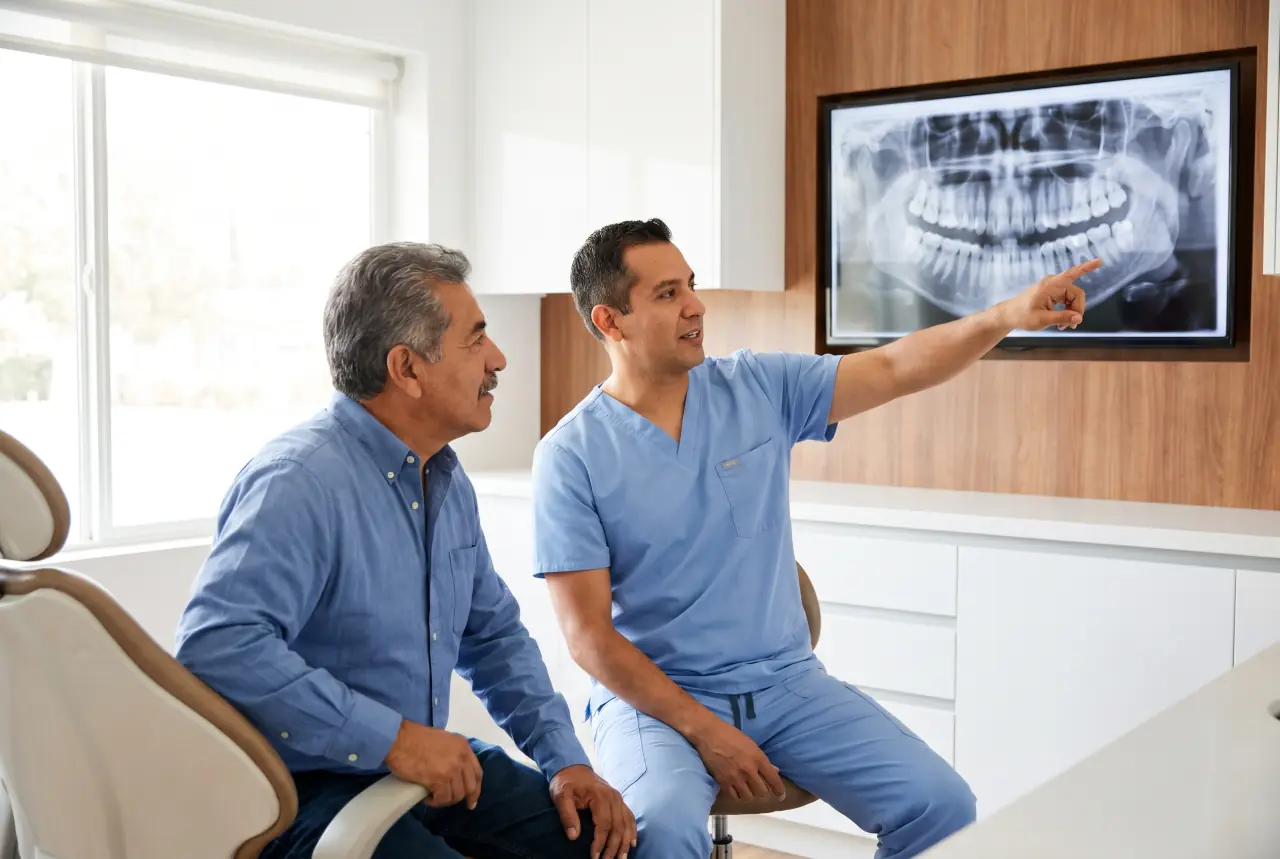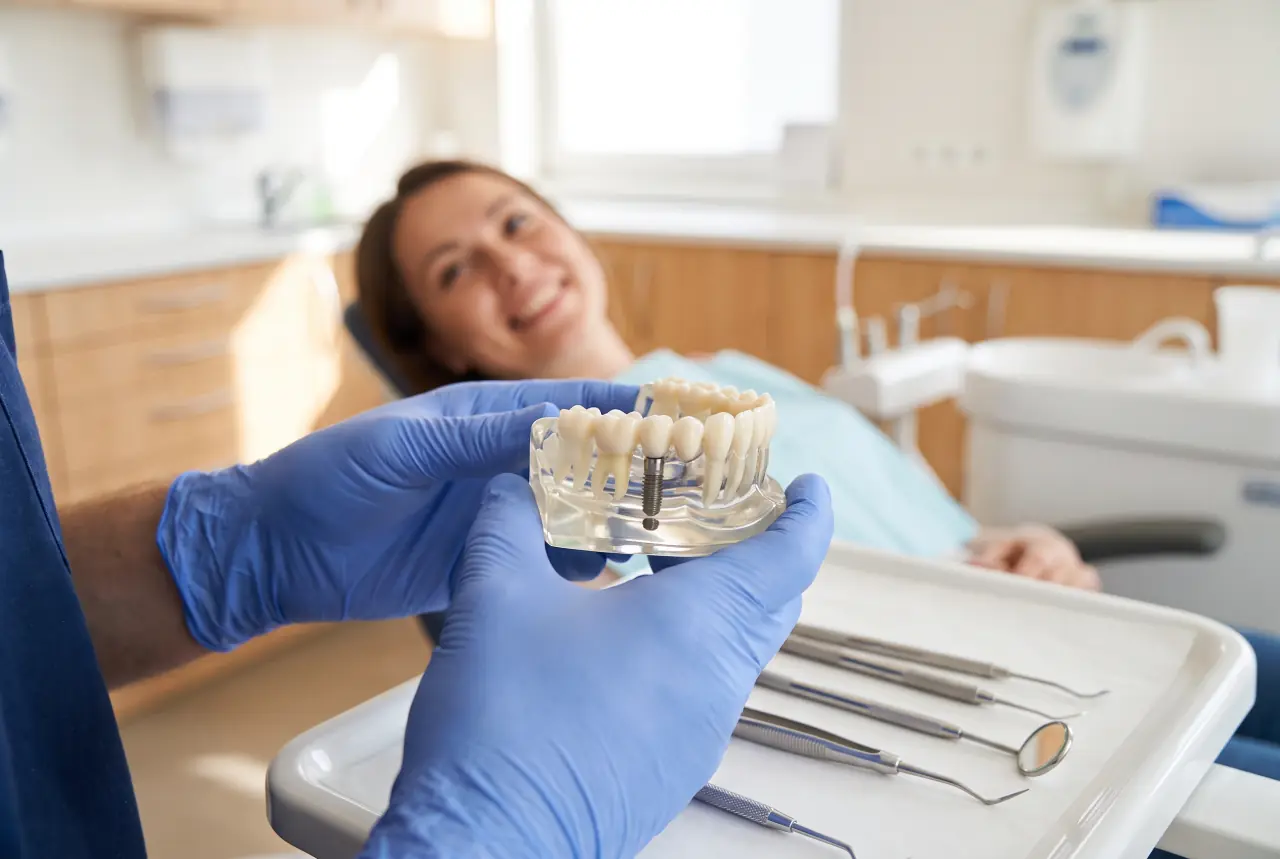

Dentures in Mexico, made in Tijuana or another city, can be a sound plan once four things are settled before any tooth comes out: a dentist has examined you and agreed which teeth to remove and which to keep; you’ve chosen between an immediate denture, fitted the day the teeth come out, and a conventional one made after your gums heal; the schedule leaves room for each fitting stage and the first adjustments; and a dentist near home is ready for the adjustments and relines that follow. You can arrange most of this before you cross.
A denture isn’t finished when you leave the chair: your gums and jawbone keep changing, fastest in the months after extractions, so plan a series of visits that carries on at home. Your dentist decides what suits your mouth; this guide covers what to ask at each step.
At a glance
- Complete or partial
- Complete dentures replace all the teeth in an arch; partial dentures replace some and are held by the teeth you keep
- Immediate or conventional
- Immediate dentures go in the day teeth come out and may need relining or remaking; conventional ones wait for healing, which may take several months
- Fitting stages
- Impressions, bite measurements, a wax try-in and the fitting, 2 weeks apart at one Scottish public clinic
- Upkeep
- Cleaned daily without toothpaste, usually out at night, checked every year and often remade after 5 to 10 years
- Price
- Depends on the extractions, materials and relines; see what a quote should list
- Check first
- Each dentist’s professional license number in Mexico’s public registry
Key takeaways
- Settle with your dentist which teeth come out and which could be kept, and whether you’ll start with an immediate denture or wait for a conventional one.
- With an immediate denture, get in writing when it will be relined or replaced, who will do that work and whether the price includes it.
- Ask for a written schedule covering every stage from impressions to fitting, and stay long enough for the first adjustment visits.
- Look up each dentist’s professional license number, and ask who designs your denture and which lab makes it.
- Before you travel, line up a dentist near home who will adjust and reline your denture and check it every year.
In this guide
- Complete or partial, immediate or conventional: the kinds of dentures
- Which teeth stay: extractions, overdentures and implant options
- Immediate or conventional: healing, shrinking gums and relines
- Denture materials: acrylic, metal frameworks and flexible partials
- The steps and visits: impressions, bite records, try-in and fitting
- Who makes your dentures: a general dentist, a prosthodontist and the lab
- Living with dentures: the first weeks, eating, speaking and cleaning
- Relines, rebases and how long dentures last
- Risks of dentures, and what you can do about each
- How much do dentures in Mexico cost, and what should a quote list?
- Questions to ask your dentist about dentures
- Before you go: checklist
- Warning signs with new dentures or after extractions
- Frequently asked questions
- Sources
Complete or partial, immediate or conventional: the kinds of dentures
Dentures are removable replacements for missing teeth that make eating and speaking easier than going without (American Dental Association, ADA). Two choices shape every plan: how many teeth the denture replaces, and when it goes in, which is covered in immediate or conventional.
| Kind | What it is | Worth knowing |
|---|---|---|
| Complete | Replaces every tooth in the upper or lower jaw and rests on the gums covering the jawbone (American College of Prosthodontists, ACP) | Attaching it to implants can improve how well it stays put (ACP) |
| Removable partial | Replaces some teeth, using the teeth you still have to hold it in place (ACP) | How many teeth are missing, and where, affects its comfort and stability (ACP) |
| Overdenture | Fits over a few natural teeth your dentist has prepared, which can help preserve the jawbone and steady the denture; implants can do the same job (ADA) | Ask whether any of your teeth could serve this way |
This guide covers removable dentures. Teeth fixed onto implants, sold as “permanent dentures”, are explained in what All-on-4 is, and dentures, overdentures and fixed bridges compared sets out the daily care each needs.
Which teeth stay: extractions, overdentures and implant options
Why it matters: once teeth are removed, the jawbone shrinks and changes shape (ACP), so deciding which teeth to keep comes before choosing a denture.
A partial denture leans on the teeth you keep, and an overdenture sits over a few prepared ones, so a tooth that can be saved may change the design. If a tooth might be treated instead of removed, see what a root canal does and when a dentist suggests a crown.
Implants can stabilize a complete or partial denture, and a lower denture held by implants lets you chew more efficiently (ACP). Whether they suit you is covered in who is a good candidate for dental implants and, for a full arch, are you a candidate for full-arch implants. If you might want them later, say so at the first exam.
When teeth come out the day a denture goes in, the sites may be painful or uncomfortable for up to several weeks (ACP), so the number of extractions also shapes your first weeks.
How to check: ask for a plan that names each tooth: which come out and why, which could be kept with a root canal or crown or to support an overdenture, and whether implants could hold the denture now or later. Ask to see the X-rays, and compare the plan with what a written plan should list.
Immediate or conventional: healing, shrinking gums and relines
Why it matters: the jaw changes fastest in the months after extractions, so a denture fitted the day teeth come out often needs adjusting or replacing, and that work belongs in your plan and your quote.
After a tooth is removed, the ridge of bone that held it narrows and loses height. A 2012 systematic review of 20 studies reported that, in the studies that measured the bone directly, the ridge lost 29% to 63% of its width and 11% to 22% of its height by 6 months after extraction, shrinking quickly in the first 3 to 6 months and gradually after that (Tan et al., 2012). These are averages across studies, not a prediction for your mouth.
| Immediate denture | Conventional denture | |
|---|---|---|
| When it goes in | The day the remaining teeth are removed, so you aren’t left without teeth while you heal (ADA) | After the tissues heal, which may take several months (ADA); ask what you’d wear meanwhile |
| How it’s made | From measurements and models taken at an earlier visit (ADA); in UK practice, usually within a few days (NHS) | Through the fitting stages |
| As you heal | Needs follow-up visits so it keeps fitting as you heal from the extractions (ACP) | With no teeth removed when it’s fitted, there should be fewer adjustments, and more minor ones (ACP) |
| Later | May need relining or remaking once the jaw has healed (ADA); in UK practice, often adjusted or replaced up to a year later, as the mouth changes shape while it heals (NHS) | May need relining once it no longer fits as well as it did (ACP) |
That leaves two routes once the jaw has healed, relining the immediate denture or replacing it, so ask which one your quote assumes. Relines and rebases are explained below.
How to check: ask whether an immediate denture will be relined or replaced, roughly when, by whom and where, and whether the price includes that work.
Denture materials: acrylic, metal frameworks and flexible partials
Why it matters: the base material can affect how a denture looks, how well it stays in and how comfortable it feels, and the evidence on newer flexible materials is still mixed.
Denture bases are conventionally made of acrylic or cast metal (Canada’s Drug Agency, 2025, a Canadian government-funded health technology agency). Dentures are plastic, so they can’t be whitened like natural teeth; daily cleaning keeps stains down (ACP).
| Material | Where it’s used | What the sources say |
|---|---|---|
| Acrylic (plastic) | Complete denture bases, and the pink gum-colored parts of partials | Durable, but not as strong as tooth enamel, so toothpaste can scratch it (ACP) |
| Metal framework | Removable partials, which typically have a metal framework, pink plastic in place of the gum, and plastic or resin teeth (ACP) | One of the two conventional base materials (Canada’s Drug Agency) |
| Flexible thermoplastic | Partial or complete dentures with a more flexible base | May give better function, looks and comfort, and may cost more than conventional dentures (Canada’s Drug Agency) |
A 2025 rapid review of 8 controlled studies, 7 of them randomized trials, found that flexible dentures may score better than acrylic or metal ones for looks and overall satisfaction, about the same for speech, pain while eating, fractures and discoloration, and worse for retention, meaning how well the denture stays in. The reviewers found no study that followed patients long enough to compare how long flexible and conventional dentures last, and the studies may be at risk of bias (Canada’s Drug Agency).
How to check: ask what the base and teeth will be made of and why, and for a partial, whether it has a metal framework or a flexible base, how it stays in, and whether it can be relined or repaired. Get the material written into the plan.
The steps and visits: impressions, bite records, try-in and fitting
Why it matters: each stage is a visit, and the time between them decides whether you need one longer stay, several trips or adjustments arranged at home.
In UK practice, dentures usually take a few weeks to make, from a putty mold or a scan of your mouth to a fitting appointment (NHS). At one clinic of the UK’s National Health Service (NHS) in Scotland, each stage is a visit, 2 weeks apart (NHS Lothian):
- Impressions. Molds of your mouth are taken, then a second, more detailed set.
- Bite records. Your dentist records how your jaws meet and the size and position the teeth should have, and you choose the shade.
- Try-in. You see and feel the teeth set in wax before the denture is finished, and the bite can still be changed; this visit may be repeated.
- Fitting. The finished denture goes in and is adjusted.
These stages describe one public clinic in Scotland; your dentist’s schedule may differ.
After the fitting, follow-up appointments are generally needed so the fit can be checked and adjusted (ADA).
What the stages can mean for your trips
We found no official or professional source that sets a number of days in Mexico for dentures, so plan from your dentist’s written schedule:
- A conventional denture: any extractions, healing that may take several months, then the stages above. If a clinic offers to finish in a few days, ask which stages are combined and whether a second try-in is possible.
- An immediate denture: a visit for measurements and models, the day of the extractions and fitting, then the first adjustment visits. Ask where later relines or a replacement will happen.
- At home: a denture made far away still needs adjusting and checking somewhere, so line up a dentist near home first.
How to check: before you book travel, get the dates in writing: each stage, the lab days, the gap between extractions and fitting, the adjustment visits before you leave, and when and where the first reline is due. Matching visits to the treatment covers lab time, and crossing the border for dental appointments sedation and the ride back.
Who makes your dentures: a general dentist, a prosthodontist and the lab
Why it matters: a dentist plans, records and fits the denture while a lab technician makes it, so knowing who does each step tells you whose license and experience to check.
Many dentists can make dentures; prosthodontists are the specialists dedicated to this work, with at least 3 more years of training in an accredited program, and are highly trained in dentures, crowns, bridges and implants (ACP). The American College of Prosthodontists (ACP), the U.S. society of these specialists, suggests seeing one as the best starting point, partly to learn whether another treatment would suit you better (ACP).
A dental laboratory technician makes the denture from the design and instructions the dentist provides (ACP). Mexico’s rule for technicians, and the specialty license number to ask for, are in who should treat you; the lookups are in checking the license and the clinic’s permits.
A license you’ve looked up is a strong starting point, and one part of a sound plan alongside a written schedule for fittings and relines and a dentist near home.
How to check:
- Ask who will examine you, remove any teeth, take the impressions and bite records, and fit and adjust the denture, and get each full name.
- Look up each cédula profesional, Mexico’s professional license number, before you pay a deposit, plus any specialty license (cédula de especialidad) for someone presented as a prosthodontist.
- Ask where the lab is, how many days it needs, and how many dentures like yours the dentist makes.
Living with dentures: the first weeks, eating, speaking and cleaning
Why it matters: the first weeks take practice and adjustment visits, and the daily routine you start now helps keep your mouth healthy.
The first weeks. New dentures may feel awkward for a few weeks, and loose while your cheek and tongue muscles learn to hold them. Minor irritation or soreness and extra saliva are not unusual, and should go away as your mouth gets used to the denture (ADA). A first denture can feel heavy, and fully adapting to it can take several weeks (ACP).
Eating. Most patients need some time to learn to use dentures; after a while, you should be able to eat fairly normally, though harder or sticky foods may take longer to get comfortable with. A little adhesive, no more than 3 or 4 pea-sized dabs per denture, may steady it while you learn; skip chewing gum, which sticks to the plastic and can break the seal (ACP). In UK advice, practicing taking it in and out and eating softer foods may help at first (NHS).

Speaking. Dentures may improve speech problems caused by missing teeth (ACP). If yours clicks when you talk, see a dentist (NHS).
Cleaning, every day:
- Each morning, before the denture goes in, brush your gums, tongue and palate with a soft-bristled brush (ADA), and any remaining teeth with fluoride toothpaste (NHS).
- Brush the denture with a denture brush or soft toothbrush and a non-abrasive soap or denture paste, not regular toothpaste (ACP). Rinse it after meals, and clean it over a sink of water or a towel in case you drop it (NHS).
- When it’s out of your mouth, keep it covered in water so it doesn’t warp (ADA), and use bleach only if your dentist shows you how (ACP).
At night. Taking dentures out at night is preferred, so your gums and bone can rest from the pressure; clean them and store them in water (ACP). UK advice is not to sleep in them unless your dentist recommends it, since trapped food raises the risk of gum infections and tooth decay, and you could choke on a denture left in while sleeping (NHS).
Adhesives. In most cases, properly fitted and maintained dentures shouldn’t need adhesive, which fills gaps left by shrinking bone and gives temporary relief (U.S. Food and Drug Administration, FDA). If you use one, follow its instructions exactly (ADA); zinc in adhesives is covered under risks.
How to check: before you leave, ask the dentist to show you how to put in, take out and clean the denture, which cleanser and adhesive to use, whether to leave it out at night, and when your next adjustment is.
Relines, rebases and how long dentures last
Why it matters: your gums and jawbone keep changing, which means a denture that fits well today will need refitting and, in time, replacing.
Two procedures restore a denture’s fit while keeping its original teeth (Canada’s Drug Agency, 2026):
- A reline resurfaces the side of the denture that touches your gums with new material, either chairside, with a soft material that sets in your mouth, or by a technician in a lab, from an impression.
- A rebase replaces the whole base in a lab, when severe bone loss affects the fit, the base is cracked or damaged, or a longer-lasting fix than a reline is needed.
Many ill-fitting dentures may have problems only a new denture can correct, so ask whether yours can simply be relined, and skip over-the-counter reline kits (ACP).
Dentures should typically be checked every year, and often need remaking once they lose their fit and turn loose, after 5 to 10 years of use; adhesive can mask that looseness (ACP). A 2026 rapid review found no evidence-based guidelines on how often to reline or rebase a denture, and little published evidence on how long relined or rebased dentures last (Canada’s Drug Agency, 2026).
How to check: ask the dentist in Mexico when the first reline is likely and where, and ask your dentist at home whether they’ll reline, repair or remake a denture made elsewhere. Book a yearly check either way.
Risks of dentures, and what you can do about each
Why it matters: each of the problems below comes with a step you can take, from adjustment visits to taking the denture out at night.
Dentures that aren’t cleaned properly or adjusted when needed can lead to a sore mouth, infections, and difficulty eating and speaking (NHS). Figures here are averages across studies, not a prediction for you.
| Risk | What it is | What you can do |
|---|---|---|
| Sore spots | Minor irritation is normal at first and should fade (ACP) | Keep the adjustment visits, and consult your dentist if irritation or soreness persists (ADA) |
| A poor or loose fit | Dentures loosen as the bone beneath them shrinks (FDA) | Have it relined or remade: a large amount of adhesive won’t necessarily fix a denture that fits badly (FDA) |
| Denture stomatitis | The most common inflammation of the mouth in denture wearers, found in 17% to 75% of them across studies: redness and swelling where the denture rests, mainly from a film of Candida yeast that poor hygiene, long-term wear, a poor fit and porous acrylic encourage (Abuhajar et al., 2023) | Clean your mouth and denture daily, leave it out at night, stop smoking if you smoke, and have a poor fit adjusted or the denture remade; your dentist may prescribe an antifungal (Abuhajar et al., 2023) |
| Bone loss over time | The jawbone shrinks once teeth are gone (ACP), and wearing an ill-fitting denture for a long time may add to the loss (FDA) | Keep yearly checks, have a loose denture refitted, and ask whether implants could help hold it |
| Dry socket after an extraction | A painful condition when the blood clot over the socket is dislodged, leaving bone and nerves exposed (ADA) | Avoid tobacco, which can delay healing, and tell your dentist; treatment may include cleaning the socket and a medicated dressing (ADA) |
| Too much zinc from adhesive | Overusing a zinc-containing adhesive, especially with zinc supplements, can contribute to too much zinc in the body, which can lead to nerve damage, especially in the hands and feet; the people in the reported cases used at least 2 tubes a week (FDA) | Use no more than the instructions say, starting with a small amount, and know that zinc-free adhesives exist; a 2.4-ounce tube used for upper and lower dentures should last 7 to 8 weeks (FDA) |
| A broken denture | A poor repair can cause chewing problems and sore spots, and an old denture may need replacing instead (ACP) | Take it, with any broken pieces, to a dentist for a professional repair (NHS; ACP) |
How to check: ask which of these problems the dentist sees most, how each is handled, and who would handle it once you’re back in the U.S.; infection control is covered in risks of dental work.
How much do dentures in Mexico cost, and what should a quote list?
Why it matters: a denture price may cover only the first denture, so extractions, relines and a final denture can change what you actually pay.
Denture fees vary widely with the complexity of the treatment, the time it takes and the practice’s location, and the best way to learn yours is to discuss your care with the dentist (ACP). We found no U.S. price for dentures from an official or professional source, so we don’t give one; an estimate from a dentist near home for the same plan is the fairest comparison.
In most cases, Medicare doesn’t cover tooth extractions or items like dentures (Medicare.gov); for other plans, see what U.S. coverage pays for.
How to check: ask each clinic for a written, itemized quote in U.S. dollars with these lines, then compare it with what a medical tourism quote should include:
| Line | What to ask |
|---|---|
| Exam and X-rays | Which images are included, and can I take copies home? |
| Extractions | How many teeth, which anesthesia, and is each one in the price? |
| Immediate denture | Is it included, for one arch or both? |
| Final denture | Is a new denture made after healing, or the immediate one relined, and is either priced? |
| Try-ins | How many are included if the first needs changes? |
| Materials and lab | What are the base and teeth made of, and which lab makes them? |
| Adjustments | How many adjustment visits are included, and for how long after the fitting? |
| Relines or rebase | How many relines are included, done chairside or in a lab, when and where? |
| Remake and repair terms | If it doesn’t fit or breaks, what’s covered, for how long, and who pays for travel? |
Questions to ask your dentist about dentures
- Which teeth will you remove, which could be kept, and why?
- Immediate or conventional: which do you recommend for me, and if immediate, will it be relined or replaced, and when?
- How many visits will the impressions, bite records, try-in and fitting take, and how many days apart?
- What will the base and the teeth be made of, and for a partial, will it have a metal framework or a flexible base?
- Who will design and fit my denture, may I have each dentist’s cédula number, and which lab makes it?
- How many adjustment visits and relines does the quote include, and where will they happen?
- If it stops fitting or breaks after I’m home, who handles it, and what do your written terms cover?
Before you go: checklist
- A plan that names each tooth to remove or keep, with your X-rays
- Immediate or conventional agreed, with the reline or replacement plan in writing
- A written schedule with every stage, the lab days and the first adjustment visits
- Each dentist’s cédula looked up, and the clinic’s permits seen
- An itemized quote listing extractions, try-ins, adjustments, relines and remake terms
- A dentist near home lined up for adjustments, relines and yearly checks
- Soft foods, a denture brush, a non-abrasive cleanser and a denture case packed
- A driver arranged if you’ll be sedated for extractions, and your crossing times planned
- The State Department’s current advisory read; see what it says about Tijuana
- The warning signs below read, and the clinic’s contact details saved
Warning signs with new dentures or after extractions
In an emergency, call 911, which works in the U.S. and Mexico, then tell your dentist.
| What you notice | What to do |
|---|---|
| Trouble breathing, speaking or swallowing, a lot of swelling in your mouth, difficulty opening it, or a swollen or painful eye or sudden problems with your eyesight | Call 911 or go to the nearest emergency room, and don’t drive yourself; then tell your dentist (adapted from UK advice on a dental abscess, where the number is 999: NHS) |
| Intense toothache or pain in your gums, a swollen face or jaw, redness inside the mouth or on the face, a bad taste or a high temperature | Ask for an urgent dental appointment: these can be signs of a dental abscess, which won’t go away on its own (NHS) |
| A painful extraction site where the blood clot seems to have come away (dry socket) | Notify your dentist (ADA) |
| Irritation or soreness from the denture that doesn’t go away | Consult your dentist (ADA) |
| A denture that slips, clicks, hurts or is damaged; very red or bleeding gums or bad breath, possible signs of gum disease, a fungal infection or decay | See a dentist (NHS) |
| Numbness or tingling in your hands or feet while you use a denture adhesive | Stop using the adhesive and consult your doctor (FDA) |
If a sign fits two rows, act on the more urgent one; that’s our rule of thumb, not a source’s.
More signs after an extraction are in warning signs after dental work. Tell whoever sees you at home which teeth were removed, when, and what the denture is made of.
Frequently asked questions
How much do dentures cost in Mexico?
It depends on how many teeth come out, the materials, and whether the price covers an immediate denture, a final denture and the relines in between. Denture fees vary with the complexity of the treatment, the time it takes and the location (ACP), and we found no U.S. figure from an official or professional source to compare against. In most cases, Medicare doesn’t cover dentures (Medicare.gov). Ask for an itemized quote; what a quote should list has the lines to check.
How many days do I need in Mexico for dentures?
It depends on the type. In UK practice, immediate dentures can usually be made within a few days, while others usually take a few weeks (NHS); at one Scottish clinic, each stage from impressions to fitting is 2 weeks apart (NHS Lothian). We found no official figure for days in Mexico, so get your dentist’s schedule in writing, including adjustment visits; see what the stages mean for your trips.
Do immediate dentures need to be relined?
Often they need refitting or replacing. An immediate denture goes in the day the teeth come out and may need relining or remaking after the jaw heals (ADA); in UK practice, immediate dentures are often adjusted or replaced up to a year later (NHS). In studies that measured it directly, the bone shrank fastest in the first 3 to 6 months after extraction (Tan et al., 2012). Agree before you go who will reline it, where and at what cost; see immediate or conventional.
Can you sleep with dentures in?
You can, but taking them out is preferred, so your gums and bone get a rest from the pressure; clean them and keep them in water overnight (ACP). UK advice is not to wear them overnight unless your dentist recommends it, because of the risks of gum infection, tooth decay and choking (NHS). Leaving dentures out at night is also part of managing denture stomatitis, a common inflammation under the denture (Abuhajar et al., 2023); see living with dentures.
How long do dentures last?
They’re often remade after 5 to 10 years of use, once they lose their fit and turn loose, and should be checked every year in between (ACP). As the gums and jawbone change, a reline or rebase can restore the fit in between, though a 2026 review found no evidence-based guideline on how often (Canada’s Drug Agency). Line up a dentist near home for those checks; see relines, rebases and how long dentures last.
Are flexible partial dentures better than metal ones?
Not across the board. A 2025 rapid review found flexible dentures may do better for looks and satisfaction, about the same for speech and fractures, and worse at staying in place than conventional acrylic or metal dentures, and it found no studies long enough to show how long they last (Canada’s Drug Agency). Ask your dentist which base suits your remaining teeth and why; see denture materials.
Is it safe to get dentures in Mexico?
Much depends on checks you can make before any tooth comes out: a plan that names each tooth, each dentist’s license, a schedule with time for adjustments, written reline and remake terms, and a dentist at home. Dentures can cause sore spots, a loose fit and denture stomatitis wherever they’re made; risks and what to do pairs each with a step, and the travel advisory is covered in is it safe to get surgery in Mexico?
Sources
- Dentures MouthHealthy, American Dental Association
- Dry Socket MouthHealthy, American Dental Association
- Frequently Asked Questions about Dentures American College of Prosthodontists (GoToAPro)
- Dentures American College of Prosthodontists (GoToAPro)
- Relined Dentures American College of Prosthodontists (GoToAPro)
- Why See a Prosthodontist? American College of Prosthodontists (GoToAPro)
- Dentures (false teeth) (page last reviewed March 19, 2025) NHS (England)
- Stages of making a denture (false teeth), Spittal Street Clinic (patient information, approved October 2025) NHS Lothian (Scotland)
- Dental abscess (page last reviewed March 18, 2026) NHS (England)
- Denture Adhesives (content current as of September 4, 2018) U.S. Food and Drug Administration
- Dental services Medicare.gov, Centers for Medicare & Medicaid Services
- A systematic review of post-extractional alveolar hard and soft tissue dimensional changes in humans (Tan et al., 2012; abstract on PubMed) Clinical Oral Implants Research (peer-reviewed journal)
- Management of Chronic Atrophic Candidiasis (Denture Stomatitis): A Narrative Review (Abuhajar et al., 2023; abstract on PubMed) International Journal of Environmental Research and Public Health (peer-reviewed journal)
- Flexible Dentures for Edentulism: Health Technologies (rapid review, November 2025; summary on PubMed) Canada’s Drug Agency (Canadian Agency for Drugs and Technologies in Health)
- Longevity of Relined or Rebased Dentures: Health Technologies (rapid review, May 2026; full text on NCBI Bookshelf) Canada’s Drug Agency (Canadian Agency for Drugs and Technologies in Health)
About this guide
The Uriym editorial team researched this guide from the 15 sources above, drafted it with AI assistance, and checked it claim by claim against those sources before publishing, last on . Our editorial standards explain how we choose sources, handle prices and make corrections.
Uriym is a healthcare navigation platform, not a medical provider. Its founder, Adriana Mendez, grew up in a family that traveled to Mexico for care and has done it herself for the past ten years. How Uriym works
This is general information, not medical, legal or financial advice: your treating provider decides what care is right for you. Rules, prices and advisories change, so check the official page before you act. Found something wrong or out of date? Email support@uriym.com.