Dental implants in Mexico can cost less than in the U.S., though a per-tooth price may cover the implant alone or the whole finished tooth. Treatment comes in stages: an assessment with scans, surgery to place the implant, a healing period while the bone grows onto it, then the final tooth. Because that healing takes months, plan for more than one trip unless your dentist tells you otherwise.
Implants can be a sound choice when your quote itemizes every part of the finished tooth, your dentist confirms your health and jawbone suit them, the dentist’s license checks out, and a dentist at home is ready for follow-up. This guide takes each of those in turn, with the questions to ask at every step.
At a glance
- Price
- Below U.S. ranges; see the price table
- What a per-tooth price covers
- May cover the implant alone or the whole finished tooth
- How long it takes
- At one British public hospital, usually at least 3 months of healing before the implant can support teeth; the whole treatment could take 6 to 12 months
- Trips
- At least 2 if treatment is staged, months apart; your dentist sets the schedule
- Check first
- The dentist’s professional license number (cédula profesional) and the clinic’s health permits
Key takeaways
- Ask for an itemized quote that prices the scans, any extraction or bone graft, the implant, the abutment, the crown and temporary teeth, so you compare like with like.
- Ask how many trips your plan needs, how far apart and how many days each, and get it in writing before you book travel.
- Look up the dentist’s professional license number and ask to see the clinic’s health permits before you pay a deposit.
- Get the treatment plan, the implant brand and model, and what the clinic covers if something needs fixing, in writing.
- Line up a dentist at home before you travel, and bring back copies of your scans and records for them.
In this guide
- What is a dental implant? The post, the abutment and the crown
- How much do dental implants in Mexico cost?
- How long do dental implants take?
- Who is a good candidate for dental implants?
- How to check a dentist and clinic in Mexico
- Getting your plan, consent and records in writing
- Caring for implants and follow-up with a dentist at home
- Questions to ask before you agree to a treatment plan
- Before you go: checklist
- Warning signs after dental implant surgery
- Frequently asked questions
- Sources
What is a dental implant? The post, the abutment and the crown
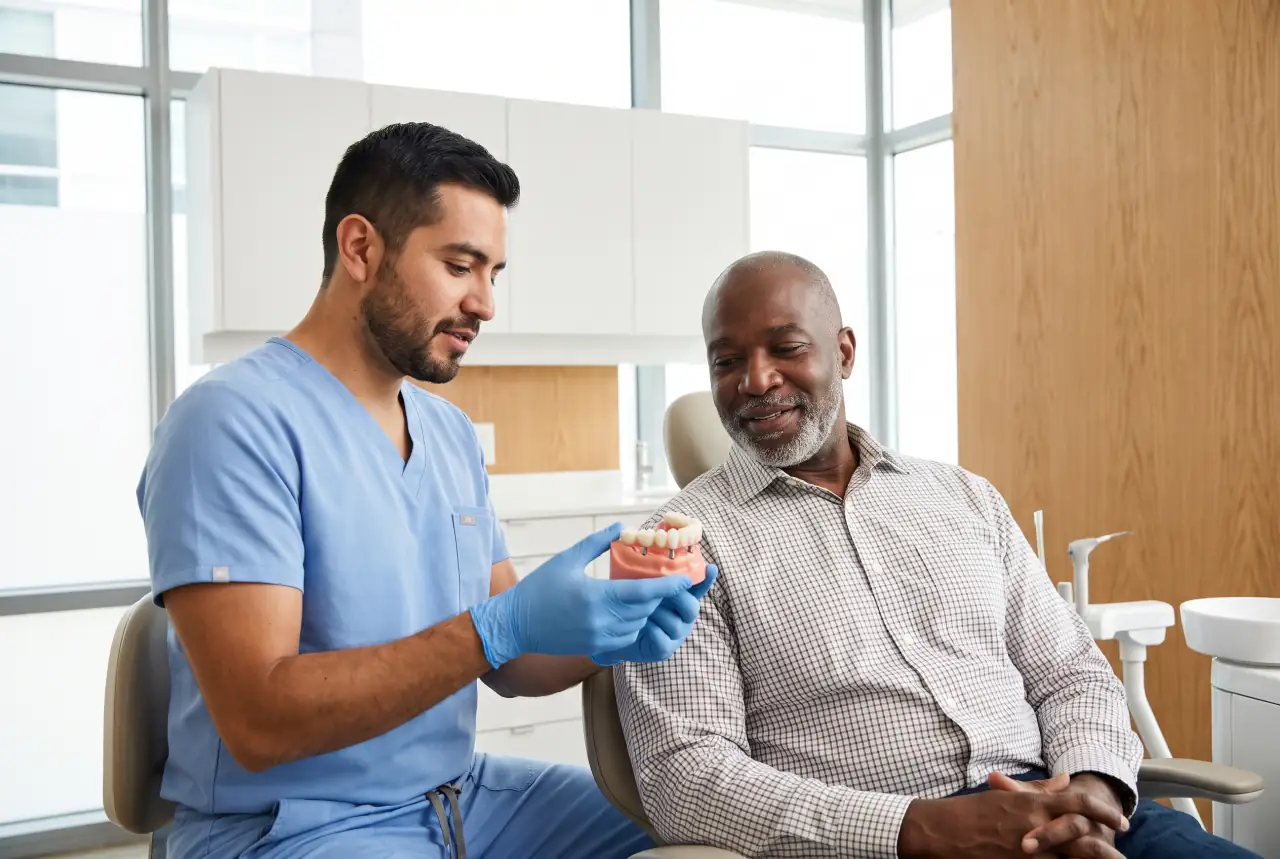
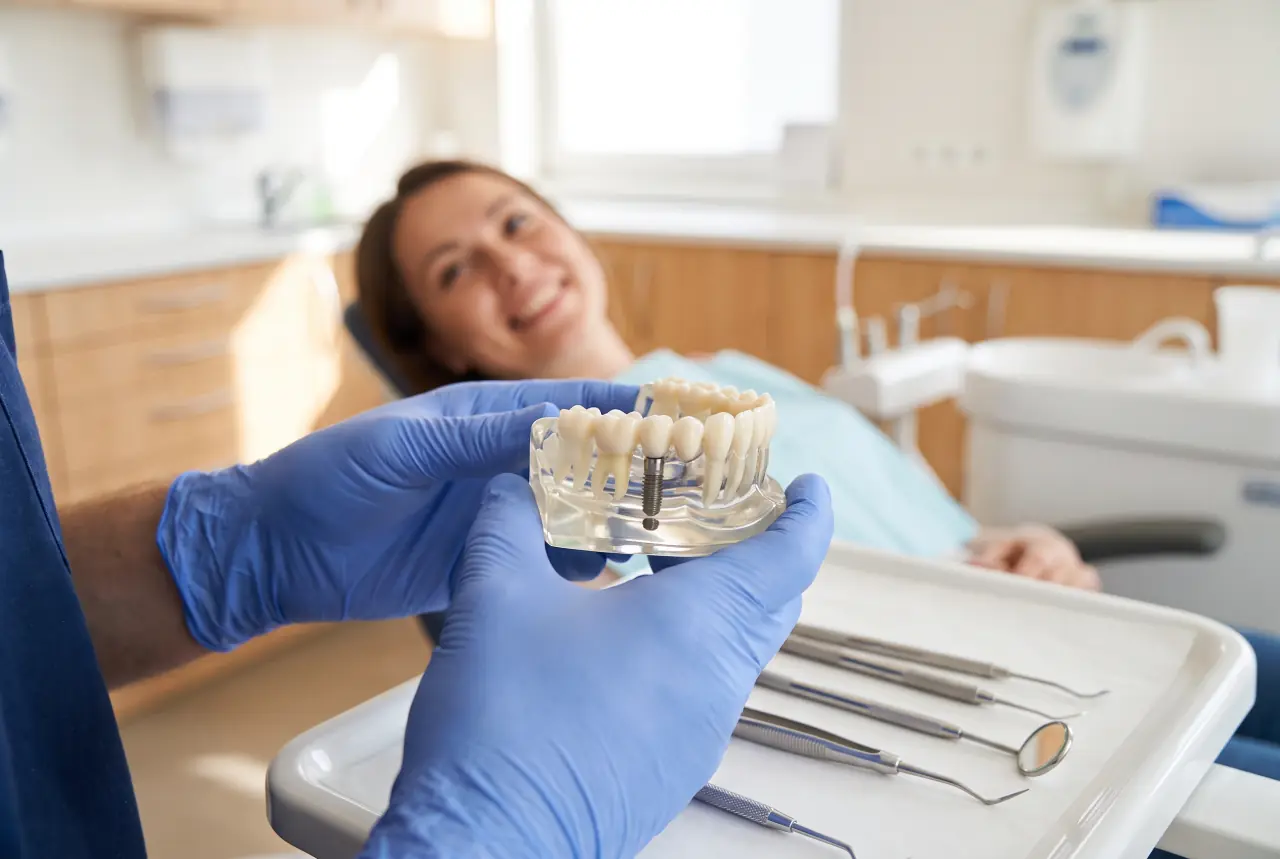
A dental implant is a man-made replacement for a tooth’s root, placed in the jawbone during surgery (Guy’s and St Thomas’; U.S. Food and Drug Administration, FDA). It restores your ability to chew and your appearance, and it helps keep the jawbone from shrinking due to bone loss (FDA). An implant tooth has three main parts, and a quote may price them separately:
- The implant body, or post, goes into the jawbone in place of the tooth’s root. Most implant systems are made of titanium or zirconium oxide (FDA).
- The abutment is usually held to the post by a small screw and comes up through the gum to support the new tooth (FDA).
- The crown, bridge or denture is the part you see. For one tooth, your dentist customizes a crown based on size, shape, color and fit, designed to blend in with your other teeth (American Dental Association, ADA).
Between the surgery and the new tooth, the bone grows around the implant and holds it in place. This process is called osseointegration, which means “combines with the bone”: it’s what makes an implant strong, and it takes time (ADA). That healing is why implant treatment is measured in months.
Implants can replace one tooth, several teeth or all of them (American Academy of Periodontology, AAP), and they can support crowns, bridges or dentures (Guy’s and St Thomas’). Some clinics market full-arch plans under names like All-on-4 or All-on-6, and the name alone doesn’t tell you what a quote includes. Our guide to All-on-4 in Mexico covers full-arch treatment in detail, from the stages to what each quote should list.
How much do dental implants in Mexico cost?
Why it matters: the price worth comparing is the one for the finished tooth, not just the part that goes into the bone.
| Treatment | Tijuana (USD) | United States (USD) |
|---|---|---|
| Dental implant, per tooth | $800 – $1,600 | $3,000 – $6,000 |
| Full-mouth restoration | $18,000 – $28,000 | $40,000 – $80,000 |
Uriym’s indicative ranges from its dental price catalog, reviewed September 7, 2026. They are not quotes and cover the listed treatment only, without taxes, travel or third-party charges.
Dental care is the most common form of medical tourism among U.S. residents, in part because of the rising cost of dental care in the United States (CDC Yellow Book). Your own price depends on your plan: how many implants you need, whether you need a bone graft, and what goes on top.
How to check: ask for a written, itemized quote. Make sure you understand which services it includes and whether follow-up care happens at the same facility, since some facilities abroad charge substantial fees for follow-up care on top of the base cost (CDC Yellow Book). These are the lines an implant quote can include, what each one pays for and what to ask about it:
| Line in the quote | What it pays for | What to ask |
|---|---|---|
| Consultation and exam | An assessment by a qualified dentist, including your full medical history, before you get a treatment plan and cost estimate (UK General Dental Council, GDC) | Is the first consultation included? |
| X-rays and molds | Images and impressions of your mouth, which help the dental team plan your treatment and make the implant fit (Guy’s and St Thomas’) | Which are included, and can I take copies home? |
| CT scan | Imaging that can include a medical or cone-beam CT (computed tomography) scan. A thorough imaging assessment gives the information needed to plan the surgery and the new tooth. Knowing precisely where the nerve canal in the lower jaw and the sinus in the upper jaw lie is very important in planning where the implant goes (StatPearls) | Is a scan planned, and is it in the price? |
| Extraction | Removing the tooth being replaced, if it’s still there | Is it included, and does it change the timeline? |
| Bone graft | Bone, or a bone substitute, added to build up the jaw where there isn’t enough to support the implant (Guy’s and St Thomas’; AAP) | Will I need one, what will it cost, and how much time does it add? |
| Sinus augmentation (sinus lift) | Raising the sinus floor and developing bone in the upper back jaw, traditionally one of the most difficult areas for implants because of too little or poor-quality bone and the nearby sinus (AAP) | Will I need one, and what will it cost? |
| Implant body (post) | The post itself | Which brand and model? |
| Temporary abutment | A temporary abutment you typically have in place of the tooth while the implant heals (FDA) | Is it included? |
| Final abutment and screw | The connector between the post and the tooth | Is it in the per-tooth price? |
| Temporary teeth | A temporary crown, bridge or denture that helps you eat and speak normally while the final teeth are made (ADA) | Will I have one, and is it included? |
| Final crown, bridge or denture | The teeth you see | Which material, and is the final crown included? |
| Anesthesia and medicines | Numbing for surgery, and prescriptions afterward | Is sedation extra? Are medicines included? |
| Follow-up visits | Stitch removal, checks on healing and fitting the final teeth | Which visits are included, and where? |
| Fixing problems | Another surgical procedure to fix or replace a failed implant (FDA), or repair of a part that loosens or wears out (Guy’s and St Thomas’) | What is covered, for how long, and who pays for travel? |
For a full-mouth plan, also ask whether the quote covers:
- One jaw or both, and how many implants in each
- Removing any remaining teeth, and any bone grafting
- Temporary teeth to wear while you heal, and when the final teeth are made
- A fixed bridge or a denture supported by implants, and what it’s made of
- How many trips, and how many days each trip takes
To add up flights, time off, follow-up and complications, use the checklist in medical tourism costs: what a quote should include. If the plan includes medicine to take home, check what U.S. rules allow at the border before you pack it.
How long do dental implants take?
Why it matters: the healing time between stages shapes how many trips you make and how long each one lasts.
At one British public hospital, Guy’s and St Thomas’ in the UK’s National Health Service (NHS), implant treatment usually involves 3 or 4 stages, each stage might involve several visits, and the whole treatment could take 6 to 12 months (Guy’s and St Thomas’). Your dentist sets your own timeline. Here is what happens at each stage and how long it can take:
| Stage | What happens | How long |
|---|---|---|
| Assessment | Exam, medical history, X-rays and molds, and sometimes a CT scan | Several visits at one NHS hospital |
| Bone graft, if needed | Bone is added where there isn’t enough | Treatment might take 4 to 6 months longer |
| Implant surgery | The post goes into the jaw, usually under local anesthetic, and the gum is stitched | Stitches out 7 to 14 days later |
| Healing | Bone grows onto the implant | Usually at least 3 months before it can support replacement teeth; can be several months or longer |
| Uncovering, if the implant was buried | A small procedure to expose an implant that healed under the gum | Before the final teeth; ask when |
| Final teeth | Abutment and crown, bridge or denture made and fitted | Several appointments |
Sources: Guy’s and St Thomas’ pages on having a dental implant and life after one; StatPearls; FDA.
Healing time varies by jaw. In the two-stage approach, the implant stays under the gum while the bone heals, usually 2 to 3 months in the lower jaw and 3 to 6 months in the upper jaw, and a second surgery then attaches the abutment (StatPearls). Some implants stick out through the gum, while those buried under it need another small surgical procedure before they can be used (Guy’s and St Thomas’).
If you live in the U.S., each long gap in that timeline is a trip home and a trip back. Many dental procedures are surgical and may require months of healing, which should be factored into your travel plans (ADA). A staged plan can look like this:
- First trip: consultation, scans and, if your dentist recommends them, extraction, grafting or implant surgery.
- Home to heal: usually at least 3 months, and longer after a graft.
- Second trip: uncovering the implant if it was buried, then the abutment and the final crown, bridge or denture, which take several appointments to make.
Teeth in one visit. Some patients can have the implants and replacement teeth placed in one visit, while others might need to wait until the implant is completely integrated, up to several months (ADA). Teeth attached at that first surgery are mostly transitional, or temporary, so the final teeth may still need another visit (StatPearls). Whether you’re suited to it is your dentist’s call.
How to check: before you book travel, ask the clinic to put the schedule in writing, including:
- The number of trips, how far apart they are and how many days each takes
- Whether the implant will be buried, and whether uncovering it adds a visit
- When the stitches come out, and whether to stay for that or have them removed at home
- Whether teeth on the day of surgery are an option for you
For documents and wait times at the border, see crossing the border to Tijuana.
Who is a good candidate for dental implants?
Why it matters: your overall health affects whether implants suit you, how long healing takes and how long an implant may stay in place (FDA).
Health counts for more than age: if you’re in good general health, implants may be an option (ADA). The ideal candidate is in good general and oral health, with enough bone in the jaw to support the implant and healthy gums free of periodontal (gum) disease (AAP). Too little bone doesn’t always rule implants out: a bone graft or sinus augmentation can help build it up, as the quote lines above describe.
The sources flag these conditions, so mention any that apply to you:
- Smoking may affect healing and decrease an implant’s long-term success (FDA). The small risk that an implant doesn’t join properly with the jawbone is higher in people who smoke (Guy’s and St Thomas’).
- Diabetes and other chronic illness. Chronic illnesses such as diabetes or leukemia may interfere with healing after surgery, and people with them may not be good candidates (ADA). Implant failure from a body-wide (systemic) infection may be more likely with uncontrolled diabetes (FDA).
- Other conditions and medicines. Reasons against implants (contraindications) fall into two groups. Relative ones include osteoporosis, bisphosphonate medicines, chemotherapy and radiation to the head and neck; absolute ones include acute illness, uncontrolled metabolic disease, and disease or infection of the bone or soft tissue (StatPearls).
How to check: at your consultation:
- Give the dentist your full medical history, including past serious illnesses, any chronic condition, past surgery or general anesthesia, and whether you smoke; the dentist assessing you should ask for all of it (GDC).
- Tell the dental team about any health problems and every medicine you take (Guy’s and St Thomas’), and bring a written list of your medicines.
- Ask whether you need a medical evaluation by a physician before surgery is scheduled (ADA).
- Ask what else could work. Options can include no treatment, preparing other teeth for crowns or bridges, or a different design of denture; implants are the choice when a dentist doesn’t want to put crowns on healthy teeth (Guy’s and St Thomas’).
Your dentist decides whether implants suit you. If a plan would crown your natural teeth, read our guide to veneers in Mexico first: it covers how much tooth a crown preparation can remove and what British dentists reported after smile makeovers abroad.
How to check a dentist and clinic in Mexico
Why it matters: these checks show whether the person treating you holds the license Mexico requires for dentistry and whether the clinic has the permits health inspectors look for.
In Mexico, practicing dentistry requires a professional degree and a cédula profesional (professional license number), under the national standard for oral health (NOM-013-SSA2-2015, in Spanish). In Baja California, the state health regulator, COEPRIS BC (State Commission for Protection against Health Risks), inspects medical offices for compliance with the health rules. In a January 2026 notice, it listed a health license (licencia sanitaria) and a notice of operation (aviso de funcionamiento), kept where patients can see them, among the essential requirements for the offices it inspects (COEPRIS BC, in Spanish). Not every clinic may have both on display, so asking to see them is the reliable check.
A verified license and the clinic’s permits are a strong starting point. They’re one part of a safe plan, alongside a written treatment plan and a dentist at home for follow-up.
Planning crowns or other work alongside your implants? See our guide to choosing a dentist in Tijuana.
How to check: do these before you pay a deposit.
- Look up the dentist’s license. Ask for the dentist’s full name and cédula number. Then, on the cédula profesional page of Mexico’s Ministry of Public Education (SEP), choose Consulta de Cédulas Profesionales to search the national registry.
- Check everyone who treats you. Ask who will carry out your treatment and what qualifications they have (GDC). The dentist who places the implant and the one who makes the crown may be different people.
- Ask to see the clinic’s permits: the licencia sanitaria and the aviso de funcionamiento.
- Ask how instruments are cleaned. Infection-control standards differ between countries, and fresh gloves, sterile instruments and safe water are not standard practice everywhere; without them, patients could be infected with diseases such as hepatitis B (the Organization for Safety and Asepsis Procedures, quoted by the ADA).
The full step-by-step, with the State Department advisory and where to complain, is in how to check a doctor and clinic in Mexico.
Getting your plan, consent and records in writing
Why it matters: written documents show exactly what you agreed to, and they give any dentist who treats you later the details they need.
Mexico’s oral-health standard applies to public and private dental care across the country, and it sets out what you can get in writing (NOM-013-SSA2-2015, in Spanish):
- Your dental record must include a treatment plan that specifies the procedures in each phase.
- The dentist must prepare a written informed-consent letter for every patient. It must use plain language and describe the procedure, its main risks, the expected benefits and feasible alternatives. You can withdraw your consent until the procedure starts, and the dentist must write a new letter if the plan changes.
- On your request, the dentist or clinic must give you a clinical summary or copies of documents from your record, and must keep the record for at least 5 years after your last visit.
Two more records help later: the brand and model of your implant system, which you should keep for your records (FDA), and copies of your records in English, if you need them, to share with your health care professionals at home (CDC Yellow Book).
How to check: before treatment starts, ask for the written plan by phase and the consent letter, and read both. Before you leave, ask for your clinical summary, X-rays and scans, and the implant’s brand and model. Asking for these up front also shows you whether a clinic follows these parts of the standard.
Caring for implants and follow-up with a dentist at home
Why it matters: an implant needs care for as long as you have it, and most of that care happens near home.
Significant dental procedures need follow-up care to make sure everything is healing and working properly (ADA). Day to day, follow your dentist’s hygiene instructions carefully, because regularly cleaning the implant and the teeth around it is very important for its long-term success, and schedule regular dental visits (FDA). Like natural teeth, implants need brushing, flossing and regular checkups. Bacteria can build up at the base of an implant, below the gum line, and over time inflame the gum; this is peri-implant disease, and if it isn’t caught early, the bone below the implant can deteriorate (AAP).

Over the years, parts of an implant can loosen or wear out, which can stop the implant working if the problem isn’t treated quickly. A local dentist can look after your implants, and regular checks of them are important (Guy’s and St Thomas’; aftercare). Before any MRI (magnetic resonance imaging) or X-ray, tell your health care providers and imaging staff that you have implants, because implants can distort or interfere with the images (FDA). If you have a problem with an implant, you can file a voluntary report with the U.S. Food and Drug Administration (FDA) through MedWatch, its safety reporting program (FDA).
How to check: set up follow-up before you travel.
- Consider arranging follow-up care with a U.S. dentist before you go, so your care continues when you return (ADA). Speak to your own dentist first: they may be able to advise from your dental history, and they’ll need to know your plans in case of later complications (GDC).
- If you have insurance for dental care outside the U.S., confirm with your insurer or employer that follow-up treatment will be covered when you return (ADA).
- Discuss how complications would be handled with both your dentist at home and the one treating you in Mexico (CDC Yellow Book).
- Bring home the documents listed in getting your plan, consent and records in writing.
Questions to ask before you agree to a treatment plan
Don’t be afraid to ask lots of questions, even blunt or obvious ones; if the answers don’t satisfy you, you don’t have to commit to anything that day (GDC). For implants, get these answers in writing:
- Who places the implant, and who makes and fits the crown? Ask for each person’s qualifications.
- Which implant system will you use, by brand and model?
- Can I have a written treatment plan and an itemized quote? The plan should list each stage, and the quote should price each line in the quote table.
- How many trips, how far apart, and how many days each? Ask when the stitches come out and when the final teeth will be fitted.
- Will the implant be buried under the gum? If so, ask when the small procedure to uncover it happens, and whether it adds a visit.
- Is the work covered for a set period? Ask what happens if an implant fails or a part loosens, who pays for extra flights, hotel stays and remedial work if you’re unhappy, and whether treatment for complications is included in the initial cost (GDC).
- Who do I contact after I get home? Ask who can advise you after treatment (GDC).
- Can I have copies of my records? Ask for X-rays, scans, the consent letter and a summary of what was done, in English if you need them.
Before you go: checklist
- Dentist’s cédula looked up, and the clinic’s permits seen
- Full medical history and medicine list shared with the dentist
- Written treatment plan, consent letter and itemized quote read line by line
- Implant brand and model in writing, and what’s covered if an implant or part needs fixing
- Trips, dates and stitch removal planned
- A dentist at home lined up, and your insurer asked about follow-up
- The clinic’s contact details saved and the warning signs below read
Warning signs after dental implant surgery
You might have some soreness, swelling, bleeding or bruising after surgery. Any discomfort is usually eased with regular painkillers and should only last up to a week (Guy’s and St Thomas’). Complications can appear soon after placement or much later (FDA), so know these signs and what to do about each. In an emergency, call 911, which works in the United States and in Mexico, and then let the dentist who treated you know.
| Sign | What to do |
|---|---|
| Bleeding that won’t stop | Roll up a clean handkerchief, press it over the wound and hold it there by biting firmly for at least 30 minutes. If the bleeding still doesn’t stop, go to the nearest emergency department (Guy’s and St Thomas’) |
| An implant that feels loose or painful | Tell your dental provider right away (FDA) |
| Numbness after surgery, which can come from a pinched or damaged nerve (FDA) | Tell your dentist |
| Red or tender gums around the implant, or bleeding when you brush | See your dentist: these are signs of peri-implant disease. Evidence suggests the milder form, peri-implant mucositis, is reversible if caught early; the advanced form, peri-implantitis, usually needs surgical treatment (AAP) |
| With a dental abscess, a build-up of pus caused by an infection: trouble breathing, speaking, swallowing or opening your mouth, a lot of swelling in your mouth, a swollen or painful eye, or sudden problems with your eyesight | Call 911 or go to an emergency room. Don’t drive yourself; ask someone to drive you or call for an ambulance (adapted from NHS advice for the UK, where the number is 999) |
Frequently asked questions
How much does one dental implant cost in Mexico?
Uriym’s indicative range for one implant in Tijuana is $800 to $1,600 per tooth, compared with $3,000 to $6,000 in the U.S. These ranges are indicative, not quotes. The total for a finished tooth depends on whether the abutment, final crown, scans and any extraction or graft are included, so ask the clinic to price each line before you compare.
How many trips to Mexico do dental implants take?
If your treatment is staged, expect at least two: one to place the implant and one, months later, for the final teeth. The bone needs time to grow onto the implant before it can hold a tooth, and a bone graft can add more; the timeline table shows each stage. Your dentist sets the schedule, so ask for the number of trips in writing.
Can I get dental implants in one day in Mexico?
Sometimes. Some patients can have implants and replacement teeth placed in a single visit, but teeth attached on the day of surgery are mostly transitional, so the final teeth may still need another trip. Your dentist decides whether a same-day approach suits you; see how long dental implants take for the stages.
What is included in All-on-4 in Mexico?
It depends on the clinic, so ask for an itemized quote. Check whether it covers one jaw or both, how many implants, removing remaining teeth, grafting, temporary teeth, the final teeth and their material, follow-up visits and the number of trips, and compare quotes only when they describe the same plan. The price table shows indicative full-mouth ranges, and our guide to All-on-4 in Mexico covers full-arch plans in detail.
How long do dental implants last?
It depends on your health and how you care for them; the patient pages we rely on, from the U.S. Food and Drug Administration, two U.S. dental societies and a British public hospital, give no set number of years. Your overall health is an important factor in how long an implant may stay in place, and smoking may decrease its long-term success (FDA). Implants are long-lasting replacements for tooth roots if you care for them properly, though parts can loosen or wear out with time (Guy’s and St Thomas’). Regular cleaning, checkups with a dentist at home and prompt attention to a loose part all count, so set up that care before you travel.
What happens if a dental implant fails after I get home?
A failed implant can mean another surgical procedure to fix or replace it (FDA). Before you book, get in writing what the clinic covers if an implant fails or a part loosens, for how long, and who pays for extra travel. Line up a dentist at home before you go, and keep the implant’s brand and model with your records, so a local dentist knows what was placed.
Does insurance cover dental implants done in Mexico?
It depends on your plan. Before you go, check what, if anything, it covers outside the U.S. (CDC Yellow Book). If you have insurance for dental care outside the U.S., confirm with your insurer or employer that follow-up treatment will be covered once you’re back (ADA). For health savings and flexible spending accounts, and what U.S. coverage generally pays for abroad, see our guide to medical tourism costs.
How do I check a dentist’s license in Mexico?
Ask for the dentist’s full name and cédula profesional (professional license number), then search the national registry, Consulta de Cédulas Profesionales, linked from the Ministry of Public Education’s cédula profesional page. Practicing dentistry in Mexico requires a professional degree and a cédula. Check both the person who places the implant and the one who makes the crown; our guide to checking a doctor and clinic in Mexico has the full steps.
Sources
- Dental Implants: What You Should Know U.S. Food and Drug Administration
- Dental Implants (StatPearls) StatPearls Publishing, NCBI Bookshelf, U.S. National Library of Medicine (NIH)
- Dental implants: overview Guy's and St Thomas' NHS Foundation Trust
- Having a dental implant Guy's and St Thomas' NHS Foundation Trust
- After having a dental implant Guy's and St Thomas' NHS Foundation Trust
- Implants MouthHealthy, American Dental Association
- Travel MouthHealthy, American Dental Association
- Dental Implant Procedures American Academy of Periodontology
- Peri-Implant Diseases American Academy of Periodontology
- Going abroad for dental treatment General Dental Council (UK)
- Medical Tourism (CDC Yellow Book) U.S. Centers for Disease Control and Prevention
- NORMA Oficial Mexicana NOM-013-SSA2-2015, Para la prevención y control de enfermedades bucales (in Spanish) Secretaría de Salud, Diario Oficial de la Federación (copy hosted by the Secretaría de Economía)
- Cédula profesional (in Spanish) Secretaría de Educación Pública, Gobierno de México
- Más de 200 consultorios médicos verificados durante el 2025 (in Spanish) COEPRIS Baja California
- Dental abscess NHS (UK National Health Service)
About this guide
The Uriym editorial team researched this guide from the 15 sources above, drafted it with AI assistance, and checked it claim by claim against those sources before publishing, last on . Our editorial standards explain how we choose sources, handle prices and make corrections.
Uriym is a healthcare navigation platform, not a medical provider. Its founder, Adriana Mendez, grew up in a family that traveled to Mexico for care and has done it herself for the past ten years. How Uriym works
This is general information, not medical, legal or financial advice: your treating provider decides what care is right for you. Rules, prices and advisories change, so check the official page before you act. Found something wrong or out of date? Email support@uriym.com.