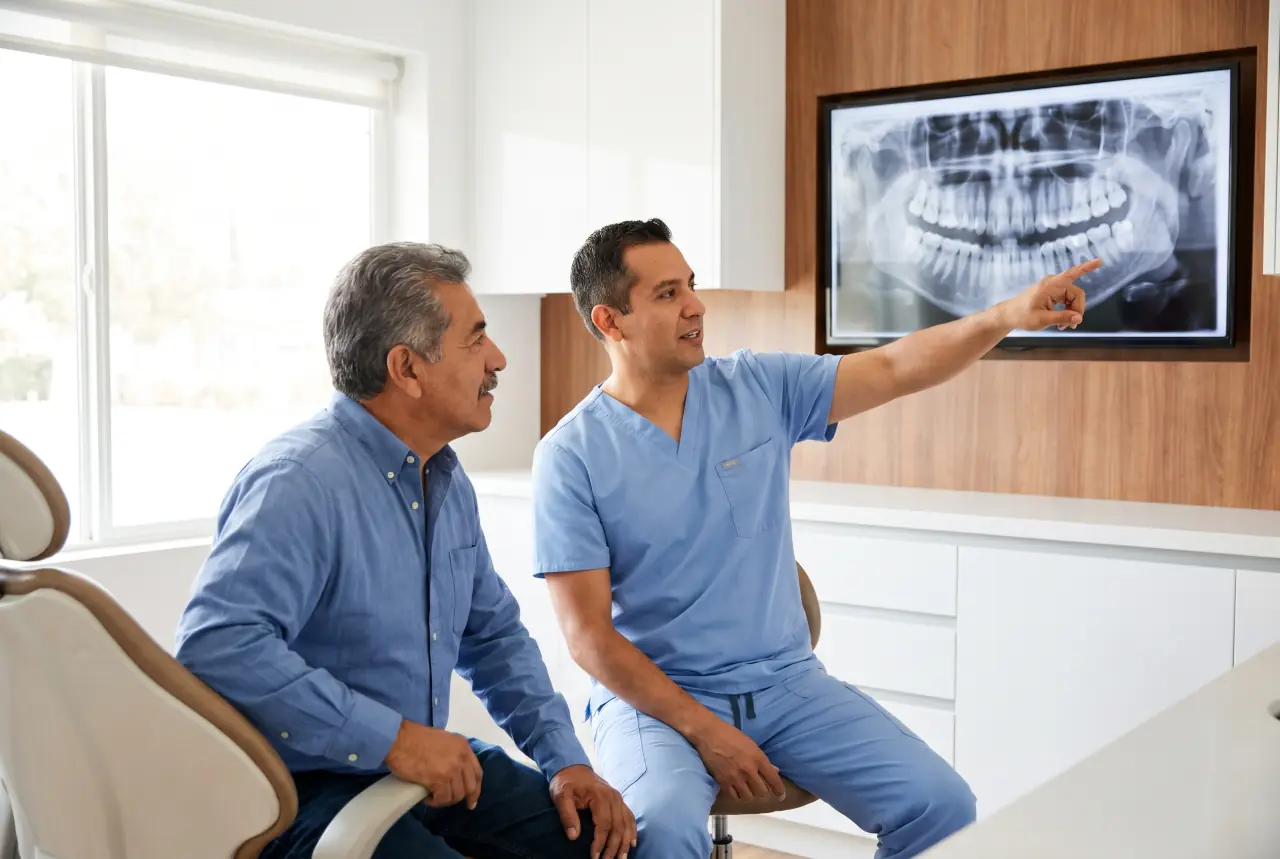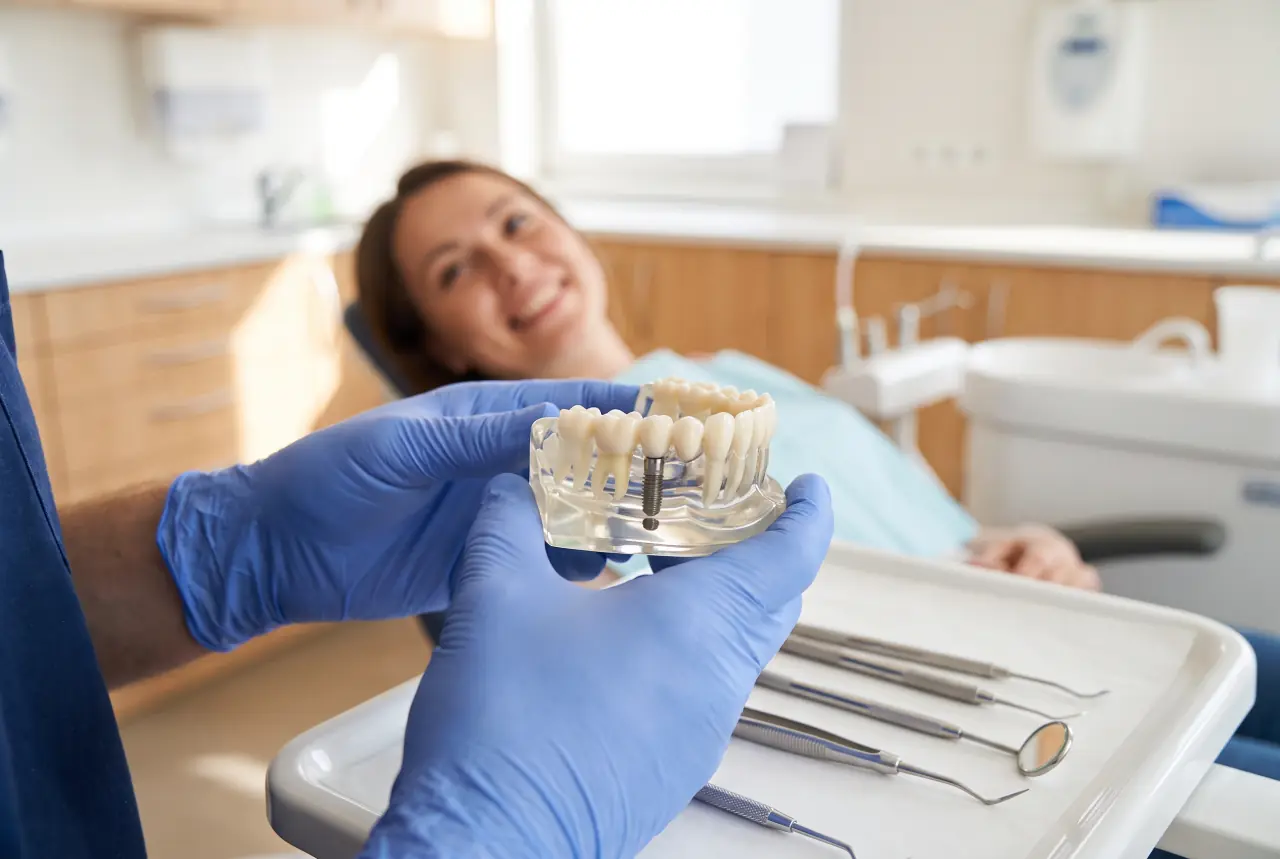

A root canal in Mexico, in Tijuana or another city, can be a sound way to keep a tooth when four things are settled before treatment starts: an exam and X-rays show that the tooth needs one; you know whether a general dentist or an endodontist, a root canal specialist, will treat it, and their licenses check out; the plan says when the crown or permanent filling goes on; and a dentist near home is ready to see the tooth afterward. Most of this can be arranged before you cross.
Because a treated tooth often needs a crown, the bigger planning question is usually what goes on it next: a crown made before you leave, one fitted on a second trip, or one from your dentist at home. Your dentist decides what the tooth needs; this guide covers what to ask at each step.
At a glance
- What it does
- Removes the inflamed or infected pulp from inside the tooth, then cleans, fills and seals the canals, to save the tooth instead of taking it out
- Appointments
- Most root canals take 1 or 2, of roughly 90 minutes each, then a later visit for the permanent filling or crown
- Who treats it
- A general dentist, or an endodontist: a dentist with at least 2 extra years of advanced training
- The crown
- Molars and premolars generally need one; front teeth don’t always
- Price
- Depends on the tooth and what the plan includes; see what a quote should list
- Check first
- Each dentist’s professional license number, any specialty license, and the clinic’s permits
Key takeaways
- Have the tooth examined and X-rayed, and ask whether a general dentist or an endodontist will treat it, before you agree to a plan.
- Decide with your dentist whether the crown or permanent filling goes on during this trip, a second trip or at home, and get that date in writing.
- Look up each dentist’s professional license number, and any specialty license, before you pay a deposit.
- Ask for a written quote that names the tooth and lists the imaging, any build-up, the crown, follow-up visits and the terms if the tooth needs treating again.
- Line up a dentist near home before you travel, and come back with your X-rays and a written record of what was done to the tooth.
In this guide
- What a root canal is, and signs a tooth may need one
- Who should do it: a general dentist or an endodontist
- The treatment, step by step: numbing, cleaning and the temporary filling
- Why a crown often follows, and fitting it into one trip or two
- Success rates, and what happens if a root canal fails
- Antibiotics: when they’re used and when they aren’t
- Risks of a root canal, and what you can do about each
- How much does a root canal in Mexico cost?
- Crossing back, flying home and follow-up at home
- Questions to ask your dentist about a root canal
- Before you go: checklist
- Warning signs after a root canal
- Frequently asked questions
- Sources
What a root canal is, and signs a tooth may need one
A root canal treats the pulp, the soft tissue inside a tooth that holds its nerves and blood vessels. The pulp can become infected after a deep cavity, repeated dental procedures on the same tooth, a cracked or fractured tooth, or an injury, even one that leaves no visible crack or chip, and without treatment the tissues around the root can become infected too (ADA). The dentist removes the infected pulp, then cleans, fills and seals the tooth to help keep infection from coming back (NHS). The point is to repair and keep your own tooth rather than remove it (ADA); left untreated, an infected tooth may have to come out (NHS).
Signs that you might need a root canal include (American Association of Endodontists, AAE, the U.S. society of root canal specialists):
- Severe pain when you chew or bite
- Pimples on the gums
- A chipped or cracked tooth
- Sensitivity to hot or cold that lingers after the hot or cold is gone
- Swollen or tender gums
- Deep decay, or darkening of the tooth or the gums
Some teeth that need a root canal cause no symptoms at all. In a 2013 newsletter written for dentists, the AAE describes a dead pulp that causes no symptoms, and inflammation at the tip of the root that shows up only as a dark area on an X-ray (AAE diagnosis newsletter). A diagnosis can’t rest on a single piece of information, and the examination the newsletter sets out goes well beyond asking how the tooth feels: cold, heat and electric tests of the pulp; tapping, pressing and biting tests; and imaging, including at least two new X-rays of the tooth and its root and a 3D scan called cone-beam computed tomography (CBCT) (AAE diagnosis newsletter). For how a root canal compares with crowns, implants and other common work, see common dental treatments.
Who should do it: a general dentist or an endodontist
Why it matters: some root canals are more complex than others, and knowing who will treat yours tells you whose training and licenses to check.
Your regular dentist may treat the tooth or send you to an endodontist, a dentist who specializes in the pulp and the tissues around the teeth (ADA). Endodontists are dentists with at least 2 extra years of advanced training (AAE).
Molars have several canals and are harder to reach, and curved, narrow or multiple canals, a repeat treatment or a severe infection may call for more advanced techniques and more time (AAE cost page). When the exam and X-rays are inconclusive, the diagnosis newsletter reminds dentists not to treat without a diagnosis: you may have to wait and be checked again later, or be referred to an endodontist (AAE diagnosis newsletter).
Endodontics is a postgraduate specialty in Mexico too. At one university, the National Autonomous University of Mexico (UNAM), the dental school’s specialization takes 2 years, admits dentists who already hold their professional license (cédula profesional), and trains them to prevent, diagnose and treat diseases of the pulp and of the tissues around the root tip, with and without surgery (UNAM, in Spanish). That is one program, not a national rule, so ask where your endodontist trained: who should treat you explains asking for a specialty license number (cédula de especialidad), and checking the license and permits covers the registry lookup and the clinic’s paperwork.
Verified licenses and training that suits your tooth give you a strong starting point, and they work alongside a written plan and the dentist who will see you at home.
How to check:
- Ask who will examine the tooth, who will do the root canal and who will place the crown, and get each person’s full name.
- Ask whether your tooth is a molar or has curved or narrow canals, and if so, whether an endodontist will treat it.
- Look up each license, and any specialty license, before you pay a deposit.
- Ask whether a repeat treatment or root-end surgery would be done at the same clinic or referred elsewhere.
The treatment, step by step: numbing, cleaning and the temporary filling
Why it matters: knowing what happens at each appointment tells you how many days to set aside and how the tooth is protected between visits.
- X-rays and numbing. The tooth is X-rayed and numbed (AAE). Local anesthesia means you stay awake without feeling the procedure (ADA; NHS), and most patients say it feels like having a routine filling (AAE).
- A dental dam. A small protective sheet isolates the tooth and keeps it clean and free of saliva while the dentist works (AAE).
- Cleaning the canals. Through an opening in the top of the tooth, the pulp is removed and the canals are cleaned and shaped (AAE); any abscess, a build-up of pus, is drained (NHS).
- Filling the canals. They’re filled, usually with a rubber-like material called gutta-percha, and sealed with cement (AAE). When the tooth is restored later, a metal or plastic post may go into the canal to help keep the filling materials in place (ADA).
- A temporary filling. In most cases, one closes the opening until the tooth is restored (AAE).
Most root canals take 1 or 2 appointments of roughly 90 minutes each (AAE), followed by a later visit for the permanent filling or crown (ADA). In UK practice, 2 or more appointments of 1 to 2 hours, sometimes longer, are usual (NHS).
Your jaw and face may stay numb for several hours (NHS). For the first hour, don’t chew, have hot or cold drinks or smoke; after that, skip hard foods and don’t bite down hard on the tooth until your dentist says it’s ready (AAE post-treatment care).
How to check: ask how many appointments your tooth needs and how long each lasts, what goes into the tooth between visits, and how long the temporary filling is meant to stay.
Why a crown often follows, and fitting it into one trip or two
Why it matters: what goes on the tooth after a root canal protects it, and when it goes on decides whether you need one trip or two.
The temporary filling is later replaced with a regular filling or a crown that protects the tooth from further damage (ADA). Molars and premolars, the back teeth that do more of the chewing, generally need crowns, while front teeth don’t always (AAE). In UK practice, a crown may also be needed when the tooth was badly infected (NHS). Crown materials, lab time and quotes are covered in dental crowns in Mexico.
Make the crown appointment as soon as the root canal is finished (AAE post-treatment care): a crown placed late, or a restoration that lets saliva into the tooth, is among the reasons a treated tooth may not heal (AAE). Three ways to plan it:
| Plan | How it works | What to agree before you travel |
|---|---|---|
| One trip | The root canal and the crown are both done before you leave | How many days the crown takes, and whether it’s made at the clinic or a lab; see matching visits to the treatment |
| Two trips | The root canal now, the crown on a return visit | How long the temporary filling can stay, and who replaces it if it comes out while you’re home |
| Crown at home | The root canal in Mexico, the crown from your dentist at home | That your dentist at home will place it, and when, and that you’ll bring back the X-rays and a record of the treatment |
How to check: before you book travel, ask which restoration your tooth needs, who will place it and on what date, and add that date to your written plan.
Success rates, and what happens if a root canal fails
Why it matters: most treated teeth heal, and knowing the options for one that doesn’t lets you agree the terms of a repeat treatment before you pay.
For a sense of scale, the AAE says studies show a success rate of more than 90% for root canal treatment; its page doesn’t name the studies (AAE). A 2010 review that pooled 14 studies put the share of treated teeth still in place at 86% after 2 to 3 years, 93% after 4 to 5 years and 87% after 8 to 10 years; the studies differed so much that comparing them directly was difficult (Ng et al., 2010). Of the factors linked to keeping the tooth, a crown after treatment had the strongest influence, followed by having teeth on both sides of it, not using it to anchor a bridge or denture, and being a tooth other than a molar, though the authors judged the evidence for these factors weak (Ng et al., 2010). These figures are averages across many patients, not a prediction for your tooth; your dentist can tell you what they mean for yours.
A treated tooth can still heal improperly and become painful or diseased months or even years later (AAE). Even then, it can often still be saved (AAE post-treatment care):
| Option | What it involves |
|---|---|
| Retreatment | The endodontist reopens the tooth, removes the old filling material, looks for missed canals or new infection, then cleans and refills the canals; the tooth then needs a more permanent restoration to seal it (AAE) |
| Root-end surgery (apicoectomy) | May be needed when inflammation or infection persists in the bone around the end of the root. Under local anesthesia, the gum is opened, the inflamed or infected tissue and the very end of the root are removed, a small filling may seal the root end, and a few stitches close the gum. Most patients are back to their usual activities the next day, and the bone heals over the following months (AAE) |
| Extraction | A last resort, once the tooth can’t be saved (AAE). The gap typically needs an implant or a bridge, which tend to cost more and take more appointments than a root canal (AAE cost page); see what an implant is and how long implants take |
How to check: ask what you’d do, and what you’d pay, if the tooth doesn’t heal: who would carry out a repeat treatment or surgery, where, and for how long any terms in the quote apply.
Antibiotics: when they’re used and when they aren’t
Why it matters: an antibiotic doesn’t replace treating the tooth, and knowing when one helps lets you ask whether you need a prescription before you carry one home.
An infection that hasn’t spread may be treatable at its source, and a toothache that stays in the tooth probably won’t need an antibiotic (ADA). For adults whose immune systems work normally, antibiotics are advised against in most cases of tooth pain from the pulp or a localized abscess, since the benefit is likely negligible and the potential harm large. They are recommended when the infection affects the whole body, with fever or a general feeling of being unwell (malaise), or when the risk of that is high, and treating the tooth itself comes first in every case (American Dental Association guideline, 2019).
A fever can mean that an infection has spread beyond the tooth, and an antibiotic can then help (ADA); after a root canal, your dentist may prescribe one if the infection has spread (ADA). Antibiotics can cause side effects such as yeast infections, nausea, vomiting and diarrhea, and overusing them can make bacteria harder to kill (ADA).
How to check:
- Ask whether your tooth calls for an antibiotic, and why.
- Mention any medicine allergy, and tell your dentist about side effects that don’t go away (ADA).
- With a heart condition or a joint replacement, raise it at your first exam.
- To bring an antibiotic or pain medicine back, read medicine prescribed after a procedure.
Risks of a root canal, and what you can do about each
Why it matters: knowing how each common problem after a root canal shows up lets you plan the step that deals with it, much of it before you leave Mexico.
Checks for any dental work, from sterilization to records, are in risks of dental work; these four are specific to a root canal:
| Risk | What it is | What you can do |
|---|---|---|
| Pain after treatment | Tenderness for a few days, usually eased with medicine from a drugstore (AAE post-treatment care); in UK practice, swelling and soreness should get better within a couple of weeks (NHS) | Ask which pain reliever to take, such as acetaminophen (paracetamol) or ibuprofen (NHS), and contact your dentist if severe pain or pressure lasts more than a few days (AAE post-treatment care) |
| A cracked tooth | A crack doesn’t heal; one running below the gum line can’t be treated and the tooth has to come out, and a crown gives a cracked tooth the most protection without assuring success (AAE). A fracture can also put a treated tooth at risk later (AAE) | Ask at the exam whether the tooth is cracked and how far the crack runs, get the crown on as planned, don’t chew ice, pens or other hard objects, and ask about a mouthguard if you grind at night (AAE) |
| Infection that persists or returns | Canals that are narrow, curved or hard to find may be missed, and new decay or a loose, cracked or broken crown or filling can let bacteria back in (AAE) | Keep the crown date, brush, floss and go to regular checkups (AAE post-treatment care), and get repeat-treatment terms in writing; the options are in success rates |
| A lost temporary filling | Losing a thin layer is normal, but a temporary filling that comes out is a reason to contact your endodontist (AAE post-treatment care), since a restoration that lets saliva into the tooth is among the reasons a treated tooth may not heal (AAE) | Brush and floss gently around it, avoid biting hard on that side (AAE post-treatment care), and agree before you leave who will replace it if it comes out at home |

How to check: before treatment, ask which of these your dentist sees most often, how each would be handled, and who would handle it once you’re back in the U.S.
How much does a root canal in Mexico cost?
Why it matters: the price depends on which tooth is treated and what else the plan includes, so two quotes compare fairly only line by line.
Molars, with several canals that are harder to reach, usually cost more than front teeth, and the complexity of the case and the restoration needed afterward also count (AAE cost page). We found no U.S. price for a root canal from an official or professional source, so we don’t give one.
Many dental insurance plans cover part of the cost of root canal treatment, and in some cases the insurer’s approval (pre-authorization) may be required before treatment begins (AAE cost page). Whether yours pays for treatment in Mexico is a separate question; see what U.S. coverage pays for abroad.
How to check: ask each clinic for a written, itemized quote with these lines, then compare it with what a medical tourism quote should include:
| Line | What to ask |
|---|---|
| The tooth | Which tooth, and is it a front tooth, a premolar or a molar? |
| Exam and imaging | Which X-rays are included, and is a 3D scan planned and priced? |
| The root canal | How many appointments, and does the price cover all of them? |
| Post and build-up | Will the tooth need a post or a build-up under the crown, and is each priced? |
| The crown or filling | Is it included, which material, and is it made at the clinic or a lab? |
| Medicines | Which prescriptions does the price include? |
| Follow-up | Which checkups after treatment are included, and are they in Mexico or with a dentist at home? |
| Repeat treatment | If the tooth doesn’t heal, what would retreatment or root-end surgery cost, and for how long do the terms apply? |
| Records | Will you get copies of the X-rays and a written record of the treatment? |
Crossing back, flying home and follow-up at home
Why it matters: numbness, any pain medicine and your crown date shape the trip home, and a dentist near home looks after the tooth from then on.
- Crossing back. Prescription narcotic pain medicine can make you drowsy, so take care with driving (AAE post-treatment care); if you’re given one, ask your dentist whether you can drive, or arrange a ride. Crossing the border for dental appointments covers sedation and the ride, and crossing back after a procedure the wait on foot.
- Flying. We found no official or professional guidance that sets a wait before flying after a root canal, the same gap the flying guide notes for other dental work. Ask your dentist before you book, especially if you’ll fly between appointments with a temporary filling in place.
- Medicines. Read medicine prescribed after a procedure before you carry any across.
- Follow-up at home. Follow-up visits may be needed after a root canal, along with regular checkups and cleanings, and pain or swelling later on is a reason to go back to a dentist (AAE post-treatment care). Find a dentist before you go explains lining one up and moving your records.
How to check: before you book travel, settle who places the crown and when, who would replace a lost temporary filling, and which dentist near home will see the tooth, then choose tickets you can change.
Questions to ask your dentist about a root canal
- Does this tooth need a root canal, and what did the tests and X-rays show?
- Will a general dentist or an endodontist treat it, and may I have each dentist’s full name and license numbers?
- Is the tooth cracked, or does it have curved or narrow canals?
- How many appointments will it take, and what goes in the tooth between them?
- Will it need a crown or a filling afterward, and can that be done before I leave?
- Do I need an antibiotic, and if so, why?
- What does the quote include, and what would a repeat treatment or surgery cost if the tooth doesn’t heal?
- Whom should I contact if the temporary filling comes out once I’m home?
Before you go: checklist
- The tooth examined and X-rayed, and the diagnosis in writing
- Each dentist’s license looked up, plus any specialty license
- The clinic’s permits seen, at the address where you’ll be treated
- A written quote naming the tooth, the imaging, any post or build-up, the crown, follow-up and repeat-treatment terms
- The crown or filling date agreed: this trip, a return trip or at home
- A dentist near home lined up for checkups and a lost temporary filling
- Pain relief planned, and a ride arranged if you’ll take prescription pain medicine that can make you drowsy
- Copies of X-rays and a treatment record requested before you leave
- The State Department’s current advisory read; see what it says about Tijuana
- The warning signs below read, and the clinic’s contact details saved
Warning signs after a root canal
In an emergency, call 911, which works in the U.S. and Mexico, then tell your dentist.
| What you notice | What to do |
|---|---|
| Finding it hard to breathe, speak or swallow, a lot of swelling in your mouth, trouble opening your mouth, or a swollen or painful eye or sudden problems with your eyesight | Call 911 or go to the nearest emergency room, without driving yourself, then tell your dentist (adapted from NHS advice on a dental abscess for the UK, where the number is 999) |
| Visible swelling inside or outside your mouth, such as a swollen face or jaw | Contact your endodontist or dentist immediately (AAE post-treatment care); in UK advice, a swollen face or jaw can be a symptom of a dental abscess, which calls for an urgent dental appointment (NHS) |
| A high temperature (fever) | Ask for an urgent dental appointment: a high temperature is a symptom of a dental abscess (NHS), and a fever can mean the infection has spread beyond the tooth, when an antibiotic can help (ADA) |
| Severe pain or pressure lasting more than a few days, or the symptoms you had before treatment coming back | Contact your endodontist or dentist immediately (AAE post-treatment care) |
| A bite that feels uneven, or the temporary filling coming out (losing a thin layer is normal) | Contact your endodontist or dentist immediately (AAE post-treatment care) |
| A rash, hives or itching after taking a medicine | Possible allergic reaction: contact your endodontist or dentist immediately (AAE post-treatment care) |
| Antibiotic side effects that don’t go away | Tell your dentist (ADA) |
Where a sign fits more than one row, follow the more urgent advice; that’s our practical rule, not a source’s.
For signs after an extraction, a crown or an implant, see warning signs after dental work. Whoever sees you at home will need to know which tooth was treated, where and when, so bring your X-rays and the treatment record.
Frequently asked questions
How much does a root canal cost in Mexico?
It depends on the tooth and on what the price includes. Molars, with several canals that are harder to reach, usually cost more than front teeth, and the complexity of the case and the restoration afterward add to it (AAE). We found no U.S. figure from an official or professional source to compare against, so compare written quotes line by line instead: the tooth, the X-rays or 3D scan, any post and build-up, the crown, follow-up visits and the terms if the tooth needs treating again. What a quote should list has the questions to ask.
How many visits does a root canal take?
Usually 1 or 2 appointments of about 90 minutes each (AAE), then a later visit to replace the temporary filling with a permanent filling or a crown (ADA). In UK practice, 2 or more appointments are usual (NHS). A crown can add days for the lab, so get the full schedule in writing before you book travel; one trip or two sets out the options.
Do I need a crown after a root canal?
Often, especially on a back tooth. Molars and premolars do more of the chewing and generally need crowns, while front teeth don’t always (AAE). In a 2010 review of 14 studies, a crown after treatment topped the list of factors linked to keeping the tooth over the years, though the evidence for those factors was weak (Ng et al., 2010). Your dentist decides what your tooth needs; ask when the crown will go on and who will place it.
Is it safe to get a root canal in Mexico?
Much depends on checks you can make before treatment: an exam and X-rays that confirm the tooth needs it, licenses you’ve looked up for each dentist, a clinic whose permits you’ve seen, a dated plan for the crown, and a dentist at home for follow-up. As with any dental procedure, a treated tooth may not heal as expected (AAE), and a temporary filling can come out; risks and what to do pairs each with a step. The travel advisory is covered in is it safe to get surgery in Mexico?
Can I fly after a root canal?
Ask your dentist before you book: we found no official or professional guidance that sets a wait before flying after a root canal. Raise it especially if you’ll fly between appointments with a temporary filling, and plan around numbness that can last several hours (NHS) and any prescription pain medicine that makes you drowsy (AAE). Crossing back and flying home covers the rest of the trip.
Do you need antibiotics after a root canal?
Not usually. In adults whose immune systems work normally, antibiotics aren’t recommended for most tooth pain from the pulp or a localized abscess; they’re recommended when the infection affects the whole body, with fever or malaise, or is at high risk of doing so, and treating the tooth comes first (American Dental Association guideline, 2019). Your dentist may prescribe one if the infection has spread (ADA). See antibiotics for what to ask, and the medication guide before you carry any home.
What happens if a root canal fails?
The tooth can often still be saved (AAE). In retreatment, the endodontist reopens the tooth, cleans and refills the canals, and the tooth is then sealed with a more permanent restoration; when inflammation or infection persists around the root tip, root-end surgery called an apicoectomy may be needed (AAE). Extraction is a last resort (AAE), and the gap typically needs an implant or a bridge (AAE). Agree repeat-treatment terms in writing before you pay; see success rates.
Sources
- Root Canal Explained American Association of Endodontists (professional society)
- Root Canal Post-Treatment Care American Association of Endodontists (professional society)
- Other Endodontic Treatment Options American Association of Endodontists (professional society)
- Endodontic Retreatment American Association of Endodontists (professional society)
- Endodontic Surgery American Association of Endodontists (professional society)
- Cracked Teeth American Association of Endodontists (professional society)
- How Much Does a Root Canal Cost? American Association of Endodontists (professional society)
- Endodontic Diagnosis (ENDODONTICS: Colleagues for Excellence, Fall 2013; newsletter for dentists) American Association of Endodontists (professional society)
- Root Canals MouthHealthy, American Dental Association
- Antibiotics for Pain and Swelling MouthHealthy, American Dental Association
- Evidence-based clinical practice guideline on antibiotic use for the urgent management of pulpal- and periapical-related dental pain and intraoral swelling (Lockhart et al., 2019; abstract on PubMed) Journal of the American Dental Association (report from the American Dental Association)
- Tooth survival following non-surgical root canal treatment: a systematic review of the literature (Ng et al., 2010; abstract on PubMed) International Endodontic Journal (peer-reviewed journal)
- Root canal treatment (page last reviewed October 3, 2025) NHS
- Dental abscess (page last reviewed March 18, 2026) NHS
- Especialización en Endodoncia (program brochure, in Spanish) Facultad de Odontología, Universidad Nacional Autónoma de México (UNAM)
About this guide
The Uriym editorial team researched this guide from the 15 sources above, drafted it with AI assistance, and checked it claim by claim against those sources before publishing, last on . Our editorial standards explain how we choose sources, handle prices and make corrections.
Uriym is a healthcare navigation platform, not a medical provider. Its founder, Adriana Mendez, grew up in a family that traveled to Mexico for care and has done it herself for the past ten years. How Uriym works
This is general information, not medical, legal or financial advice: your treating provider decides what care is right for you. Rules, prices and advisories change, so check the official page before you act. Found something wrong or out of date? Email support@uriym.com.