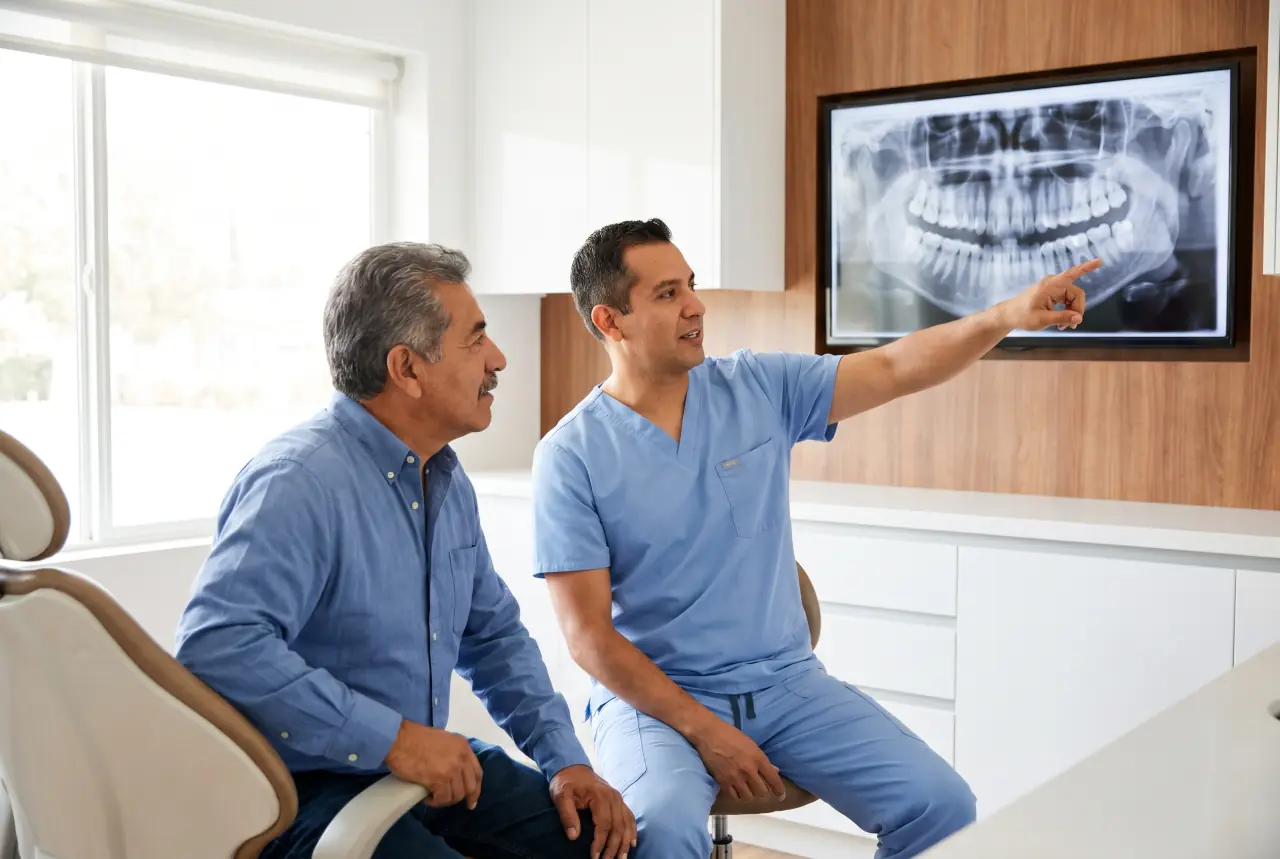
Choosing a dentist in Tijuana comes down to checks you can make before treatment starts: the dentist’s professional license, the training your treatment calls for, the clinic’s permits, and a written plan that says what each tooth gets, what it’s made of, how many visits it takes and what the price includes. You can look up the license online and settle the rest at your first exam.
Then plan the trip around the treatment, since lab time and healing can stretch it from one visit to several trips. Line up a dentist near home too, and bring back your X-rays and a record of the work.
At a glance
- Price
- Indicative implant, veneer and full-mouth ranges sit below U.S. ranges; see the price table
- Check first
- Each dentist’s professional license number in Mexico’s public registry, and the clinic’s notice of operation and health license
- Visits
- A crown usually takes 2; a root canal usually 1 or 2, then a follow-up; implants take months
- What can’t be undone
- Preparing a tooth for a crown or a veneer removes tooth structure, which can’t be undone, so settle each tooth’s plan first
- Sedation and the border
- Laughing gas wears off almost at once; prescription sedation means you need a driver to take you home
Key takeaways
- Look up each dentist’s professional license number in Mexico’s public registry, and ask to see the clinic’s permits before you pay a deposit.
- Get the plan in writing, tooth by tooth: what each tooth gets, the material, the number of visits, what the price includes and the terms for repairs.
- Ask your dentist at home to send recent X-rays, and bring back copies of everything taken or done in Tijuana.
- Match the trip to the treatment: leave room for lab time and a bite check, and arrange a ride back if you’ll be sedated.
- Line up a dentist near home before you go, and tell them what’s planned so they can look after the work afterward.
In this guide
- Crowns, root canals, implants and other common treatments
- A general dentist or a specialist: who should treat you?
- How to check the dentist’s license and the clinic’s permits
- What your first exam should include
- Your written plan and estimate, tooth by tooth
- How much does dental work in Tijuana cost?
- Day trip or longer stay? Matching visits to the treatment
- Crossing the border for dental appointments
- Risks of dental work, and what you can do about each
- Follow-up at home: find a dentist before you go
- Questions to ask a dentist in Tijuana
- Before you go: checklist
- Warning signs after dental work
- Frequently asked questions
- Sources
Crowns, root canals, implants and other common treatments
Dental care is the most common form of medical tourism among U.S. residents, and Mexico is among the countries they most often travel to (CDC Yellow Book). What each common treatment does:
| Treatment | What it does | Before you agree |
|---|---|---|
| Crown | A tooth-shaped cap that replaces the tooth above the gum line, to support a weak tooth or improve its look (MedlinePlus) | Preparing the tooth shaves away some of its structure, and that removal can’t be undone (UK General Dental Council blog); see veneers vs. crowns |
| Root canal | Removes the nerve from a badly damaged or infected tooth and seals the canals, to save the tooth instead of pulling it (ADA) | Ask whether the tooth will need a crown afterward |
| Implant | A post in the jawbone in place of a tooth’s root, topped by a crown, bridge or denture | Healing takes months; see how long implants take |
| Veneer | A thin covering bonded to the front surface of a chipped, stained, crooked or misshapen tooth, which can also mask gaps (ADA) | Enamel is removed to place one, so the treatment can’t be undone (ADA); ask whether whitening, bonding or aligners could work instead |
| Bridge | Fills a gap created by missing teeth; crowns can be used to attach it (MedlinePlus) | Ask which teeth would be crowned to hold it |
| Dentures | Removable teeth, put in the day the remaining teeth come out (immediate) or after the tissues heal, which may take several months (conventional) (ADA) | Follow-up visits check and adjust the fit, and immediate dentures may need relining or remaking once the jaw has healed |
| Cleaning | Removes tartar, which only a dentist or dental hygienist can do; gum disease may need a deep cleaning called scaling and root planing (NIDCR) | Early gum disease can often be reversed with daily brushing and flossing |
Your dentist decides what each tooth needs after examining you; when a plan would replace many teeth, weigh it against fixed bridges, overdentures and dentures.
A general dentist or a specialist: who should treat you?
Why it matters: some treatments are often handed to dentists with extra training, so knowing who does each step tells you whose license and experience to check.
A general dentist may do a root canal or refer you to an endodontist, who specializes in the pulp, the soft tissue inside the tooth that holds its nerves and blood vessels, and the tissues around it (ADA). For gum disease, your dentist may refer you to a periodontist, a specialist who may offer treatments your dentist doesn’t (NIDCR). Extractions are usually done by a general dentist, an oral surgeon or a periodontist, and complex ones often by an oral surgeon (MedlinePlus). Prosthodontists, who specialize in replacing teeth, are covered in who should do full-arch work.
A crown is often made in a dental lab from an impression of your tooth (MedlinePlus). Under NOM-013-SSA2-2015, Mexico’s national standard for oral health, dental technicians work to the dentist’s instructions and may not carry out clinical procedures on their own (NOM-013-SSA2-2015, in Spanish).
How to check:
- Ask who will examine you, do each procedure, and fit and adjust the finished work, and get each dentist’s full name.
- For a root canal, gum treatment, extraction or implant, ask whether a specialist will do it, and how often they do it.
- If someone presents as a specialist, ask where they trained and for their specialty license number (cédula de especialidad), and look that up too.
How to check the dentist’s license and the clinic’s permits
Why it matters: dentists in other countries might not face the same licensure oversight as U.S. dentists (CDC Yellow Book), and in Mexico you can check the license and the clinic’s paperwork yourself.
The dentist. Practicing dentistry in Mexico takes a professional degree and a cédula profesional, the professional license number (NOM-013-SSA2-2015, in Spanish). How to check a dentist and clinic in Mexico walks through the registry lookup, and how to check a dentist in Mexico adds questions on experience and language.
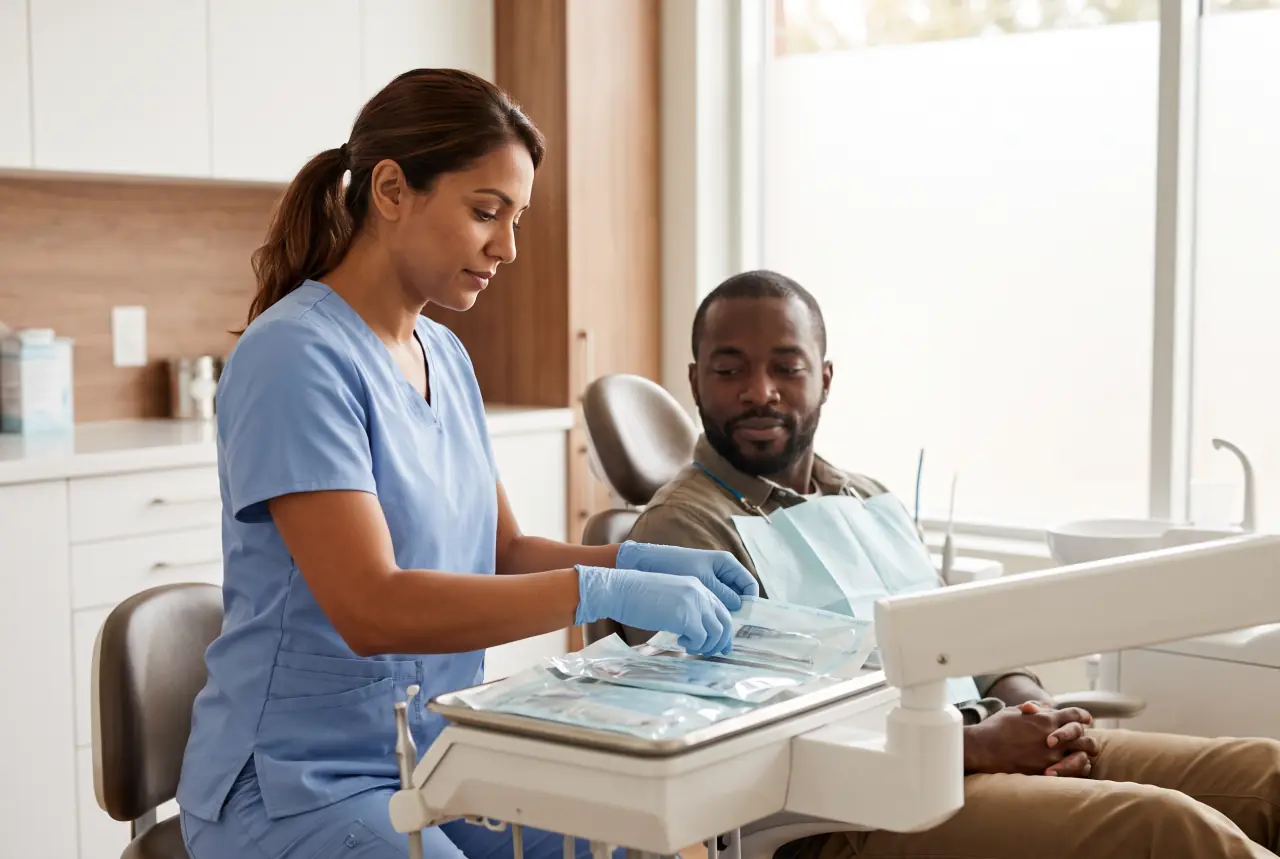
The clinic. On a 2016 page, COFEPRIS, Mexico’s Federal Commission for Protection against Health Risks, says every health establishment must file a notice of operation (aviso de funcionamiento) with the health authority and name a person responsible for health compliance (responsable sanitario), whether or not it also needs a health license (licencia sanitaria) (COFEPRIS, in Spanish). Not every clinic may have its paperwork in order, so ask to see it; how to check a clinic’s health license covers what Baja California expects offices to display and what to compare.
Infection control. The oral-health standard calls for staff to wear new disposable gloves and a new surgical mask with every patient, sterile needles and new anesthetic cartridges for each patient, only sterile instruments, an autoclave (a steam sterilizer) for the drill’s handpieces, and a biological test of sterilization every 2 months, with the results recorded (NOM-013-SSA2-2015, in Spanish).
A license you’ve looked up and paperwork that matches the address are a strong starting point; they’re one part of a sound plan, along with a written treatment plan and a dentist near home.
How to check:
- Look up the cédula of each dentist who will treat you before you pay a deposit.
- Ask to see the clinic’s notice of operation and health license, and check that the name and address match where you’ll be treated.
- Ask how instruments and handpieces are sterilized, whether gloves, needles and cartridges are new for you, and when the sterilizer was last tested.
What your first exam should include
Why it matters: a plan is only as good as the exam behind it, and X-rays can reveal damage or disease that isn’t visible when the dentist looks in your mouth (ADA).
Under Mexico’s oral-health standard, your dental record starts with a clinical history, including past illnesses and any tobacco, alcohol or other substance use, and an exam of your mouth, head and neck with your vital signs. It adds an initial chart of your teeth and gums (an odontogram and periodontogram), any tests ordered, with their interpretation, a diagnosis, and a treatment plan that sets out the procedures in each phase (NOM-013-SSA2-2015, in Spanish).
- X-rays. If your dentist at home has recent images, the new dentist may ask for copies instead of taking new ones, and both offices can help forward them (ADA).
- Gums. A tiny ruler called a probe measures the pockets around each tooth; healthy pockets are usually 1 to 3 millimeters deep, and X-rays can show bone lost to gum disease (NIDCR).
- Your health. An extraction can let bacteria into the bloodstream, so mention conditions that may make you prone to infection, such as heart or liver disease, a weakened immune system or recent surgery, including joint procedures with metal hardware (MedlinePlus). Some heart conditions, including artificial heart valves, and knee or hip replacements may call for antibiotics before invasive dental procedures (ACP).
How to check: ask your dentist at home to send recent X-rays, bring a list of your medicines, supplements and health conditions, ask which X-rays will be taken and for copies, and get the diagnosis and plan in writing before treatment starts.
Your written plan and estimate, tooth by tooth
Why it matters: the written plan shows exactly what you’re agreeing to and paying for, and it becomes the record a dentist at home will need.
The same standard requires a plain-language consent letter and lets you ask for a clinical summary of your record; getting your plan, consent and records in writing covers both. For crowns, the material changes how a tooth looks, wears and holds up:
| Crown material | Strengths | Trade-offs |
|---|---|---|
| Metal | Holds up to chewing and grinding, rarely chips and lasts the longest | Doesn’t look natural in color |
| Resin | Costs less than other crowns | Wears down sooner, is weaker and is prone to cracking |
| Ceramic or porcelain | Matches the color of your other teeth, and may suit you if you have a metal allergy | Wears down the opposing teeth more than metal does |
| Porcelain fused to metal | Porcelain over a metal cap, called a coping | The porcelain is more prone to fracture than an all-porcelain crown |
Source: MedlinePlus.
How to check: ask for the plan and a written, itemized estimate before treatment starts, and go through these lines:
| Line | What to ask |
|---|---|
| Each tooth | What does each tooth get, in which material, and why? |
| Work needed first | Does any tooth need a filling, root canal or gum treatment before the main work? |
| X-rays and temporaries | Are the X-rays and any temporary crown or denture included? |
| The lab | Is the work made here or in a lab, and how many days does that take? |
| Fitting and bite | Are adjustments after fitting included, and when will you check my bite? |
| Sedation and medicines | Which anesthesia or sedation, and which prescriptions, does the price include? |
| Follow-up | Which follow-up visits are included, and where do they happen? |
| Repairs | Is there a written warranty or guarantee? How long does it last, what does it cover, and who pays for travel if a crown comes off or breaks? |
| Records | Will I leave with a clinical summary, my X-rays and the material used on each tooth? |
Before you commit, show the plan to your dentist at home: a dentist who knows your history can guide you (ADA).
How much does dental work in Tijuana cost?
Why it matters: two estimates for the same mouth can include different work, so compare what each line pays for rather than the totals.
| Treatment | Tijuana (USD) | United States (USD) |
|---|---|---|
| Dental implant, per tooth | $800 – $1,600 | $3,000 – $6,000 |
| Porcelain veneer, per tooth | $400 – $800 | $1,000 – $2,500 |
| Full-mouth restoration | $18,000 – $28,000 | $40,000 – $80,000 |
Uriym’s indicative ranges from its treatment costs page, reviewed September 7, 2026. They are not quotes and cover the listed treatment only, without taxes, travel or third-party charges.
For crowns, root canals, bridges, dentures and cleanings, ask each clinic for a written, itemized estimate, priced tooth by tooth and visit by visit, before you compare. The treatment guides break down the lines for implants, veneers and full-arch bridges. Some overseas facilities charge substantial fees for follow-up care on top of the base price, so ask for a line listing what the estimate leaves out (CDC Yellow Book).
Care abroad is usually paid for out of pocket (CDC Yellow Book). If your dental plan does pay for treatment outside the U.S., ask your insurer or employer to confirm that follow-up treatment back home is covered too (ADA).
How to check: get the estimate in U.S. dollars, then see what a medical tourism quote should include, how to pay for care in Mexico and what U.S. coverage pays for abroad.
Day trip or longer stay? Matching visits to the treatment
Why it matters: lab time and healing between visits decide whether you cross once, stay a few nights or come back weeks or months later.
| Treatment | Visits | What to plan for |
|---|---|---|
| Root canal | Usually 1 or 2, then a follow-up to replace the temporary filling with a permanent filling or crown (ADA) | Ask whether any crown can be finished before you leave |
| Crown | Usually 2: preparation and a temporary crown, then the permanent crown is cemented; some dentists make crowns in their office from a digital scan (MedlinePlus) | Lab days between visits; see lab time for crowns and veneers |
| Extraction | You may go home shortly afterward; the socket heals in 1 to 2 weeks (MedlinePlus) | Soft foods, chewing on the other side, and no straws for at least 24 hours |
| Dentures | For immediate dentures, an earlier visit for measurements; then follow-up visits to check and adjust the fit (ADA) | Ask whether the first adjustments happen before you go home |
| Implants | Months between surgery and the final teeth | How long implants take; for a full arch, how many trips All-on-4 takes |
| Gum treatment | The number and type of treatments vary with how far the disease has gone (NIDCR) | Ask whether other work waits until the gums are treated |
Surgical dental work can need months of healing, which belongs in your travel plans from the start (ADA). After a crown or bridge, stay close enough to go back for a bite check. A day trip suits an exam and a plan to take home and think over, or work your dentist confirms can be done in one visit.
How to check: before you book travel, get the schedule in writing: how many visits, how many days apart, where the lab is, when your bite is checked, and which visits must happen in Tijuana.
Crossing the border for dental appointments
Why it matters: every visit ends with a crossing back into the U.S., and how you feel after treatment decides whether you drive, walk the line or need a ride.
After an extraction, numbness in your lips and cheek wears off in a few hours (MedlinePlus). Nitrous oxide, or laughing gas, wears off almost at once and lets you drive home afterward; prescription sedation, including sedation through a vein, requires good general health and a driver to take you home (ACP). For antibiotics or pain medicine you’re given, see medicine prescribed after a procedure in Mexico.
For U.S. citizens, a passport book or passport card works in both directions by land; see documents for each direction. The same guide covers:
- Timing an appointment around the border, so you head back while your lane is open
- Checking wait times at San Ysidro and Otay Mesa before you leave the clinic
- Faster lanes, if your treatment means several trips
- What to carry and declare
- Crossing back after a procedure, including the line and the walk
For the rest of the trip, from how long to stay to getting home, see medical tourism in Tijuana.
How to check: ask which anesthesia or sedation you’ll have and whether you’ll be fit to drive or walk back across, and if you’ll be sedated, arrange a driver.
Risks of dental work, and what you can do about each
Why it matters: each risk below is paired with something you can do, and several of those steps happen before you leave the clinic.
Any procedure carries some risk, and complications can occur wherever treatment is received (CDC Yellow Book). After surgical dental procedures, the risks include bleeding, pain, swelling and infection (ADA).
| Risk | What it is | What you can do |
|---|---|---|
| Infection | Infections are the most common complications among medical tourists, and lapses in infection control can spread blood-borne infections such as hepatitis B, hepatitis C and HIV (CDC Yellow Book) | Ask the sterilization questions first, and ask your doctor whether your routine vaccines are current, especially hepatitis B (CDC Yellow Book) |
| A crown that fails | It can fall off if the core of the tooth holding it is too weak, it can chip or crack, and the tooth under it can still decay (MedlinePlus) | Ask how sound each tooth is; if you grind or clench, ask about a bite splint or mouth guard at night; brush twice a day and floss once a day |
| An unfinished root canal | The temporary filling protects the tooth until a permanent filling or crown can be placed, at the earliest opportunity (ADA) | Agree before you leave when and where that will happen |
| A bite that’s off | A new crown takes a few days to get used to, and a bite that doesn’t feel right is a reason to contact your dentist (MedlinePlus) | Book a bite check before you go home, and speak up if anything feels high or uneven |
| Sensitivity | A crowned tooth that keeps its nerve may be sensitive to heat or cold for a while, and a nerve that becomes extra sensitive and painful may need a root canal (MedlinePlus); after a root canal, the area may feel sensitive for a few days (ADA) | Ask what to expect, and report sensitivity that gets worse or doesn’t fade |
| An implant your dentist at home can’t identify | With more than 300 implant makers worldwide and more dental tourism, patients often arrive at dentists with implants of unknown origin, design and composition, and identifying them affects maintenance and the handling of complications (ACP) | Get the implant’s brand and model, each tooth’s material and the lab in writing, with copies of your X-rays |
| Fewer options if something goes wrong | Medical tourists might not have the same legal recourse as they would after care in the U.S. (CDC Yellow Book) | Keep the plan, estimate and repair terms in writing, and know the official complaint routes in Mexico |
How to check: before treatment, talk through who would handle a complication, and how, with both the dentist in Tijuana and your dentist at home (CDC Yellow Book).
Follow-up at home: find a dentist before you go
Why it matters: continuity of care is worth weighing when you choose treatment, and a dentist near home who knows your history can catch problems early, when treatment is simpler (ADA).
Consider arranging follow-up with a U.S. dentist before you travel; if you don’t have one, the American Dental Association’s Find-a-Dentist search can point you to a member dentist nearby (ADA). Ask both dentists how your records will cross the border, since transfers to and from facilities outside the U.S. should be consistent with U.S. privacy and security guidelines (ADA). Copies of your records in English help anyone who treats you later (CDC Yellow Book). With dentures, regular checkups show whether they still fit (ADA); for implants, see caring for implants at home.
How to check: before you go, tell your dentist at home what’s planned and ask whether they’ll see you for checks and adjustments; before you leave Tijuana, collect a clinical summary, your X-rays, each tooth’s material and lab, any implant’s brand and model, and your prescriptions.
Questions to ask a dentist in Tijuana
- What does each tooth need, what are the options, and why do you recommend this one?
- Who will do each step, and may I have each dentist’s full name and cédula number?
- Which material will you use, and is the work made here or in a lab?
- How many visits will I need, how many days apart, and when will you check my bite?
- Which anesthesia or sedation will I have, and can I drive or walk back across the border afterward?
- What does the estimate include, and is there a written warranty or guarantee on the work?
- If something comes loose or breaks after I’m home, who repairs it, and who pays for the travel?
- How are instruments sterilized, and when was the sterilizer last tested?
Before you go: checklist
- Each dentist’s cédula looked up, plus any specialty cédula
- The clinic’s notice of operation and health license seen, at a matching address
- Recent X-rays sent from home or packed, with a list of your medicines and conditions
- A written plan, tooth by tooth, with materials, visits and an itemized estimate
- Repair terms in writing, including who pays for travel
- A visit schedule that allows for lab time and a bite check
- A driver arranged if you’ll be sedated, and your crossing times planned
- A dentist at home lined up, and your insurer asked about follow-up treatment
- The State Department’s current travel advisory read; see what it says about Tijuana
- The warning signs below read, and the clinic’s contact details saved
Warning signs after dental work
In an emergency, call 911, which works in the United States and in Mexico, and then let the dentist who treated you know.
| What you notice | What to do |
|---|---|
| Swelling under the tongue or in the neck that comes on fast, with trouble swallowing or breathing, drooling, fever or neck pain | Breathing difficulty is an emergency: go to the emergency room or call 911 right away. Otherwise, contact your provider: these can be symptoms of Ludwig angina, an infection of the floor of the mouth that often follows a tooth infection and can swell quickly enough to block the airway (MedlinePlus) |
| After an extraction: fever or chills, severe swelling or pus from the socket, pain or heavy bleeding that continues several hours later, pain days later because the blood clot has come out, a rash or hives, trouble swallowing, or a cough, shortness of breath or chest pain | Call your dentist or oral surgeon (MedlinePlus) |
| After a crown: swelling that keeps getting worse, a bite that feels wrong, a lost temporary crown, a tooth that seems out of place, or pain that over-the-counter medicine doesn’t ease | Contact your dentist (MedlinePlus) |
| After a root canal: discomfort you need help relieving, or problems taking an antibiotic you were prescribed | Talk to your dentist (ADA) |
| New dentures: irritation or soreness that doesn’t go away | Consult your dentist (ADA) |
| An implant that feels loose or painful | See warning signs after implant surgery |
Where a sign appears in more than one row, such as trouble breathing or swallowing, follow the more urgent advice; that’s our practical rule, not a source’s.
Don’t put off care for a problem that starts after you’re home: getting care promptly can lead to earlier diagnosis and treatment, and a better outcome (CDC Yellow Book). Tell whoever treats you what was done, where and when, and bring your records.
Frequently asked questions
Is it safe to go to a dentist in Tijuana?
It depends on things you can check before treatment starts: the dentist’s license and training for your treatment, the clinic’s permits and sterilization, a written plan, and a dentist at home for follow-up. Any procedure carries some risk, and complications can occur wherever treatment is received (CDC Yellow Book). Each risk is paired with a step in risks and what you can do, and the travel advisory is in whether surgery in Mexico is safe.
How much does dental work cost in Tijuana?
Uriym’s indicative ranges for Tijuana are $800 to $1,600 per dental implant, $400 to $800 per porcelain veneer and $18,000 to $28,000 for full-mouth restoration, compared with $3,000 to $6,000, $1,000 to $2,500 and $40,000 to $80,000 in the U.S. These ranges are indicative, not quotes. For crowns, root canals, bridges, dentures and cleanings, ask each clinic for a written, itemized estimate; the lines to check are in your written plan and estimate.
How much is a crown in Tijuana?
It depends on the tooth, the material and what the price includes, so ask for a written, itemized estimate before you compare. Crowns can be metal, resin, ceramic or porcelain, or porcelain fused to metal, and each differs in how it looks, wears and holds up (MedlinePlus). Ask whether the price covers the X-rays, any filling or root canal the tooth needs first, the temporary crown, the lab, the fitting and bite check, and a repair if it comes off.
Do I need a passport to cross back from Tijuana?
You need a passport or another accepted document. For U.S. citizens, a passport book or passport card works in both directions by land, and the documents table in our border guide lists the others accepted on the way back, including what children under 16 need. For sedation and the ride home, see crossing the border for dental appointments.
Can I get dental work done in one day in Tijuana?
Some of it. A root canal usually takes 1 or 2 visits, plus a follow-up for the permanent filling or crown (ADA), and a crown usually takes 2 visits, though some dentists can scan the tooth and make the crown in their office (MedlinePlus). Dentures need fittings and adjustments, and implants take months. Ask for the schedule in writing before you book travel; see day trip or longer stay.
Will my dental insurance pay for a dentist in Tijuana?
Ask your plan before you go. Care abroad is usually paid for out of pocket, so check what, if anything, your plan covers outside the U.S. (CDC Yellow Book), and whether it would pay for follow-up treatment at home (ADA). For Medicare and private plans, see what U.S. coverage pays for abroad, and for cards, cash and deposits, paying for care in Mexico.
What should I do if a crown feels wrong after I get home?
Contact the dentist who placed it, and tell your dentist at home. A bite that doesn’t feel right, a lost temporary crown, swelling that’s getting worse, or pain that over-the-counter medicine doesn’t relieve are all reasons to contact a dentist after a crown (MedlinePlus). Before treatment, ask whether repairs are covered for a set period and who pays for travel, and keep the answer in writing; see warning signs.
Sources
- Root Canals MouthHealthy, American Dental Association
- Dentures MouthHealthy, American Dental Association
- X-rays MouthHealthy, American Dental Association
- Veneers MouthHealthy, American Dental Association
- Travel MouthHealthy, American Dental Association
- Dental crowns MedlinePlus, U.S. National Library of Medicine
- Tooth extraction MedlinePlus, U.S. National Library of Medicine
- Ludwig angina MedlinePlus, U.S. National Library of Medicine
- Heavy is the Head: Complaints about dental crowns – sharing insights and learning (blog for dental professionals by Shamir B. Mehta, Lead Clinical Adviser, Fitness to Practise; September 10, 2026) General Dental Council (UK)
- Periodontal (Gum) Disease National Institute of Dental and Craniofacial Research (NIDCR), National Institutes of Health
- Preparing for Dental Treatment American College of Prosthodontists (GoToAPro)
- Novel Method of Identifying Unknown Dental Implants Via 3D Scan Data Matching (summary of a 2025 Journal of Prosthodontics study) American College of Prosthodontists
- Medical Tourism (CDC Yellow Book 2026) U.S. Centers for Disease Control and Prevention
- NORMA Oficial Mexicana NOM-013-SSA2-2015, Para la prevención y control de enfermedades bucales (in Spanish) Secretaría de Salud, Diario Oficial de la Federación (copy hosted by the Secretaría de Economía)
- Aviso de Funcionamiento, Responsable Sanitario y otros, para Establecimientos que ofrecen Servicios de Salud (in Spanish) COFEPRIS
About this guide
The Uriym editorial team researched this guide from the 15 sources above, drafted it with AI assistance, and checked it claim by claim against those sources before publishing, last on . Our editorial standards explain how we choose sources, handle prices and make corrections.
Uriym is a healthcare navigation platform, not a medical provider. Its founder, Adriana Mendez, grew up in a family that traveled to Mexico for care and has done it herself for the past ten years. How Uriym works
This is general information, not medical, legal or financial advice: your treating provider decides what care is right for you. Rules, prices and advisories change, so check the official page before you act. Found something wrong or out of date? Email support@uriym.com.