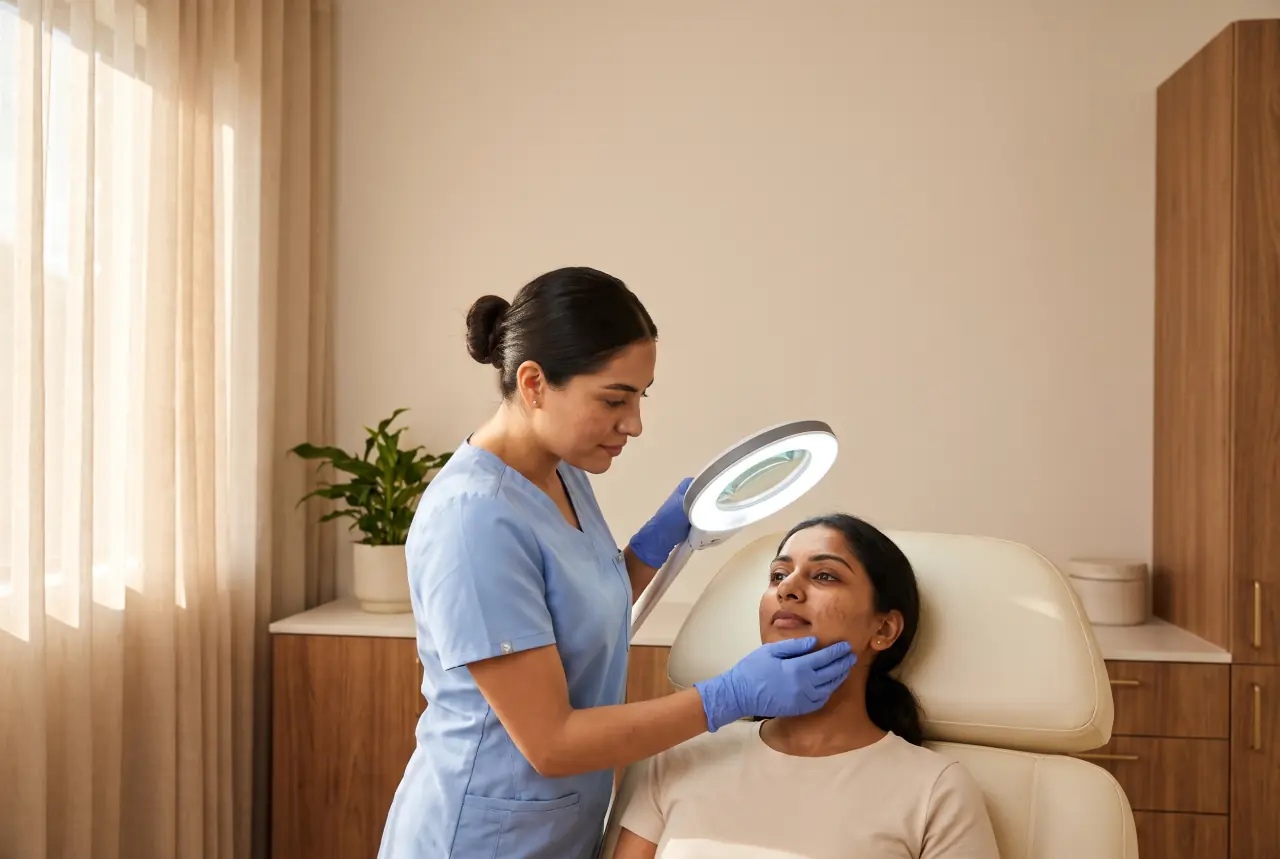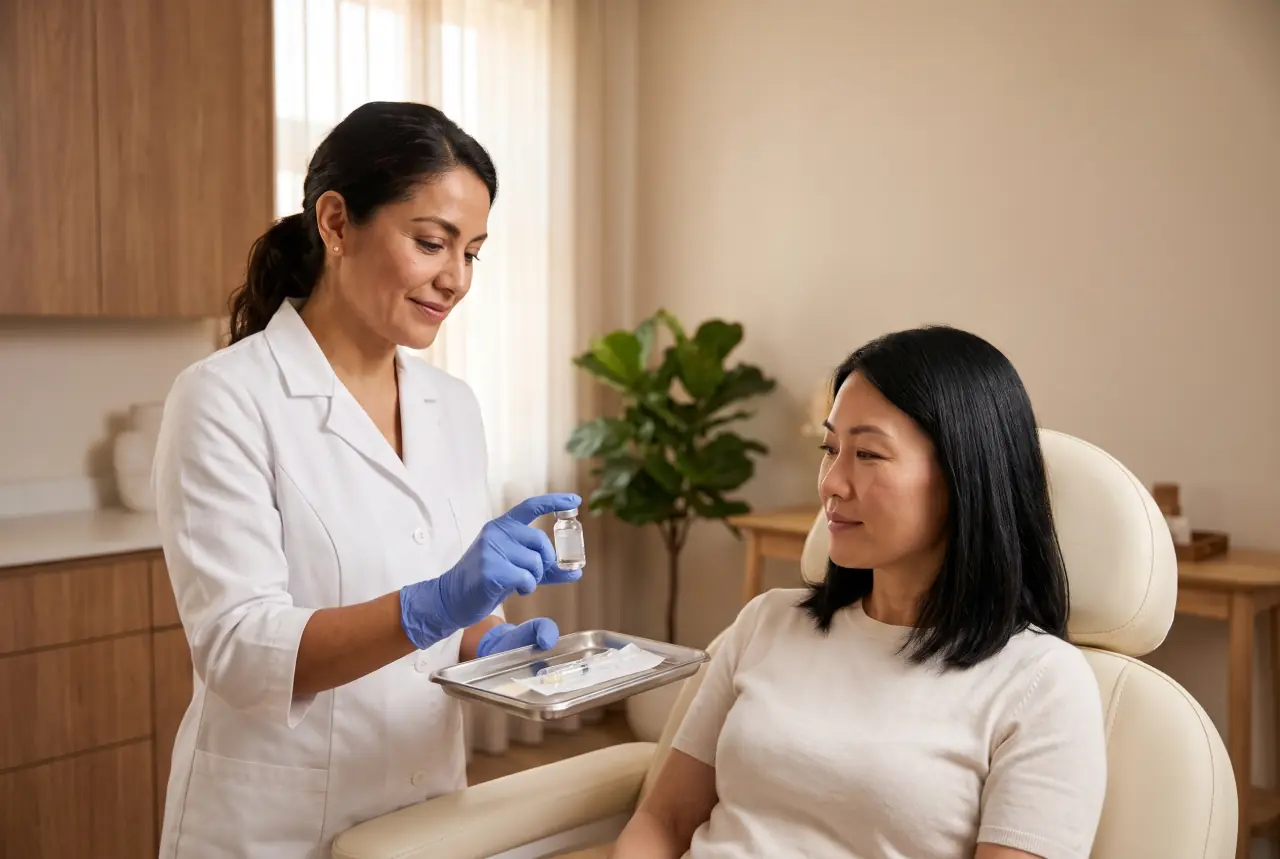
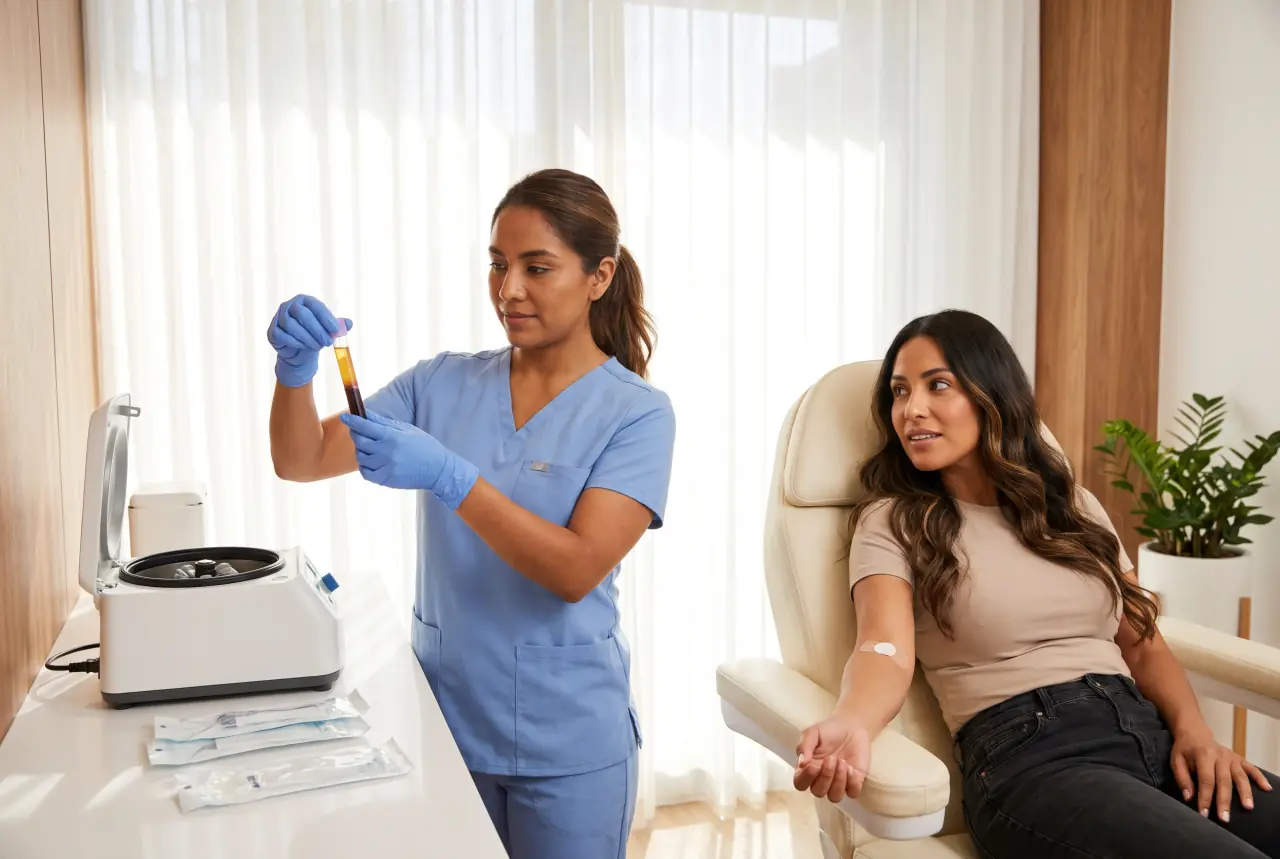
Platelet-rich plasma (PRP) is plasma, the liquid part of your own blood, with a high concentration of platelets (ASPS). A PRP facial in Mexico, often called a vampire facial, can be a well-planned choice when four things check out: the clinic is licensed; every needle, tube and cartridge that touches your blood or skin is new, sterile and opened in front of you, and your blood is labeled and used only for you; a licensed professional trained in the treatment reviews your health and treats you; and your expectations match the evidence, which is still limited.
You can check most of this with a few questions before you pay a deposit, and the rest by watching the treatment room on the day. Your provider decides whether the treatment suits your skin and health.
At a glance
- Price
- Below U.S. ranges in Tijuana; see the price table
- What it is
- Your own blood, spun to concentrate its platelets, then applied after microneedling or injected
- Procedure time
- About 45 minutes to an hour for the whole procedure
- Sessions
- Still an open question for dermatologists; most patients who get results have 3 or more treatments
- Downtime
- Little to none; pain, bruising and swelling tend to go away within a few days
- Check first
- The clinic’s health license, and new needles, tubes and cartridges opened from sealed packs in front of you
Key takeaways
- Ask to see the clinic’s notice of operation or health license before you pay a deposit, and choose a clinic that can show one.
- Watch every needle, tube and microneedling cartridge come out of a sealed package, and ask how your blood is labeled so only yours goes back in.
- Ask who will draw your blood and treat your face, look up their professional license numbers, and ask how often they do this treatment.
- Tell the clinic about any blood thinner, bleeding disorder, skin infection, cold sores or pregnancy before you book.
- Get the method, the number of sessions, the weeks between them and what each includes in writing, and agree how you’ll judge the result.
In this guide
- What a PRP facial is, and what the evidence shows
- How your blood and the needles should be handled
- How PRP facials are regulated in the U.S. and Mexico
- Who draws your blood and treats you, and how to check them
- Who a PRP facial may not suit, and what to tell the provider
- How many sessions, how much downtime, and when results may show
- Risks of a PRP facial, and what you can do about each
- How much does a PRP facial in Mexico cost?
- Questions to ask before your PRP facial
- Before you go: checklist
- Warning signs after a PRP facial
- Frequently asked questions
- Sources
What a PRP facial is, and what the evidence shows
Platelets are blood cells that help blood clot and start wound healing, and they release more than 30 growth factors and other proteins; that mix likely explains the benefits reported with PRP (ASPS). A PRP facial has three steps:
- Blood draw. A small amount of blood, about 2 to 4 tablespoons, is taken from your arm (AAD).
- Spinning. The tube goes into a centrifuge, a machine that separates the blood into layers. The red blood cells are removed, leaving plasma with a high concentration of platelets (AAD; ASPS).
- Back into your skin. In a vampire facial, the skin is microneedled first, which makes many tiny punctures, and the PRP is applied on top. PRP can also be injected with a syringe (ASPS; AAD; FDA).
The whole procedure takes about 45 minutes to an hour, and some providers add a filler for a more immediate effect (AAD). Whatever the clinic calls its treatment, ask which steps it includes; if a filler is added, the checks in checking Botox and fillers in Mexico apply.
What the evidence shows
Research on PRP for the face is limited, and its findings are mixed; the American Academy of Dermatology (AAD) still calls it “an unproven treatment” for younger-looking skin (AAD).
| Question | What the research found |
|---|---|
| Does PRP rejuvenate facial skin? | The evidence is insufficient for firm conclusions about PRP, alone or with other treatments, in an overview of 13 systematic reviews; most of the studies behind them had no comparison group (Cruciani et al., 2024) |
| How much do injections improve aging skin? | Modest improvement in appearance, texture and lines, at least for a time, in a 2020 review of 24 studies, most convincingly for texture (Maisel-Campbell et al., 2020) |
| What did a randomized trial find? | One cheek got a single treatment of PRP injections and the other sterile salt water (saline); dermatologists who didn’t know which was which saw no significant difference, while the 19 patients analyzed rated texture and wrinkles as more improved on the PRP side at 6 months (Alam et al., 2018) |
| Does PRP help microneedling for acne scars? | Adding PRP was linked to more improvement and higher satisfaction than microneedling without PRP in a 2022 meta-analysis of 14 controlled studies, though 10 weren’t randomized and the best way to prepare PRP is unknown (Kang and Lu, 2022) |
These are findings across groups of patients, not a prediction for you; ask your provider what they’d expect for your skin. If texture or acne scars are your main concern, ask too how PRP compares with other options: lasers, other energy-based devices, chemical peels and dermal fillers are among the alternatives to microneedling that the U.S. Food and Drug Administration (FDA) asks providers to discuss (FDA). CO2 (carbon dioxide) laser resurfacing and radiofrequency microneedling such as Morpheus8 each have their own guide.
How your blood and the needles should be handled
Why it matters: the treatment breaks your skin and puts your own blood back into it, so sterile, single-use equipment and careful handling of your sample are central to a safe plan.
Most health care providers follow safe injection practices, and unsafe ones are uncommon. A needle or syringe should be used only once, on one patient, and then thrown away, because reusing injection equipment can spread hepatitis B and C, bacterial and fungal infections and possibly HIV (human immunodeficiency virus) (CDC).
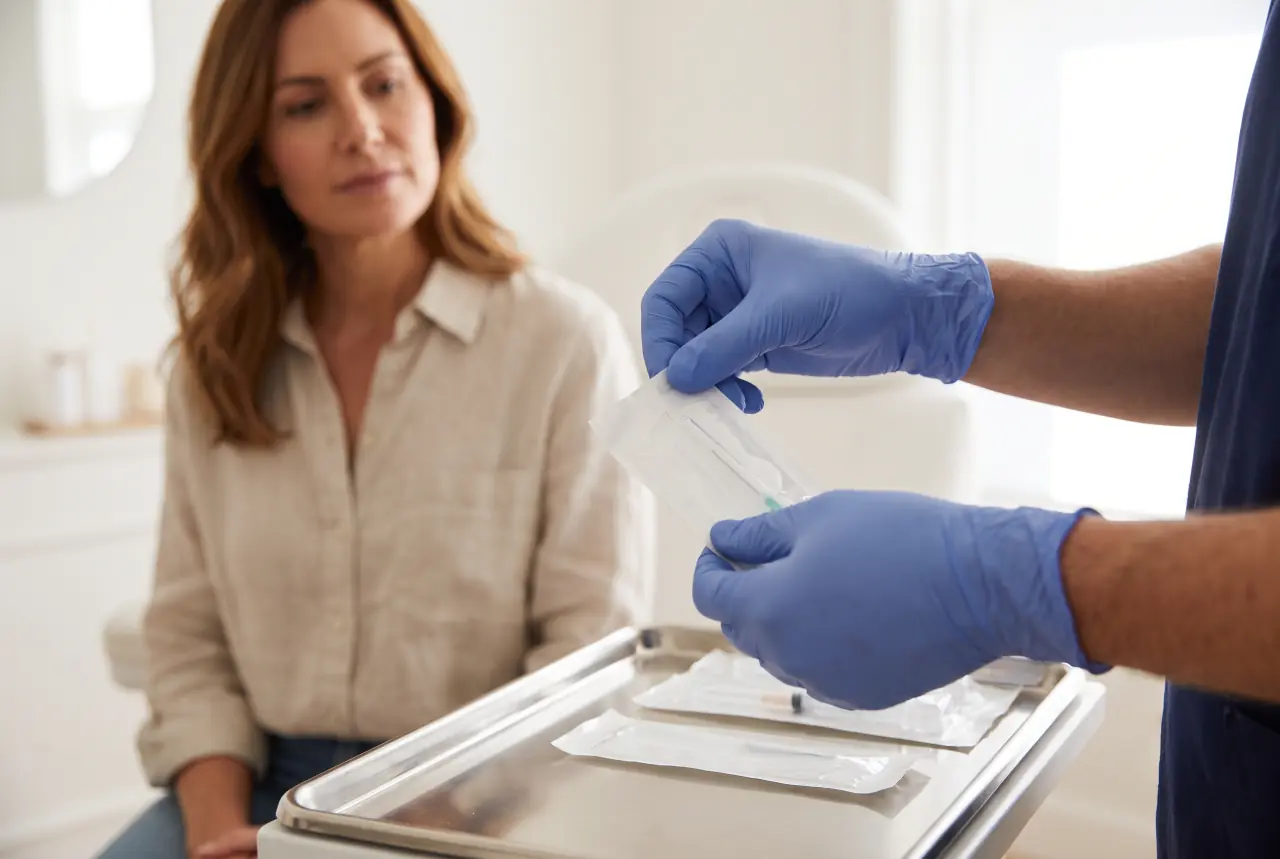
The biggest risks come from how your blood is handled, in the AAD’s view: it must be kept sterile, or you could develop an infection, and the clinic should follow the same process transfusion centers use to make sure your own blood, and no one else’s, goes back into you (AAD). Each patient, and each session, should get a new microneedling cartridge; reusing one is unsafe even after cleaning (FDA).
What a 2024 investigation found
In April 2024, the Centers for Disease Control and Prevention (CDC) and New Mexico’s health department reported the first investigation to link HIV transmission to nonsterile cosmetic injection services (CDC report). It concerned an unlicensed spa in New Mexico, the U.S. state, that offered PRP microneedling facials. Five people were found with highly similar HIV strains: four women who’d had the facial there in 2018, and the sexual partner of one of them, who never received any services at the spa. That couple’s infections likely came from exposures before the spa services. For the other three, the evidence suggests HIV was transmitted through contamination at the spa, from a source that remains unknown.
An inspection of the spa in fall 2018 found:
- a centrifuge and a rack of unlabeled tubes of blood on a kitchen counter
- unlabeled tubes of blood, and injectable medicines, in the kitchen refrigerator with food
- unwrapped syringes in drawers and on counters, and syringes thrown in ordinary trash cans
- no autoclave (steam sterilizer) on the premises
- disposable device tips cleaned by soaking in alcohol and used again
The spa also had no appointment system that stored clients’ contact details, so investigators pieced together a client list from consent forms, handwritten appointment records and phone contacts. For a sense of scale, 198 former clients and their sexual partners were tested from 2018 to 2023; no further HIV infections were found, and no hepatitis B or C (CDC report).
The report’s recommendations are written for public health practice: requiring adequate infection control at spas offering cosmetic injections can help prevent the spread of HIV and other bloodborne infections, and keeping client records allows clients to be traced and notified if problems arise.
How to check: before you book, and on the day:
- See the clinic’s notice of operation or health license before you book; checking a clinic’s health license shows how.
- Watch the needle for your blood draw, the PRP tube or kit, and the microneedling cartridge or syringes each come out of a sealed package.
- Ask how your tube will be labeled with your name, and how the clinic makes sure the plasma put back into you is yours.
- Ask where your blood will be spun and kept until it’s used, and expect a clinical area, not a kitchen.
- Check that used needles go into a biohazard container, not the trash, and that there’s a sink with soap near where you’re treated; keeping biohazardous waste out of the ordinary trash, and that sink, are on the self-check list that COFEPRIS, Mexico’s Federal Commission for Protection against Health Risks, publishes for aesthetic clinics (COFEPRIS self-check guide, in Spanish).
- Ask how the microneedling device is cleaned between patients (FDA).
- Make sure the clinic records your name, contact details and treatment; a daily patient register and a clinical record are on the same list, and they let a clinic reach you if a problem comes to light.
- If anything is reused, unwrapped or unlabeled, stop, and choose another licensed provider.
How PRP facials are regulated in the U.S. and Mexico
Why it matters: the FDA hasn’t reviewed microneedling with PRP, and we found no Mexican rule written for PRP facials, so the clinic’s license and equipment are what you can check.
In the U.S., specific microneedling devices are authorized to improve the look of facial acne scars, facial wrinkles and abdominal scars in patients aged 22 or older, but microneedling devices aren’t approved to deliver blood products such as PRP into the skin (FDA). No microneedling device has been cleared for use with PRP or any other product, so the FDA hasn’t reviewed the safety or effectiveness of combining them, and the risks of the combination aren’t known (FDA consumer update; FDA). The Morpheus8 guide covers what the FDA has cleared for microneedling.
The kit that makes the PRP is a separate device. One, described in a 2024 FDA clearance summary, is single-use and sterile, and concentrates blood components and helps separate them by density in a centrifuge; its cleared use is PRP mixed with bone graft material for orthopedic surgery, and the summary says the PRP it makes “has not been evaluated for any clinical indications” (FDA 510(k) summary).
In Mexico, COFEPRIS’s self-check guide for non-surgical aesthetic clinics lets a clinic check itself against the minimum the current rules require, and makes public the criteria applied in health inspections; the guide itself has no legal force and is meant to help clinics follow the health rules in force (COFEPRIS, in Spanish). Besides the hygiene and record points above, its list includes:
- a notice of operation (aviso de funcionamiento) and a notice naming the person responsible, matching the services the clinic offers
- the doctor’s professional degree, or the documents that prove it, on public display, and complete, current staff documents
- medicines and supplies within their expiry date, with a Mexican health registration (registro sanitario)
- operating manuals for the equipment, and the equipment on a maintenance program
Not every clinic may meet these points, so check the ones you can see.
How to check:
- Ask which PRP kit and which microneedling device the clinic uses, and for their Mexican registration numbers; checking a device’s registration shows the lookup. Check the kit’s expiry date too.
- Ask to see the doctor’s professional degree, and when the centrifuge was last serviced.
Who draws your blood and treats you, and how to check them
Why it matters: the people treating you draw your blood, prepare the plasma and work on your skin, so their licenses and training matter at every step.
Microneedling may be considered a medical procedure rather than a cosmetic one, and the FDA recommends choosing a provider trained to do it and asking about their training and experience (FDA). We found no Mexican rule naming which professions may perform a PRP facial. For Mexico’s official advice on checking who performs aesthetic treatments, and the free lookup of a professional license number (cédula profesional), see who may inject Botox and fillers in Mexico; the Morpheus8 guide’s who does the treatment adds questions for anyone using a microneedling device.
A checked license and real training in the procedure are a strong starting point. They’re one part of a safe plan, alongside sterile handling of your blood and a clear way to reach the clinic once you’re home.
How to check:
- Ask who will draw your blood, who will prepare the PRP and who will treat your face, and whether a doctor will treat you or supervise.
- Look up each person’s cédula profesional, using the steps linked above.
- Ask how often they do PRP facials, how they were trained, and how they’d handle a problem once you’re home.
Who a PRP facial may not suit, and what to tell the provider
Why it matters: some conditions and medicines can make PRP or microneedling a poor fit, or change the plan, so they belong in your first message to the clinic.
Your provider decides how each row applies to you.
| If this applies to you | What the sources say, and what to do |
|---|---|
| Hepatitis C, HIV or AIDS (acquired immunodeficiency syndrome), any type of blood cancer, or skin cancer in the area to be treated | PRP isn’t recommended (AAD). Talk it over with your doctor at home before you book |
| Heart or blood vessel disease that needs a blood thinner | PRP isn’t recommended (AAD). Tell the provider before anything is planned |
| A bleeding or clotting disorder, such as hemophilia, or a blood thinner such as warfarin, heparin or low-dose aspirin | Microneedling can cause bleeding, so it may not suit you (FDA consumer update; FDA). List every medicine and supplement, and ask the doctor who prescribed a blood thinner before changing it |
| An active skin infection, a rash on your face or a cold sore outbreak | On the FDA’s list of reasons microneedling may not suit you (FDA). Tell the provider, and ask whether to wait until it clears |
| Pregnancy or breastfeeding | Also on that list (FDA). Tell the provider before you plan sessions |
| Eczema, diabetes or a weakened immune system | You may want to avoid microneedling (FDA consumer update). Raise it at your consultation |
| An allergy to numbing medicines or to stainless steel | On the FDA’s list, and numbing medicine is typically applied before microneedling (FDA; FDA consumer update). Say so before anything goes on your skin |
Your skin type, recent sun, acne medicine such as isotretinoin and the rest of the FDA’s list for microneedling are in your skin type, the sun and your medicines, with what to do about each.
How to check: write down every medicine and supplement you take, any condition in the table and any past trouble with blood draws, and send the list before you book. Ask whether anything changes the plan.
How many sessions, how much downtime, and when results may show
Why it matters: the number of sessions decides how many trips you plan, and none of the sources we read sets a standard number.
How many treatments to give, and how far apart, are still open questions for dermatologists, though most patients who get results have 3 or more treatments (AAD). The acne scar studies in the 2022 meta-analysis used two to six sessions (Kang and Lu, 2022), and with microneedling in general an improvement may not last, so keeping it may take further procedures (FDA consumer update).
Sources differ on how long results last. The AAD’s page says results can last as long as 18 months (AAD). The 2020 systematic review found that how long the effects persist isn’t known (Maisel-Campbell et al., 2020).
| When | What to expect |
|---|---|
| During the procedure | About 45 minutes to an hour in all, including the blood draw (AAD) |
| The first few days | A bit of pain, bruising and swelling, which tend to go away within a few days, with little to no downtime (AAD) |
| Days to weeks, after microneedling | Bleeding, bruising, redness, tightness, itching and peeling typically go away without treatment; skin may be more sensitive to the sun and to skin care products (FDA consumer update) |
| Weeks to months | If you get results, the full effect appears (AAD) |
Ask your provider for your own timeline.
On a Tijuana trip, plan shade and sunscreen for the way home, border line included; see the sun after microneedling and timing an appointment around the border.
How to check: before you book, ask for a written plan: microneedled or injected, the number of sessions and the weeks between them, what to avoid afterward and for how long, and when you’ll judge the result together. Then book return trips you can move.
Risks of a PRP facial, and what you can do about each
Why it matters: most side effects of microneedling appear soon after treatment and resolve, though some can last a long time or be permanent (FDA), and each risk below has a step that lowers it or catches it early.
| Risk | What the sources say | What you can do |
|---|---|---|
| Infection | A less common risk of microneedling (FDA) | Use the checks in how your blood and the needles should be handled |
| Getting someone else’s blood back | You could become very sick (AAD) | Ask how your tube is labeled and tracked from the draw to your face |
| The blood draw itself | Slight pain or bruising where the needle went in, which usually passes quickly (MedlinePlus) | Tell the person drawing your blood about any past trouble with blood draws |
| Skin effects of microneedling | Dryness, redness, itching, peeling, bleeding and crusting are common; color changes, cold sore flare-ups and swollen lymph nodes are less common (FDA) | Tell the provider about cold sores and your skin type; see who it may not suit |
| A result you didn’t hope for | The evidence is limited and mixed; see what the evidence shows | Agree on goals, the number of sessions and how you’ll judge progress before you start |
How to check: ask which of these the provider sees most, how they’d treat each, and whom you’d contact once you’re home. Ask, too, about their plan if a complication appears, on site or by referral; keeping such a plan up to date is one of the FDA’s recommendations to microneedling providers (FDA). For planning beyond the clinic, see what can go wrong and how to plan for it.
How much does a PRP facial in Mexico cost?
Why it matters: a quote only compares fairly once you know whether it covers one session or a series, and whether the PRP is microneedled, injected or both.
| Treatment | Tijuana (USD) | United States (USD) |
|---|---|---|
| PRP facial | $350 – $800 | $1,000 – $2,500 |
Uriym’s indicative ranges from its treatment costs page, reviewed September 7, 2026. They are not quotes and cover the listed treatment only, without taxes, travel or third-party charges.
How to check: ask each clinic to quote the same way, then compare these lines.
| Line | What to ask |
|---|---|
| Method | Is the PRP applied after microneedling, injected, or both, and is a filler added? |
| Sessions | Is the price for one session or a series, and how many weeks apart are the sessions? |
| Numbing | Is numbing cream included? |
| Kit and needles | Is a new, sealed PRP kit and needle cartridge included for every session? |
| Aftercare | Which creams or sunscreen will I need afterward, and are they in the price? |
| Follow-up | Is a check-up included, and what does an extra session cost? |
To budget the travel around it, use the line items in what a medical tourism quote should include.
Questions to ask before your PRP facial
- Can I see your notice of operation or health license?
- Who will draw my blood, prepare the PRP and treat my face, and what are their license numbers?
- Which PRP kit and microneedling device do you use, and what are their Mexican registration numbers?
- Will I see each needle, tube and cartridge opened from a sealed package?
- How is my tube labeled, where is it spun, and how do you make sure only my own plasma goes back in?
- Will the PRP be microneedled, injected or both, and will you add a filler?
- How many sessions do you suggest, how many weeks apart, and what does each one include?
- What should I avoid afterward, and whom do I contact once I’m home?
Before you go: checklist
- Clinic’s notice of operation or health license seen
- License numbers of everyone treating you looked up
- PRP kit and microneedling device noted, and their registrations looked up
- Medicines, supplements and health conditions sent to the clinic
- Written plan with the method, the sessions, the weeks between them and what each includes
- On the day: sealed needles, tubes and cartridge opened in front of you, and your tube labeled
- A written note of the treatment for your doctor at home
- Sunscreen, a hat and shade planned for the trip home
- Clinic contact details saved, and the warning signs below read
Warning signs after a PRP facial
In an emergency, call 911 (it works in the U.S. and Mexico), then tell the clinic that treated you.
| Sign | What to do |
|---|---|
| Redness, increased pain, yellow or green pus, or excessive clear fluid around a treated area or the blood-draw site | Contact your provider right away; these are signs of infection (MedlinePlus) |
| A fever of 100°F (37.7°C) or higher for more than 4 hours | Contact your provider right away (MedlinePlus) |
| Bleeding that won’t stop after 10 minutes of direct pressure, or pain that won’t go away even after pain medicine | Contact your provider right away (MedlinePlus) |
| Any other sign of a complication after microneedling | Seek medical attention right away, as the FDA asks providers to tell patients (FDA), then tell the clinic |
| Pain, bruising, swelling or redness in the first days | Common and usually short-lived (AAD; FDA consumer update); the timeline shows how long each tends to last. Tell the clinic if they get worse |
The first three rows follow MedlinePlus’s general guide to wound healing; ask your provider which signs to report after your treatment.
If a clinic ever tells you its injection practices weren’t safe, get tested as it advises; providers are expected to notify the patients who may be affected and tell them to get tested (CDC). Tell any doctor who sees you later where and when you had the facial, and how the plasma was applied. You can report a problem with a microneedling product through the FDA’s MedWatch program (FDA consumer update).
Frequently asked questions
How much is a PRP facial in Tijuana?
Uriym’s indicative range for a PRP facial in Tijuana is $350 to $800, compared with $1,000 to $2,500 in the U.S. These ranges are indicative, not quotes. Before you compare, ask whether a price covers one session or a series, whether the PRP is microneedled or injected, and whether numbing and a new, sealed kit are included; the lines to compare are in what a PRP facial costs.
Is a vampire facial safe?
It depends largely on how the clinic handles needles and your blood, and you can check both. Choose a licensed clinic, see every needle, tube and microneedling cartridge come out of a sealed package, and ask how your blood is labeled so that only yours goes back into you. How your blood and the needles should be handled explains why, including what a 2024 investigation by U.S. health officials found. You may have a bit of pain, bruising and swelling, which tend to pass within a few days (AAD); each risk is paired with a step in risks and what you can do.
How many PRP facial sessions do you need?
We found no standard number, so your provider sets the plan. Most patients who get results have had 3 or more treatments, according to the American Academy of Dermatology, and how many treatments to give and how far apart are still open questions (AAD). Ask for the number of sessions and the weeks between them in writing, since each one can mean another trip; see sessions and downtime.
Do PRP facials work?
The evidence is limited and mixed. For facial rejuvenation, it was judged insufficient for firm conclusions in an overview of systematic reviews (Cruciani et al., 2024), and in a randomized trial, dermatologists saw no significant difference between PRP and salt water, though patients rated texture and wrinkles as more improved on the PRP side (Alam et al., 2018). For acne scars, microneedling with PRP did better than microneedling without PRP in a meta-analysis, though most of its studies weren’t randomized (Kang and Lu, 2022). The details are in what the evidence shows.
Is PRP FDA-approved for the face?
No microneedling device has been cleared for use with PRP, and microneedling devices aren’t approved to deliver blood products such as PRP into the skin, so the U.S. Food and Drug Administration hasn’t reviewed whether the combination is safe or effective (FDA; FDA consumer update). The kit that makes the PRP is a separate device; one described in a 2024 FDA summary is cleared for PRP mixed with bone graft material in orthopedic surgery (FDA 510(k) summary). See how PRP facials are regulated.
What is the downtime after a vampire facial?
Usually little: pain, bruising and swelling tend to go away within a few days, with little to no downtime (AAD). After microneedling, skin effects such as redness and peeling can take a few days or weeks to settle, and your skin may be more sensitive to the sun (FDA consumer update). On a Tijuana trip, plan shade for the wait at the border; see sessions and downtime.
Can you get a PRP facial if you take blood thinners?
Tell the provider first, because it may not suit you. PRP isn’t recommended with heart or blood vessel disease that needs a blood thinner, according to the American Academy of Dermatology (AAD), and microneedling can cause bleeding, so it may not suit people who take medicine to thin their blood (FDA consumer update). Don’t change a prescribed blood thinner on your own; ask the doctor who prescribed it. The full list is in who a PRP facial may not suit.
Sources
- Investigation of Presumptive HIV Transmission Associated with Receipt of Platelet-Rich Plasma Microneedling Facials at a Spa Among Former Spa Clients — New Mexico, 2018–2023 (MMWR, April 25, 2024) U.S. Centers for Disease Control and Prevention
- Safe Injection Practices and Your Health U.S. Centers for Disease Control and Prevention
- Microneedling Devices U.S. Food and Drug Administration
- Microneedling Devices: Getting to the Point on Benefits, Risks and Safety U.S. Food and Drug Administration
- 510(k) summary: FG-001 Platelet Rich Plasma (PRP) Device, platelet and plasma separator for bone graft handling (prepared September 5, 2024) U.S. Food and Drug Administration
- Is platelet-rich plasma the secret to younger-looking skin? American Academy of Dermatology
- The Evolving Role of Platelet-Rich Plasma in Plastic Surgery (press release, December 23, 2020) American Society of Plastic Surgeons
- What You Need to Know About Blood Testing MedlinePlus, U.S. National Library of Medicine
- How wounds heal (MedlinePlus Medical Encyclopedia) MedlinePlus, U.S. National Library of Medicine
- Guía de autoverificación en materia de establecimientos de atención médica con fines estéticos sin procedimientos quirúrgicos, junio de 2026 (in Spanish) COFEPRIS, Secretaría de Salud
- Platelet rich plasma for facial rejuvenation: an overview of systematic reviews (Cruciani et al., 2024; abstract on PubMed) Blood Transfusion (peer-reviewed journal)
- A systematic review of the safety and effectiveness of platelet-rich plasma (PRP) for skin aging (Maisel-Campbell et al., 2020; abstract on PubMed) Archives of Dermatological Research (peer-reviewed journal)
- Effect of Platelet-Rich Plasma Injection for Rejuvenation of Photoaged Facial Skin: A Randomized Clinical Trial (Alam et al., 2018; abstract on PubMed) JAMA Dermatology (peer-reviewed journal)
- Combined Effect of Microneedling and Platelet-Rich Plasma for the Treatment of Acne Scars: A Meta-Analysis (Kang and Lu, 2022) Frontiers in Medicine (peer-reviewed journal), via PubMed Central
About this guide
The Uriym editorial team researched this guide from the 14 sources above, drafted it with AI assistance, and checked it claim by claim against those sources before publishing, last on . Our editorial standards explain how we choose sources, handle prices and make corrections.
Uriym is a healthcare navigation platform, not a medical provider. Its founder, Adriana Mendez, grew up in a family that traveled to Mexico for care and has done it herself for the past ten years. How Uriym works
This is general information, not medical, legal or financial advice: your treating provider decides what care is right for you. Rules, prices and advisories change, so check the official page before you act. Found something wrong or out of date? Email support@uriym.com.