Carbon dioxide (CO2) laser resurfacing vaporizes damaged skin, either across the whole treated area or in narrow columns, and the skin that grows back as it heals is smoother and firmer (ASPS; StatPearls). CO2 laser resurfacing in Mexico, in Tijuana or another city, can be a well-planned choice when four things are settled before you pay a deposit: the kind of treatment suits your skin and goals, a trained, licensed professional uses a registered laser, your skin type and medicines have been reviewed, and your trip leaves room for the healing. You can check each of them before you travel.
The appointment is the short part; the healing sets the length of the trip. Your provider decides whether resurfacing suits you and which kind to use, and this guide doesn’t recommend any laser or clinic.
At a glance
- Price
- Full face, below U.S. ranges in Tijuana; see the price table
- Two kinds
- Fully ablative treats the whole area; fractional treats narrow columns and heals faster
- Crusting
- About 3 to 4 days after fractional treatment, 7 to 10 days after fully ablative
- Pink skin
- Lightens over 2 to 3 months, and can take up to a year to fade
- Sun afterward
- Daily sunscreen once healed, and as little direct sun as possible for months
- Check first
- Your skin type, the laser’s Mexican health registration and who will use it
Key takeaways
- Ask whether fractional or fully ablative treatment is planned, and why, since the choice changes how long you heal and how many sessions you may need.
- Before you book, tell the provider your skin type, any cold sores, the dates of any isotretinoin, smoking and every medicine you take, and ask how the plan changes.
- Look up the laser’s Mexican health registration and the license of the person who will use it before you pay a deposit.
- Get one written quote that covers the area, the numbing or sedation, aftercare products, prescriptions and follow-up visits.
- Stay until the crusting clears and any in-person check your provider wants is done, and plan shade and a hat for the walk back across the border.
In this guide
- What CO2 laser resurfacing is, and what it can and can’t do
- Fractional or fully ablative: which treatment is planned?
- Who it suits: your skin type, medicines and health
- The laser, and who uses it
- Recovery: the raw days, the pink weeks and the sun
- How long to stay, and crossing back with healing skin
- Risks of CO2 laser resurfacing, and what you can do about each
- How much does CO2 laser resurfacing cost in Mexico?
- Questions to ask before your CO2 laser treatment
- Before you go: checklist
- Warning signs after CO2 laser resurfacing
- Frequently asked questions
- Sources
What CO2 laser resurfacing is, and what it can and can’t do
A laser is a beam of light focused on a very small area, and it heats the cells it targets until they burst (MedlinePlus). The CO2 laser’s invisible infrared beam is absorbed mainly by water in the skin, which suits it to cutting and vaporizing skin (StatPearls). In resurfacing, it removes the outer layer of skin, the epidermis, and heats the dermis beneath, which stimulates new collagen (ASPS). The other laser commonly used for resurfacing is the erbium laser (ASPS).
| What you want to change | What the sources say |
|---|---|
| Fine lines and wrinkles | Around or under the eyes, on the forehead or around the mouth (ASPS); CO2 is particularly well suited to fine wrinkles around the eyes and mouth (StatPearls) |
| Scars | From acne or chickenpox (ASPS); laser treatment can make a scar less noticeable, but can’t get rid of it (AAD) |
| Sun damage | Aged or sun-damaged skin, and liver spots (ASPS) |
Resurfacing has limits. Deep wrinkles, excessive or sagging skin and active acne are among the reasons you may not be a good candidate (ASPS). The effects can last for many years, but wrinkles and expression lines come back as you age, and the treatment can be repeated (ASPS). A problem not going away is also among the listed risks of laser surgery on the skin, so agree on realistic goals and ask how many treatments you’ll need (MedlinePlus). If sagging skin is your main concern, ask a surgeon whether a facelift would suit you better. Other skin treatments have guides of their own: Morpheus8 in Mexico, a PRP facial in Mexico and laser hair removal in Mexico.
Fractional or fully ablative: which treatment is planned?
Why it matters: the two kinds of CO2 treatment remove different amounts of skin, so they differ in healing time, risk and the number of sessions you may need.
Fully ablative lasers, also called full-field or non-fractional, treat the whole targeted area. Fractional lasers treat narrow columns of skin within it, which lowers the risk of side effects and speeds recovery, because the untreated skin around each column lets it heal quickly (StatPearls).
| Fractional CO2 | Fully ablative CO2 | |
|---|---|---|
| Crusting | Clears in about 3 to 4 days | Clears in about 7 to 10 days |
| Redness | About 2 weeks | Several weeks to months after aggressive treatment |
| Recovery | Generally a recovery period of 4 to 10 days | Generally back to work 14 to 21 days after the full face |
From StatPearls, a 2023 review for clinicians. Timings vary with the treatment, so ask your provider for yours.
Sources differ on what you give up for the faster healing. In a number of studies, fractional CO2 worked about as well on wrinkles as traditional CO2, according to the 2023 review (StatPearls). Fully ablative lasers bring greater improvement in wrinkles, pigmentation and sun damage than fractional ones, but with longer downtime and a higher risk of infection, pigment changes and scarring, according to a 2025 expert consensus paper on fully ablative resurfacing (2025 consensus). Many patients may need 3 or more treatments for the result they want, particularly with fractional treatment (StatPearls).
With CO2, the discomfort often calls for local anesthetic plus sedation (StatPearls), and general anesthesia may be used for extensive resurfacing (ASPS); if it is, a licensed anesthesiologist should give it (2025 consensus).
How to check: ask which kind of treatment is planned for each area and why, how many sessions and how far apart, which numbing or sedation you’ll have and who gives it, and how long your crusting is likely to last.
Who it suits: your skin type, medicines and health
Why it matters: your skin type, recent sun, cold sores, some medicines and a few conditions change whether resurfacing suits you, which kind and when.
Darker skin
Sources differ here, so ask how your provider would plan for your skin. Very dark skin is among the reasons you may not be a good candidate, and darker skin tones have a greater risk of healing with darker patches, according to the American Society of Plastic Surgeons (ASPS), a U.S. professional society (ASPS). Lasers in general can be used on all skin types, says the American Academy of Dermatology (AAD), another U.S. professional society, but darker skin is more prone to burns and dark marks, so it advises a dermatologist experienced in treating darker skin with lasers (AAD). Fitzpatrick skin types IV to VI are on the 2023 review’s list of contraindications to ablative resurfacing, because of a higher risk of pigment changes; the review doesn’t recommend traditional fully ablative CO2 for type IV or darker, and prefers an erbium laser to CO2 for types IV to VI (StatPearls). The 2025 consensus panel didn’t count darker skin as a reason to rule out fully ablative treatment, but noted a significantly higher risk of dark patches and called for an experienced provider skilled in managing pigment changes; cooling, conservative settings and strict sun protection are among the ways it gives to lower that risk (2025 consensus). The Fitzpatrick scale of skin types is explained in the Morpheus8 guide.
Medicines and conditions
| If this applies to you | What to do |
|---|---|
| You get cold sores | Tell the provider; an antiviral taken before and after treatment can prevent a flare (ASPS) |
| You’re tanned or sunburned | Wait until it fades; a laser could burn or discolor tanned or sunburned skin (AAD) |
| You smoke | Stop, since tobacco smoke complicates healing (ASPS) |
| You use skin products, medicines or supplements | List them all, since some medicines can make skin more sensitive to laser light, and ask whether to stop topical retinoids beforehand (AAD) |
| Keloids, radiation treatment to the area, or an active infection elsewhere in the body | Talk it through, since each may raise the risk of problems (2025 consensus); keloid scarring and past radiation are also on the 2023 review’s list of contraindications (StatPearls) |
| Vitiligo, now or in the past, or an active skin infection in the area | Fully ablative treatment isn’t considered beneficial (2025 consensus); with a herpes outbreak or other infection there, wait until it clears (StatPearls) |
| A recent chemical peel, scleroderma, morphea or a lower eyelid that turns outward (ectropion) | Mention it; each is on the 2023 review’s list of contraindications, and after a peel the wait may be 6 weeks to 6 months, depending on its depth (StatPearls) |
| Frequent or serious skin infections, poorly controlled diabetes or repeated yeast infections | Ask whether you need preventive antibiotic or antifungal medicine (2025 consensus) |
| A past injury to the cornea (the clear front of the eye) or severe dry eye | Mention it if the treatment is near your eyes (2025 consensus) |
Rows citing the 2025 consensus come from its advice on fully ablative resurfacing of the face; ask your provider how each applies to your treatment.
If you’re also having toxin or filler, what to tell the injector covers that side.
Isotretinoin
Traditional teaching is to stop isotretinoin taken by mouth 6 to 12 months before resurfacing (StatPearls). The belief behind it, that isotretinoin taken within 6 to 12 months of skin surgery contributes to abnormal scarring or slow healing, rests on 3 small case series from the mid-1980s (Spring et al., 2017). A 2017 systematic review with expert consensus found too little evidence to support delaying fractional ablative laser treatment for people taking isotretinoin or recently finished, but did not recommend fully ablative laser during isotretinoin treatment (Spring et al., 2017). Give your provider the dates, and let them decide the timing.
How to check: bring a written list to the consultation with your skin type, your last tan or sunburn, isotretinoin dates, medicines and any row above that fits. Then ask what changes for your skin: the kind of laser, the settings, the medicines and the sun plan.
The laser, and who uses it
Why it matters: the results of a laser procedure depend largely on the skill of the person performing it (AAD), and you can check the laser too.
In the U.S., a carbon dioxide laser for skin treatment is classified as a powered laser surgical instrument: a Class II device that reaches the market through the 510(k) process of the U.S. Food and Drug Administration (FDA) (FDA classification). So a CO2 laser sold legally for the skin in the U.S. is FDA-cleared, not FDA-approved; what the FDA has cleared explains the difference. Each clearance covers the device it names, for the uses it lists; one cleared in October 2021, for example, lists laser skin resurfacing for wrinkles, fine lines, acne scars and uneven pigmentation (510(k) K212703).
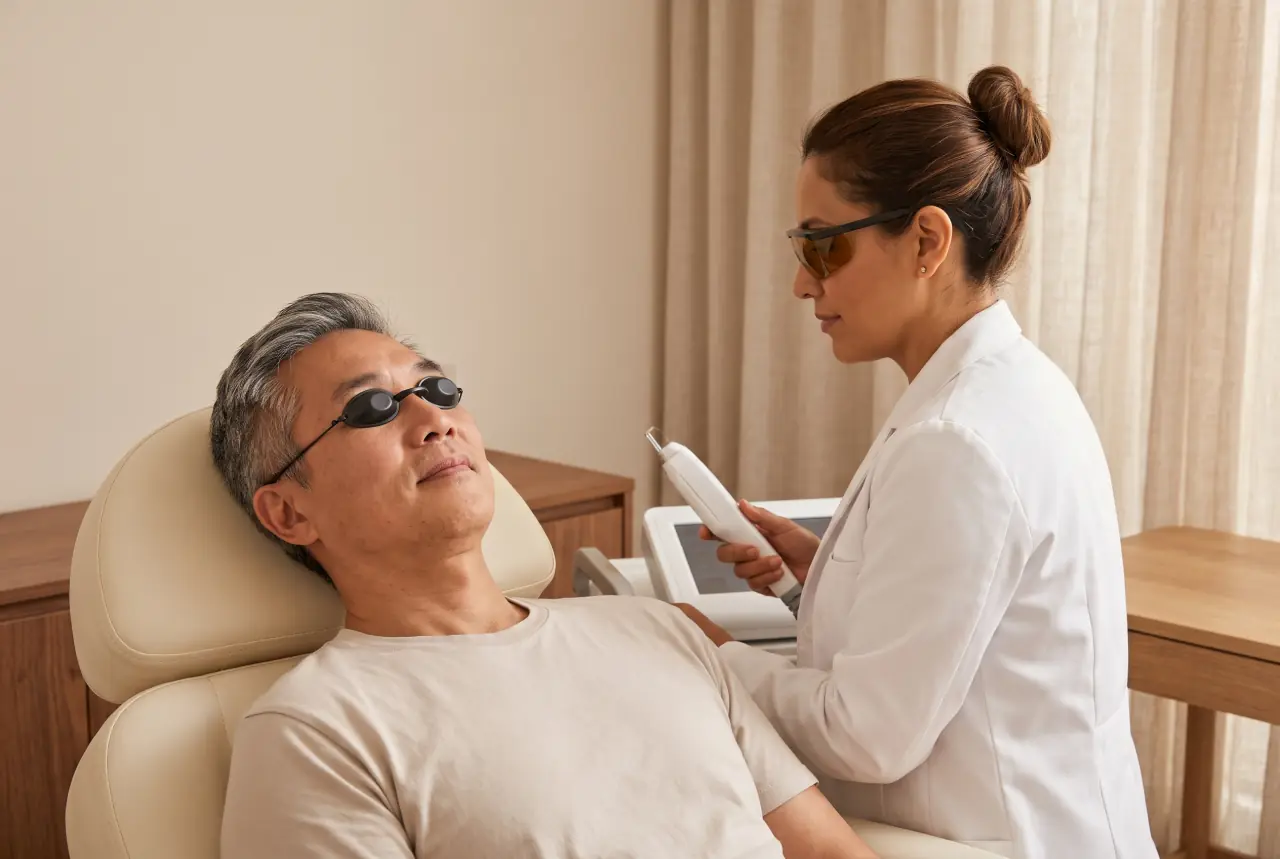
Mexico has its own system: COFEPRIS, Mexico’s Federal Commission for Protection against Health Risks, grants health registrations (registros sanitarios) for medical devices, and a public viewer of current device registrations opened on August 20, 2026 (COFEPRIS, in Spanish). A U.S. clearance doesn’t show which laser a clinic in Mexico uses or whether that laser is registered there, so ask for both. The rules, and how to look a registration up, are in is the device genuine and registered in Mexico.
Laser resurfacing can be dangerous in the wrong or inexperienced hands, so look for a doctor trained in facial plastic surgery with specific experience of this procedure; in the U.S. practice ASPS describes, another health professional may deliver the laser under the surgeon’s close supervision (ASPS). Spas and other non-medical settings may be convenient, but their limited training, supervision and equipment may put your health at risk (AAD), and a medical consultation should come before any laser treatment (AAD).
For the professional license lookup (cédula profesional) and what Mexican officials say about aesthetic treatments, see who may inject Botox and fillers in Mexico; training questions for energy devices are in who does the treatment. We found no Mexican rule naming the professions allowed to operate a CO2 laser, so ask the clinic directly and check the answers with the steps below. A license you’ve looked up and real experience with the laser are a strong start, and one part of a sound plan alongside a registered laser and settings chosen for your skin.
How to check: do these before treatment day.
- Ask for the laser’s brand, model and registro sanitario number, and check it in the viewer linked from COFEPRIS’s announcement (in Spanish).
- Ask who will hold the laser, their license number, and whether a doctor will treat you or supervise; then look the license up.
- Ask how many CO2 treatments they do, how often on skin like yours, and how your eyes will be protected.
- Ask to see the clinic’s health license; checking a clinic’s health license shows what to look for.
- If you’ll have sedation or general anesthesia, ask who gives it, and check that license too.
Recovery: the raw days, the pink weeks and the sun
Why it matters: the healing takes far longer than the appointment, and the care your skin gets while it heals can help lower the risk of infection, scarring and pigment changes (2025 consensus; ASPS).
| When | What to expect |
|---|---|
| Before treatment | Skin treatments customized for your skin type may start 6 weeks or more ahead (ASPS) |
| Treatment day | Usually an outpatient visit of 30 minutes to 2 hours, ending with a dressing on the treated skin (ASPS) |
| First few days | Often like a mild sunburn; after some treatments, raw, oozing skin that may blister and crust (ASPS) |
| About 5 days to a week | The skin becomes dry and peels (ASPS) |
| 2 to 3 months, up to a year | The new, pink skin gradually lightens; redness tends to last longer in blondes and redheads (ASPS) |
| Up to a year | Skin may stay extra sensitive to sunlight, and the improvement continues (ASPS) |
Crusting and recovery time for each kind of treatment are in fractional or fully ablative. Ask your provider for your own timeline.
While your skin heals, the sources describe a routine like this. Points cited to the 2025 consensus come from its advice on fully ablative resurfacing of the whole face or other large areas, which may not apply to small areas, so your provider’s written instructions for your own treatment come first.
- Soaks and ointment. Clean the treated skin 2 to 5 times a day with saline or a diluted vinegar solution, as your doctor directs (ASPS), and keep it moist with ointment until the crusting has gone; distilled or purified water for soaks, rather than tap water, can reduce the risk of infection (2025 consensus).
- Hands off. Don’t scratch or pick at crusts, which can cause scarring (ASPS).
- Swelling. Sleep with your head raised on an extra pillow and use an ice pack for the first day or two (ASPS), clean and not directly on the skin (2025 consensus).
- Pain. Over-the-counter pain relievers come first unless they’re not right for you; opioid painkillers can mask increasing pain, which is often a sign of infection (2025 consensus).
- Germs. Until new skin has formed, avoid direct contact with animals, hot tubs and steam rooms, and limit contact with gyms, phones and crowded areas, which may help prevent skin infection (2025 consensus).
- Sun. Avoid direct sun as much as you can while new skin forms (2025 consensus), then wear sunscreen every day once healed (ASPS); after fully ablative treatment, keep avoiding direct sun as much as possible for at least 3 to 4 months after the new skin forms (2025 consensus). A sunscreen with a sun protection factor (SPF) of 30 or more, a wide-brimmed hat and staying out of the midday sun lower the risk of dark patches (StatPearls).
- Products and makeup. Leave out irritants such as retinoids, acids and vitamin C until your provider says otherwise (2025 consensus). Once healed, a green-based, oil-free makeup can tone down the pink (ASPS).
How to check: before treatment day, ask for written aftercare: how often to soak and with what, which ointment, when the crusting should end, when you can start sunscreen and makeup, and which changes should make you call.
How long to stay, and crossing back with healing skin
Why it matters: the crusting days, any in-person check and the trip home all fall inside your stay, so they decide how long it is.
No official or professional source we read gives a number of days to stay after CO2 resurfacing; these are the pieces to plan around.
- The crusting days. See the table above; you’ll spend them soaking and applying ointment.
- The follow-up. A follow-up visit, in person or virtual, and an on-call provider at all times are part of the aftercare in the 2025 consensus (2025 consensus); ask whether yours has to be in person.
- Your medicines. In that approach, an antiviral started before treatment continues until the new skin has formed (2025 consensus). For medicine you carry home, see medicine prescribed after a procedure in Mexico.
- The trip home. Plan shade and a hat for the border crossing, and keep your aftercare kit with you. Timing an appointment around the border helps you aim for a shorter line, and crossing back into the U.S. after a procedure covers the walk and the wait.
How to check: before you buy tickets, ask your provider when your crusting should end, whether they want to see you before you travel, and how to reach them, or the on-call provider, from home; then book travel you can change.
Risks of CO2 laser resurfacing, and what you can do about each
Why it matters: some effects of resurfacing are expected and settle, a few can last, and each one has steps that lower the risk or catch it early (2025 consensus).
Expected or common effects of fully ablative resurfacing include redness lasting less than 4 months, swelling, oozing of clear fluid and acne-like breakouts (2025 consensus). Every type of laser resurfacing can bring complications, though fractional treatment tends to bring them less often and less severely (StatPearls).
| Risk | What the sources say | What you can do |
|---|---|---|
| Infection: bacterial, viral or fungal | Among the serious adverse events of fully ablative resurfacing (2025 consensus) | Take any preventive medicine as prescribed, keep to the soaks and ointment, and avoid the germ sources listed under recovery |
| Cold sores | Can flare after treatment around the mouth (ASPS) | Tell your provider about past cold sores, and take the antiviral before and after treatment |
| Darker patches | More likely in darker skin (ASPS); in the consensus panel’s experience with fully ablative treatment, most fade within 6 to 12 months (2025 consensus) | Agree on settings for your skin type, keep out of the sun, and ask about a bleaching solution if patches appear (ASPS) |
| Lighter patches | Rarer (ASPS); after fully ablative treatment, they can appear late and are often permanent (2025 consensus) | Ask whether fully ablative treatment is needed for your goals |
| Redness that lasts | After fully ablative treatment, redness beyond 4 months counts as prolonged (2025 consensus) | Plan for weeks of pink skin, and raise redness that isn’t fading at your follow-up |
| Scarring | Rare, but possible (ASPS) | Don’t pick or scratch, mention any keloids, and keep your follow-ups, since early scarring can be treated (2025 consensus) |
| Acne flares and milia (small white bumps) | Both can appear during healing (ASPS) | Ask for an acne plan; gentle cleansing with a washcloth can remove milia (ASPS) |
| Eyes and eyelids | Eye protection for everyone in the room, and corneal shields with lubricant for treatment around the eyes, lower the risk of eye injury (2025 consensus); a lower eyelid pulled outward (ectropion) is a listed complication (StatPearls) | Expect eye protection for the whole treatment, and if skin under your eyes is in the plan, ask how your lower lids will be assessed first |
How to check: ask the provider which of these they see most often with the treatment planned for you, what they’d do about each one, and how follow-up works once you’ve gone home.
How much does CO2 laser resurfacing cost in Mexico?
Why it matters: the range below is for the full face, so your price depends on the area treated, the kind of treatment and what the clinic includes.
| Treatment | Tijuana (USD) | United States (USD) |
|---|---|---|
| CO2 laser resurfacing, full face | $600 – $2,500 | $3,000 – $7,000 |
Uriym’s indicative ranges from its treatment costs page, reviewed September 7, 2026. They are not quotes and cover the listed treatment only, without taxes, travel or third-party charges.
How to check: ask each clinic for an itemized, written quote, then compare these lines. Facility costs, anesthesia fees and prescription medicines can all be part of a resurfacing bill (ASPS).
| Line | What to ask |
|---|---|
| Area | The full face, or part of it, such as around the eyes or mouth? |
| Kind of treatment | Fractional or fully ablative, and is the price for one session or a series? |
| Numbing or sedation | A cream, injections, sedation or general anesthesia, and who gives it? |
| Medicines and preparation | Are the antiviral, other prescriptions and any skin-care routine beforehand included? |
| Aftercare products | Which ointment, soaks and sunscreen will I need, and are they included? |
| Follow-up | How many follow-up visits, in person or virtual, and until when? |
| More treatment | What would another session, or care for a complication, cost? |
For the deposit, refunds and other general lines, see what a medical tourism quote should include.
Questions to ask before your CO2 laser treatment
- Do you recommend fractional or fully ablative treatment for my skin and goals, and why?
- Which laser and model will you use, and what is its Mexican registration number?
- Who will perform the treatment, what is their license, and how often do they treat skin like mine?
- Which skin type do you assign me, and which medicines should I start or stop beforehand?
- What numbing or sedation will I have, and how will my eyes be protected?
- When should the crusting end, when can I travel, and do you need to see me before I leave?
- If my skin gets more painful or I feel unwell once I’m home, whom do I contact, and at what hours?
Before you go: checklist
- Fractional or fully ablative treatment agreed, with the areas to treat
- Skin type, recent sun, cold sores, isotretinoin dates, medicines and smoking discussed
- Laser brand, model and registration number noted, and the registration looked up
- Provider’s license looked up, and the clinic’s health license seen
- Written quote with numbing or sedation, aftercare, prescriptions and follow-up
- Antiviral or other medicines prescribed, with the day to start
- Stay long enough for the crusting days and any in-person follow-up
- Ointment, soaking supplies, distilled or purified water and a wide-brimmed hat packed for the trip home
- Clinic’s after-hours contact saved, and the warning signs below read
Warning signs after CO2 laser resurfacing
In an emergency, call 911 (it works in the U.S. and Mexico), then tell the clinic that treated you.
| Sign | What to do |
|---|---|
| Increasing pain, drainage, burning or redness, excessive itching, new spots or sores, or raw areas that don’t heal or that reopen | These can be signs of infection: contact your provider promptly for an in-person or virtual check (2025 consensus) |
| Feeling generally unwell, a fever or chills | Also concerning for infection: contact your provider promptly (2025 consensus) |
| Any other increase in pain, or a symptom that worries you | Contact your provider; an on-call provider should be available at all times (2025 consensus) |
| Redness, swelling, itching or stinging at first, oozing and crusting after some treatments, then peeling | Expected (ASPS); tell the clinic if they get worse rather than better |
| Darker or lighter patches, or redness lasting beyond about 4 months | Tell your provider and keep up daily sun protection; darker patches can be treated (2025 consensus) |
Rows citing the 2025 consensus come from its advice on fully ablative resurfacing of the face; ask your provider which signs to report after your own treatment.
Early care matters, because resurfaced skin is a weaker barrier against an infection spreading through the body (2025 consensus). If you see a doctor at home, bring the clinic’s notes on the treatment, the laser and the medicines you were given.
Frequently asked questions
How much does CO2 laser resurfacing cost in Mexico?
Uriym’s indicative range for full-face CO2 laser resurfacing in Tijuana is $600 to $2,500, compared with $3,000 to $7,000 in the U.S. These ranges are indicative, not quotes. Your price depends on the area treated, whether the treatment is fractional or fully ablative, the numbing or sedation, and which aftercare products, prescriptions and follow-up visits are included, so ask each clinic to list those lines; the full list is in what CO2 laser resurfacing costs.
What is the difference between fractional and fully ablative CO2 laser?
Fully ablative treatment vaporizes skin across the whole treated area, while fractional treatment works in narrow columns with untreated skin around them, which lowers the risk of side effects and lets it heal faster (StatPearls). Sources differ on the trade-off: fractional CO2 has worked about as well on wrinkles in a number of studies (StatPearls), while a 2025 expert consensus paper credits fully ablative lasers with greater improvement, at the cost of longer downtime and more risk (2025 consensus). Your provider recommends which suits your skin; see fractional or fully ablative.
How long is the recovery from CO2 laser resurfacing?
Expect several days of raw, crusting skin, then weeks to months of pinkness. Crusting typically clears in 3 to 4 days after fractional treatment and 7 to 10 days after fully ablative treatment; fractional CO2 generally needs a recovery period of 4 to 10 days, and people can generally return to work 14 to 21 days after full-face fully ablative CO2 (StatPearls). The new skin is pink and lightens over 2 to 3 months, though the pinkness can take up to a year to go away (ASPS). See recovery.
Is CO2 laser resurfacing safe for dark skin?
Sources differ, and darker skin carries a higher risk of dark patches after treatment, so ask how your provider would plan for your skin type. Very dark skin is among the reasons you may not be a good candidate, according to the American Society of Plastic Surgeons (ASPS). Fitzpatrick skin types IV to VI are among the contraindications to ablative resurfacing in a 2023 review, which doesn’t recommend traditional fully ablative CO2 for type IV or darker (StatPearls), while a 2025 expert consensus didn’t count darker skin as a reason to rule out fully ablative treatment, and called for an experienced provider, with conservative settings and strict sun protection among the ways to lower the risk (2025 consensus). See darker skin.
Is CO2 laser FDA approved?
In the U.S., CO2 lasers for the skin reach the market by clearance rather than approval. A carbon dioxide laser for skin treatment is a Class II device that goes through the 510(k) process of the U.S. Food and Drug Administration, and each clearance covers the device it names, for the uses it lists; one 2021 clearance, for example, lists laser skin resurfacing for wrinkles, fine lines and acne scars, among others (FDA; 510(k) K212703). A U.S. clearance doesn’t show whether a clinic’s laser is registered in Mexico, where COFEPRIS, the federal health regulator, grants its own device registrations (COFEPRIS, in Spanish); see the laser, and who uses it.
How long should I stay in Tijuana after CO2 laser resurfacing?
Long enough for the crusting to clear and for any in-person check your provider wants; we found no official or professional source that sets a number of days. Crusting typically clears in 3 to 4 days after fractional treatment and 7 to 10 days after fully ablative treatment (StatPearls), and a follow-up can be in person or virtual (2025 consensus), so ask which yours will be. For the line and the walk home, see crossing back into the U.S. after a procedure.
How many CO2 laser treatments will I need?
It depends on the kind of treatment and your goals, so ask your provider for a written plan. Many patients may need 3 or more treatments for the result they want, particularly with fractional treatment (StatPearls). The effects can last for many years, but wrinkles and expression lines return with age, and resurfacing can be repeated (ASPS). Each session can mean another trip; see fractional or fully ablative.
Can I have CO2 laser resurfacing after taking isotretinoin?
Tell your provider the dates you took it, because sources differ on the timing. Traditional teaching is to stop isotretinoin 6 to 12 months before resurfacing (StatPearls). Too little evidence was found to justify delaying fractional ablative laser treatment, though fully ablative laser isn’t recommended during isotretinoin treatment, in a 2017 systematic review with expert consensus recommendations (Spring et al., 2017). Your provider decides the timing; see isotretinoin.
Sources
- What is laser skin resurfacing? American Society of Plastic Surgeons
- Who is a good candidate for laser skin resurfacing? American Society of Plastic Surgeons
- What are the steps of a laser skin resurfacing procedure? American Society of Plastic Surgeons
- What should I expect during my laser skin resurfacing recovery? American Society of Plastic Surgeons
- What results should I expect after laser skin resurfacing? American Society of Plastic Surgeons
- How much does laser skin resurfacing cost? American Society of Plastic Surgeons
- Skin conditions that lasers can treat (last updated August 31, 2021) American Academy of Dermatology
- 10 things to know before having laser treatment for your scar American Academy of Dermatology
- Laser surgery for the skin (MedlinePlus Medical Encyclopedia) MedlinePlus, U.S. National Library of Medicine
- Product classification: Powered Laser Surgical Instrument (product code GEX, 21 CFR 878.4810) U.S. Food and Drug Administration
- 510(k) K212703: clearance letter and summary for a CO2 laser system (October 19, 2021) U.S. Food and Drug Administration
- Ablative Laser Resurfacing (StatPearls; Verma, Yumeen and Raggio; last updated April 23, 2023; full text on Europe PMC) StatPearls Publishing, via Europe PMC
- Consensus Statement on the Prevention and Management of Complications of Fully Ablative Laser Resurfacing of the Face (Kang et al., 2025; full text on eScholarship) Lasers in Surgery and Medicine (peer-reviewed journal), via University of California eScholarship
- Isotretinoin and Timing of Procedural Interventions: A Systematic Review With Consensus Recommendations (Spring et al., 2017; abstract on PubMed) JAMA Dermatology (peer-reviewed journal)
- COFEPRIS publica Visor de Registros Sanitarios de Dispositivos Médicos, 20 de agosto de 2026 (in Spanish) COFEPRIS, Gobierno de México
About this guide
The Uriym editorial team researched this guide from the 15 sources above, drafted it with AI assistance, and checked it claim by claim against those sources before publishing, last on . Our editorial standards explain how we choose sources, handle prices and make corrections.
Uriym is a healthcare navigation platform, not a medical provider. Its founder, Adriana Mendez, grew up in a family that traveled to Mexico for care and has done it herself for the past ten years. How Uriym works
This is general information, not medical, legal or financial advice: your treating provider decides what care is right for you. Rules, prices and advisories change, so check the official page before you act. Found something wrong or out of date? Email support@uriym.com.