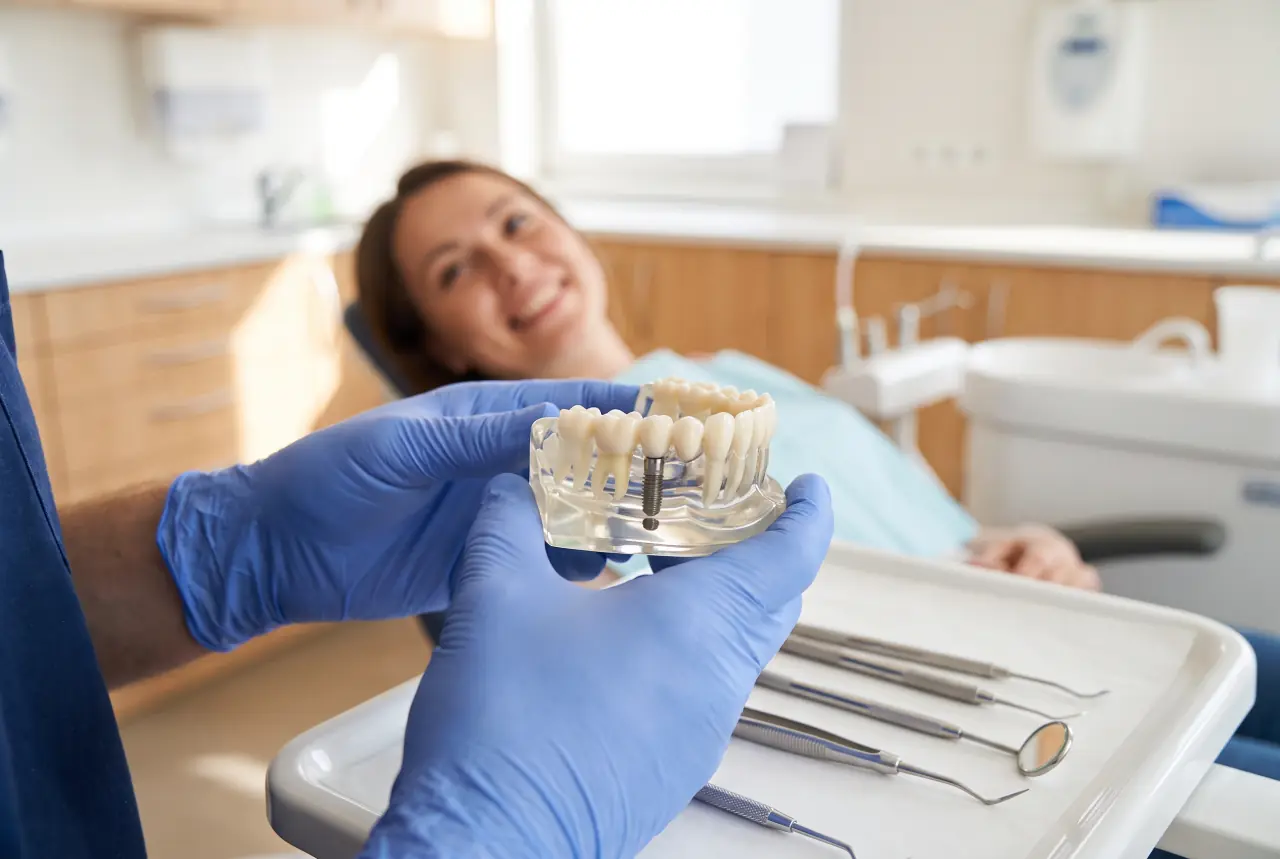

A dental bridge in Mexico, whether in Tijuana or another city, can be a sensible way to replace one or a few missing teeth once four things are clear before any tooth is shaped: X-rays show that the teeth beside the gap can hold a bridge; you’ve compared it with an implant and a removable partial denture; a licensed dentist, or a prosthodontist for complex work, plans and fits it; and the schedule leaves time for the lab, the fitting and a bite check. Much of that checking can happen before you book a trip.
For a traditional bridge, the teeth at either side of the gap are cut down for crowns, which can’t be reversed, so the first decision comes before anything else: a bridge, an implant or a partial denture. Your dentist decides what fits your mouth, and a dentist at home can look over the plan with you first.
At a glance
- What a bridge is
- Artificial teeth that span a gap, fixed to the teeth or implants that support them; only a dentist can take a fixed bridge out
- Main types
- Traditional, cantilever, resin-bonded (Maryland) and implant-supported
- Visits
- Usually 2 to 3 for a bridge on natural teeth, in a British dental school’s guides; a bridge on implants can take months
- Can it be undone?
- Not a traditional bridge: the teeth beside the gap are cut down for good. A resin-bonded bridge needs little or no drilling
- How long it lasts
- 80% of conventional bridges last 10 years or longer, in one British dental hospital’s guide
- Price
- Compare written quotes line by line; see what a bridge quote should list
Key takeaways
- Weigh a bridge against an implant and a removable partial denture with your dentist, and ask what each would mean for the teeth beside the gap.
- Ask which teeth will be shaped and how much of each, and whether a resin-bonded design that needs little drilling could suit your gap.
- Get a written schedule showing the lab days, how long you’ll wear a temporary bridge and when your bite is checked before you head home.
- Look up each dentist’s professional license number, and ask anyone presented as a prosthodontist for a specialty license number as well.
- Ask for a quote that prices every unit of the bridge and lists the material, the temporary, the lab, any root canal, adjustments and remake terms.
In this guide
- What is a dental bridge? Traditional, cantilever, Maryland and implant bridges
- Bridge vs implant vs partial denture: which fits your gap?
- Are the teeth beside the gap ready to hold a bridge?
- How long does a dental bridge last, and how do you care for it?
- The steps and visits for a bridge, and what they mean for your trips
- Risks of a dental bridge, and what you can do about each
- Who should make your bridge: a general dentist or a prosthodontist?
- How much does a dental bridge cost in Mexico, and what should a quote list?
- Questions to ask your dentist about a bridge
- Before you go: checklist
- Warning signs after a dental bridge
- Frequently asked questions
- Sources
What is a dental bridge? Traditional, cantilever, Maryland and implant bridges
A bridge, sometimes called a fixed partial denture, replaces one or more missing teeth with artificial teeth that span the gap. It can be made of gold, alloys, porcelain or a combination, and a fixed bridge can only be removed by a dentist (American Dental Association, ADA). Two words will appear in your plan: an abutment is the tooth that supports one end of the bridge, and a pontic is the artificial tooth (ADA glossary).
| Type | How it’s held | Worth knowing |
|---|---|---|
| Traditional (conventional) | The teeth on both sides of the gap are prepared for crowns, a false tooth is joined to the crowns, and the bridge is cemented on (American College of Prosthodontists, ACP) | Can be more secure than an adhesive bridge, and is usually advised when the supporting teeth already have crowns or large fillings, in a British dental hospital’s guide (Leeds Dental Institute) |
| Cantilever | The false tooth sits beyond the supporting tooth: in the glossary’s terms, a cantilever extension, the part of a fixed bridge that extends beyond the tooth it’s attached to and has no additional support (ADA glossary) | A 2007 review advised it only as a second option, for reasons of anatomy or patient preference (Pjetursson et al., 2007) |
| Resin-bonded (Maryland or adhesive) | Wing-like retainers bonded to the abutment teeth (ADA glossary) | Needs very little or no drilling, though the supporting tooth can sometimes look slightly grayer (Leeds); usually advised for a single missing tooth at a British university dental school (Bristol Dental School) |
| Implant-supported | Artificial teeth attached directly to the jaw or under the gum tissue (ADA); for more than one tooth, a bridge is made to fit your mouth and the implants (ADA) | Some patients may need to wait up to several months for the bone to grow around the implants before teeth go on, while others get teeth in the same visit (ADA); see what an implant is |
A conventional bridge can replace only a small number of teeth (Bristol Dental School). A whole arch fixed onto a few implants is a bridge too, covered in what All-on-4 is.
What is a 3-unit bridge?
Clinics and quotes often describe a bridge by its number of units, usually counting one unit for each crown and each false tooth. For one missing tooth, the traditional design crowns the tooth at each side of the gap and joins the false tooth between them (ACP), so a clinic would usually call it a 3-unit bridge: two crowns and one pontic. We found no official or professional definition of that count, so ask the clinic how it counts units and to list each unit by tooth number; the list also shows you which teeth will be crowned.
Bridge vs implant vs partial denture: which fits your gap?
Why it matters: each option asks something different of the teeth beside the gap, of your travel schedule and of your daily routine, so compare them before any tooth is shaped.
Missing teeth are replaced with removable partial dentures, bridges or implants, and a prosthodontist can help work out which suits you (ACP). Implants are often considered the “gold standard”, but in the right circumstances a fixed bridge can be a viable alternative (ACP).
| Bridge on natural teeth | Single implant | Removable partial denture | |
|---|---|---|---|
| What it involves | Crowns on the teeth beside the gap hold the false tooth, and the bridge is cemented in (ACP) | A post placed in the jawbone by surgery; once the bone has grown around it, a crown goes on top (ADA) | Teeth that attach to the teeth you still have and rest on the gums (ACP); taken out at night and for cleaning (Leeds) |
| The teeth beside the gap | Cut down for a traditional bridge, which can’t be undone (Bristol) | If you don’t want sound tooth structure removed for a bridge, ask your dentist whether an implant is an option (ADA) | They hold it in place (ACP) |
| Visits | Usually 2 to 3, at a British dental school (Bristol) | Surgery, then for some patients up to several months of healing before the tooth goes on (ADA); see how long implants take | Several fitting stages; see the steps for dentures |
| How long it lasts, on average | In a 2007 review, estimated 10-year survival close to a single implant crown’s, as averages across patients (Pjetursson et al., 2007); see the survival table | Estimated 10-year survival close to a traditional bridge’s in the same review, as averages; the figures are in the same table | Dentures should typically be checked every year, and often need remaking once they lose their fit, after 5 to 10 years of use (ACP) |
Research survival figures are averages, not a prediction for your mouth, and they count whether a bridge or implant was still there, not whether it needed repairs. A partial denture is usually suggested when several teeth are missing (Leeds); the kinds of dentures explains partials.
Leaving the gap is a choice too. In the Leeds guide, it carries a small risk of the teeth around it drifting into the space, making a bridge harder to fit later (Leeds). The ACP puts it more firmly: the teeth next to and above a gap will shift, move and tip into it over time, and a tooth is much easier to replace soon after it’s lost (ACP).
How to check:
- Ask your dentist to go through all three options, and leaving the gap, for your mouth, and to explain the recommendation.
- Look at the X-rays of the teeth beside the gap together, and ask what each option would mean for them.
- If an implant is possible, read who is a good candidate for implants; if many teeth are missing, compare fixed bridges, overdentures and dentures.
Are the teeth beside the gap ready to hold a bridge?
Why it matters: a bridge is only as sound as the teeth or implants under it, so their health decides which design suits you, and whether a bridge suits you at all.
Whichever bridge your dentist recommends, its success depends on that foundation, which makes keeping your remaining teeth healthy important (ADA). At Bristol Dental School, in UK practice:
- Traditional bridges are used only where the surrounding teeth are strong enough, and not on teeth with active decay or gum disease. The school also doesn’t use them on teeth that have never had a filling or other restoration, and notes that a bridge can strengthen a supporting tooth with a large filling (Bristol).
- Resin-bonded bridges need a healthy supporting tooth, checked with X-rays if needed, and may not suit several missing teeth (Bristol).
An anchor tooth with deep decay or an infected nerve may need a root canal first. Each anchor tooth of a traditional bridge gets a crown, so the crown guide’s advice on settling each tooth first applies to it too.
How to check:
- Ask to see X-rays of each anchor tooth, roots included, and what they show.
- Ask whether each anchor tooth is untouched, filled or already crowned, and whether its nerve is healthy.
- Ask whether fillings or gum treatment come first; your first exam lists what an exam should cover.
How long does a dental bridge last, and how do you care for it?
Why it matters: a bridge is a long-term fixture rather than a permanent one, and most of the cleaning and checkups that help it last happen once you’re home.
For a sense of scale, research reviews have estimated the share of bridges still in place after 5 and 10 years, with single implant crowns for comparison:
| Type of bridge | After 5 years | After 10 years |
|---|---|---|
| Traditional, on teeth at both ends | 93.8% | 89.2% |
| Cantilever, on teeth | 91.4% | 80.3% |
| Resin-bonded | 91.4% | 82.9% |
| On implants only | 95.2% | 86.7% |
| Joining a tooth and an implant | 95.5% | 77.8% |
| Single implant crown, for comparison | 94.5% | 89.4% |
Estimated survival, meaning the bridge or implant crown was still in place, from Pjetursson et al., 2007, and for resin-bonded bridges Thoma et al., 2017.
Treat them as averages from research, not a forecast for your own bridge. Still in place isn’t the same as trouble-free: within 5 years, 15.7% of patients with traditional bridges, 20.6% with cantilever bridges and 38.7% with implant bridges had some complication (Pjetursson et al., 2007). Resin-bonded bridges held by one tooth lasted better and came unstuck less often than those held by two or more, and did better at the front of the mouth than at the back (Thoma et al., 2017). In the Leeds guide, 80% of conventional bridges last 10 years or longer with relatively minor complications, and around 80% of adhesive bridges last 5 years or longer (Leeds).
Materials. Bridges are commonly made of metal, metal with ceramic, and sometimes all-ceramic (Bristol). In a 2015 review of 40 studies, an estimated 94.4% of metal-ceramic and 90.4% of zirconia bridges survived 5 years, a difference that wasn’t statistically significant; zirconia bridges had significantly more ceramic fractures and came loose more often, and their anchor teeth had more decay (Pjetursson et al., 2015). How the same materials compare on single teeth is in crown materials.
Daily care:
- Brush the bridge as normal, and when you floss, sweep the floss under the false tooth along the gum line; your dentist or hygienist can show you how (Leeds).
- Special aids are available to keep a fixed bridge clean (ACP), and interdental brushes also clean between teeth (Bristol).
- Brush twice a day for 2 minutes with fluoride toothpaste and keep regular checkups, so problems are found early (Bristol).

How to check: before you leave the clinic, have someone show you how to clean under your bridge, and ask which aid suits it: a floss threader, an interdental brush or something else? Line up a dentist near home using follow-up at home.
The steps and visits for a bridge, and what they mean for your trips
Why it matters: a bridge is made in a lab between appointments, so the number of visits and the days between them decide whether one stay is enough or you cross twice.
At Bristol Dental School, a conventional bridge typically takes 2 to 3 visits, starting with X-rays of the teeth that will support it (Bristol):
- Shaping and recording. The area is numbed, the teeth beside the gap are shaped, an impression is taken, and you choose the shade of the false tooth.
- A temporary bridge. It protects the shaped teeth until the next appointment.
- The lab. A dental laboratory technician makes the bridge from the dentist’s design and instructions (ACP).
- Try-in and fitting. The temporary comes off, the bridge is tried on for fit and looks, then cemented, and the bite is adjusted as needed (Bristol).
A resin-bonded bridge usually takes 2 to 3 appointments of 1 to 2 hours, with molds sent to a dental lab and sometimes a temporary tooth between visits (Bristol). A bridge on implants follows the implant timeline, and you may wear a temporary bridge while the final one is made (ADA).
Planning the trips
No official or professional source we found gives a number of days in Tijuana for a bridge, so build the trip around the clinic’s written schedule:
- One longer stay: shaping, the lab days and the fitting on one trip, with a few days nearby afterward in case the bite needs adjusting. Ask how many lab days your bridge’s material needs.
- Two trips: the teeth shaped and a temporary fitted now, the bridge cemented on a return visit. Ask how long the temporary can stay; the steps for crowns explains why a shorter wait may matter for a shaped tooth.
Matching visits to the treatment compares other dental work, and crossing the border for dental appointments covers sedation and each crossing back.
How to check: ask the clinic to write down every appointment date, the lab’s location and turnaround, the days you’ll spend in a temporary bridge, the day your bite is checked, and any root canal or gum treatment that adds a visit, then book flexible tickets.
Risks of a dental bridge, and what you can do about each
Why it matters: many bridge problems start at the anchor teeth or the cement holding the bridge, and each one has a step that makes it less likely or limits the harm.
Conventional and adhesive bridges are generally very successful (Leeds), though like any dental work they can run into problems. The figures below are averages, not a prediction for you.
| Risk | What it is | What you can do |
|---|---|---|
| Decay, gum disease or a broken anchor tooth | A small proportion of supporting teeth may develop decay along the edge of the bridge or gum disease (Leeds). In a 2004 review of 19 studies, the 10-year risk of losing a bridge to decay was 2.6%, to gum disease 0.7%, and of a supporting tooth fracturing 2.1% (Tan et al., 2004) | Floss under the false tooth (Leeds) and keep regular checkups (Bristol); ask how sound each anchor tooth is, and whether a weak one should be rebuilt first |
| A nerve problem that needs a root canal | In the Leeds guide, up to 10% to 15% of supporting teeth for a conventional bridge may eventually need a root canal because the nerve dies (Leeds). The Bristol guide puts the chance that a healthy nerve in a supporting tooth becomes inflamed and dies over time at roughly 20%, after which the tooth needs a root canal or removal (Bristol) | Ask whether each anchor tooth’s nerve is healthy, keep the time in a temporary short (see the steps for crowns), and ask who would do a later root canal and what it would cost |
| A bridge that comes loose | The 10-year risk of a bridge losing its hold was 6.4% (Tan et al., 2004). Over 5 years, 15% of resin-bonded bridges came unstuck (Thoma et al., 2017); in the Leeds guide, that’s usually fixed by cleaning off the old cement and bonding the bridge again (Leeds) | Keep a bridge that comes out, so it can be checked and possibly cemented again (Bristol), and agree in writing who would do that once you’re home |
| Chipped or fractured porcelain | Porcelain on a bridge may fracture, and the bridge then needs replacing (Bristol); the 10-year risk of material fractures was 3.2% (Tan et al., 2004) | Tell the dentist if you grind or clench your teeth, and ask whether the material, and a night guard, suit that; see chipping or fracture |
| A bite that feels wrong | The bite is adjusted when the bridge is cemented (Bristol); after a resin-bonded bridge, a bite that feels different is normal and settles over a number of weeks (Bristol) | Have the bite checked at the fitting, stay in the area for a few days, and make an appointment if the bridge feels uncomfortable or painful (Bristol) |
| Tooth structure you can’t get back | Cutting the supporting teeth makes a traditional bridge irreversible, and as gums recede with age, its edges may show (Bristol) | Settle the design first: a resin-bonded bridge needs little or no drilling (Leeds), and an implant may let you keep that tooth structure (ADA) |
How to check: ask the dentist how each problem in the table would be handled if it showed up a year from now, back home, and get the answer into the written terms. Sterilization checks and what to do if something goes wrong in Mexico are covered in risks of dental work.
Who should make your bridge: a general dentist or a prosthodontist?
Why it matters: a bridge involves several teeth, a lab and your bite, so knowing who plans, shapes and fits it tells you whose training and license to look into.
Prosthodontists are dentists who add at least 3 years of advanced training in an accredited program after dental school, and bridges are among the treatments they’re highly trained in, though many other dentists can do some of this work (ACP). In Mexico, who should treat you explains the specialty license to ask for and the rule that lab technicians work to the dentist’s instructions, and checking the license and permits walks through the lookups.
Checking the license gives you a strong starting point; it works alongside X-rays of the anchor teeth, a written schedule and a dentist near home who can look after the bridge.
How to check:
- Get the full name of whoever will examine you, shape the anchor teeth, and fit and adjust the bridge.
- Before paying any deposit, look up each dentist’s cédula profesional (professional license number).
- If someone is presented as a prosthodontist, ask where they trained and for their cédula de especialidad (specialty license number), and look that up as well.
- Ask how many bridges like yours they make in a year, and which lab makes them.
How much does a dental bridge cost in Mexico, and what should a quote list?
Why it matters: a bridge has several parts, and two quotes for the same gap can cover different teeth, materials and visits, so the lines say more than the totals.
The official and professional dental sources we checked don’t publish a typical U.S. fee for a bridge. For a fair comparison, ask a dentist near home to price the same plan in writing.
How to check: ask each clinic for a written, itemized quote in U.S. dollars with these lines:
| Line | What it pays for | What to ask |
|---|---|---|
| Exam and X-rays | Checking the health of the teeth that will support the bridge (Bristol) | Which images are included, and may I take copies home? |
| Each part of the bridge | Every part that attaches the bridge to a supporting tooth (a retainer) and every false tooth (a pontic) (ADA glossary) | How many units do you count, which teeth get crowns, how many false teeth, and what does each part cost? |
| Material | Metal, metal with ceramic, or all-ceramic (Bristol), such as zirconia (Pjetursson et al., 2015) | Which material, and why for this gap and my bite? |
| Work on anchor teeth first | A root canal, or rebuilding a weak tooth, before it takes a crown | Does any anchor tooth need it, and is it priced separately? |
| Temporary bridge | Protecting the shaped teeth until the fitting (Bristol) | Is it included, and will you re-cement it if it comes off? |
| Lab | The bridge itself, made by a technician (ACP) | Which lab, and is its fee in the unit price? |
| Fitting and adjustments | The try-in, cementing and bite adjustments | How many adjustment visits are included, and for how long? |
| Remake terms | What happens if the bridge comes loose or chips, or an anchor tooth fails | What’s covered, for how long, and who pays for the trip back? |
For travel, time off and follow-up outside the dental chair, use what a medical tourism quote should include; whether U.S. coverage pays toward dental work abroad is in insurance and Medicare for dental work in Mexico.
Questions to ask your dentist about a bridge
- For my gap, would you suggest a bridge, an implant or a partial denture, and why?
- Which teeth will anchor the bridge, and how much of each will you remove?
- Could a resin-bonded or cantilever design work here, and what would I give up?
- Does any anchor tooth need a root canal, a rebuild or gum treatment before the bridge?
- How many visits will it take, how many days apart, and how long will I wear the temporary bridge?
- How should I clean under the false tooth, and which cleaning aid do you recommend?
- If the bridge comes loose or chips, or an anchor tooth fails after I’m home, who deals with it, and what do your written terms cover?
Before you go: checklist
- Bridge, implant and partial denture compared with your dentist, with the reasons written down
- X-rays of every anchor tooth seen, and any root canal, fillings or gum treatment booked first
- The bridge design and material named in the written plan
- Each dentist’s cédula looked up, along with any specialty license
- A quote that prices each unit and lists the temporary, the lab, adjustments and remake terms
- A dated schedule covering lab days, time in a temporary and a bite check
- Shown how to clean under the bridge, with your cleaning aid packed
- A dentist near home ready for checkups
- The State Department’s current advisory read; see what the advisory says about Tijuana
- The warning signs below read, with the clinic’s phone and email saved
Warning signs after a dental bridge
In an emergency, call 911, which works in the U.S. and Mexico, then tell your dentist.
| What you notice | What to do |
|---|---|
| Struggling to breathe, speak or swallow; a swollen or painful eye, or sudden trouble seeing; a lot of swelling in your mouth; or difficulty opening it | Call 911 or go to the nearest emergency room, and have someone else drive; then tell your dentist (adapted from UK advice on a dental abscess, where the number is 999: NHS) |
| Signs of a dental abscess, a build-up of pus from an infection, such as intense pain in a tooth or the gums, a swollen face or jaw, a bad taste or a high temperature | Ask for an urgent dental appointment; an abscess needs a dentist’s treatment and won’t go away on its own (NHS) |
| A bridge that feels uncomfortable or painful, or sensitivity after treatment that doesn’t settle | Make an appointment with your dentist; some sensitivity at first should fade (Bristol) |
| A bridge that comes loose or falls out | Keep it and take it to your dentist, who can review it and may be able to cement it again (Bristol) |
If a sign fits more than one row, follow the more urgent advice; that’s our own rule of thumb, not a source’s.
For signs after an extraction or other dental work, see warning signs after dental work. Whoever sees you at home will want your X-rays and a note of the bridge’s design, material and anchor teeth.
Frequently asked questions
How much does a dental bridge cost in Mexico?
It depends on how many teeth the bridge crowns and replaces, the material and what else the plan includes, so compare written quotes line by line rather than headline prices. Each quote should price every crown on an anchor tooth and every false tooth, and list the X-rays, any root canal or rebuild of an anchor tooth, the temporary bridge, the lab, adjustments after the fitting and the terms if the bridge fails. None of the official or professional sources we checked gives a typical U.S. fee, so ask a dentist near home to price the same plan; what a bridge quote should list has the questions.
Is a bridge or an implant better for a missing tooth?
Neither suits every gap. Implants are often considered the gold standard for replacing missing teeth, but in the right circumstances a fixed bridge can be a viable alternative, and a prosthodontist can advise after a full exam (American College of Prosthodontists). A traditional bridge means cutting down the teeth beside the gap, while an implant spares them but needs surgery and, for some patients, up to several months for the bone to heal (American Dental Association). In a 2007 review, their estimated 10-year survival was close, as averages across patients (Pjetursson et al., 2007); bridge vs implant vs partial denture compares them side by side.
How long does a dental bridge last?
Many last 10 years or more. In a British dental hospital’s guide, most conventional bridges last 10 years or longer with relatively minor complications (Leeds Dental Institute), and research reviews found most traditional bridges still in place after 10 years, with cantilever and resin-bonded bridges somewhat lower. Those are averages across patients, not a prediction for yours. Cleaning under the false tooth every day and regular checkups help; see how long a bridge lasts.
How many days do I need in Tijuana for a dental bridge?
Plan around 2 or 3 visits for a bridge on natural teeth, with lab days between shaping the teeth and fitting the bridge; that’s the number of visits one British dental school gives for a conventional bridge (Bristol Dental School). No official source we found sets a number of days in Tijuana, so ask for the dentist’s written schedule, including your time in a temporary bridge and a bite check before you leave. A bridge on implants can take months; see the steps and visits.
What is a Maryland bridge?
A resin-bonded bridge: the false tooth is held by wing-like retainers bonded to the teeth beside it (American Dental Association glossary). It needs very little or no drilling, though the supporting tooth can sometimes look slightly grayer, and its most common problem is coming unstuck, which is usually fixed by bonding it again (Leeds Dental Institute). At one British dental school, it’s usually advised for one missing tooth (Bristol Dental School); see the types of bridge.
What is a 3-unit bridge?
Clinics usually mean a bridge that replaces one missing tooth with two crowns and one false tooth, counting each as a unit; we found no official definition of the count, so ask the clinic how it counts. In the traditional design, the teeth on both sides of the gap are prepared for crowns and the false tooth, called a pontic, is joined between them (American College of Prosthodontists; American Dental Association glossary). A quote for a 3-unit bridge should name both anchor teeth and the material, and say whether the temporary bridge, the lab and adjustments are included.
Does a dental bridge damage the teeth next to it?
A traditional bridge changes them for good, since the supporting teeth are cut down to take crowns (Bristol Dental School), and the nerve of a supporting tooth can be damaged, so that the tooth later needs a root canal (Leeds Dental Institute). A resin-bonded bridge needs little or no drilling (Leeds Dental Institute), and if you’d rather keep that tooth structure, ask your dentist whether an implant is an option (American Dental Association). See risks and what to do.
How do you clean under a dental bridge?
Brush as normal, and when you floss, guide the floss under the false tooth along the gum line; your dentist or hygienist can show you how (Leeds Dental Institute). Special aids are made for keeping bridges clean (American College of Prosthodontists), and interdental brushes also clean between teeth (Bristol Dental School). Ask which aid suits your bridge before you leave the clinic; daily care has the rest of the routine.
Sources
- Bridges MouthHealthy, American Dental Association
- Implants MouthHealthy, American Dental Association
- Glossary of Dental Terms (Code on Dental Procedures and Nomenclature, CDT) American Dental Association
- Bridges American College of Prosthodontists (GoToAPro)
- Missing Teeth American College of Prosthodontists (GoToAPro)
- Frequently Asked Questions about Dentures American College of Prosthodontists (GoToAPro)
- Why See a Prosthodontist? American College of Prosthodontists (GoToAPro)
- Bridges (patient information, Leeds Dental Institute; last reviewed July 31, 2025) Leeds Teaching Hospitals NHS Trust
- Conventional dental bridges (patient information) Bristol Dental School, University of Bristol
- Resin-Bonded Bridges (patient information) Bristol Dental School, University of Bristol
- Dental abscess (page last reviewed March 18, 2026) NHS (England)
- Comparison of survival and complication rates of tooth-supported fixed dental prostheses (FDPs) and implant-supported FDPs and single crowns (SCs) (Pjetursson et al., 2007; abstract on PubMed) Clinical Oral Implants Research (peer-reviewed journal)
- A systematic review of the survival and complication rates of fixed partial dentures (FPDs) after an observation period of at least 5 years (Tan et al., 2004; abstract on PubMed) Clinical Oral Implants Research (peer-reviewed journal)
- A systematic review of the survival and complication rates of resin-bonded fixed dental prostheses after a mean observation period of at least 5 years (Thoma et al., 2017; abstract on PubMed) Clinical Oral Implants Research (peer-reviewed journal)
- All-ceramic or metal-ceramic tooth-supported fixed dental prostheses (FDPs)? A systematic review of the survival and complication rates. Part II: Multiple-unit FDPs (Pjetursson et al., 2015; abstract on PubMed) Dental Materials (peer-reviewed journal)
About this guide
The Uriym editorial team researched this guide from the 15 sources above, drafted it with AI assistance, and checked it claim by claim against those sources before publishing, last on . Our editorial standards explain how we choose sources, handle prices and make corrections.
Uriym is a healthcare navigation platform, not a medical provider. Its founder, Adriana Mendez, grew up in a family that traveled to Mexico for care and has done it herself for the past ten years. How Uriym works
This is general information, not medical, legal or financial advice: your treating provider decides what care is right for you. Rules, prices and advisories change, so check the official page before you act. Found something wrong or out of date? Email support@uriym.com.