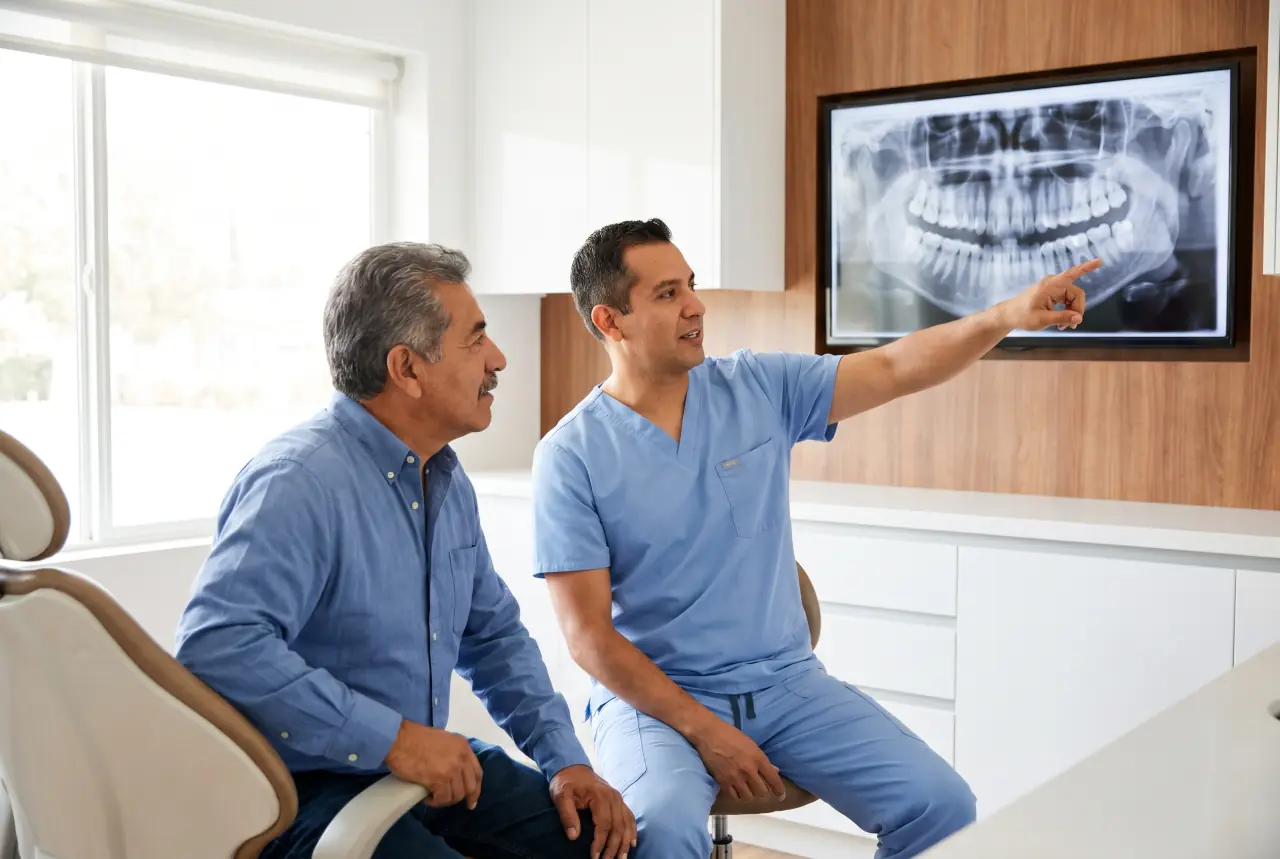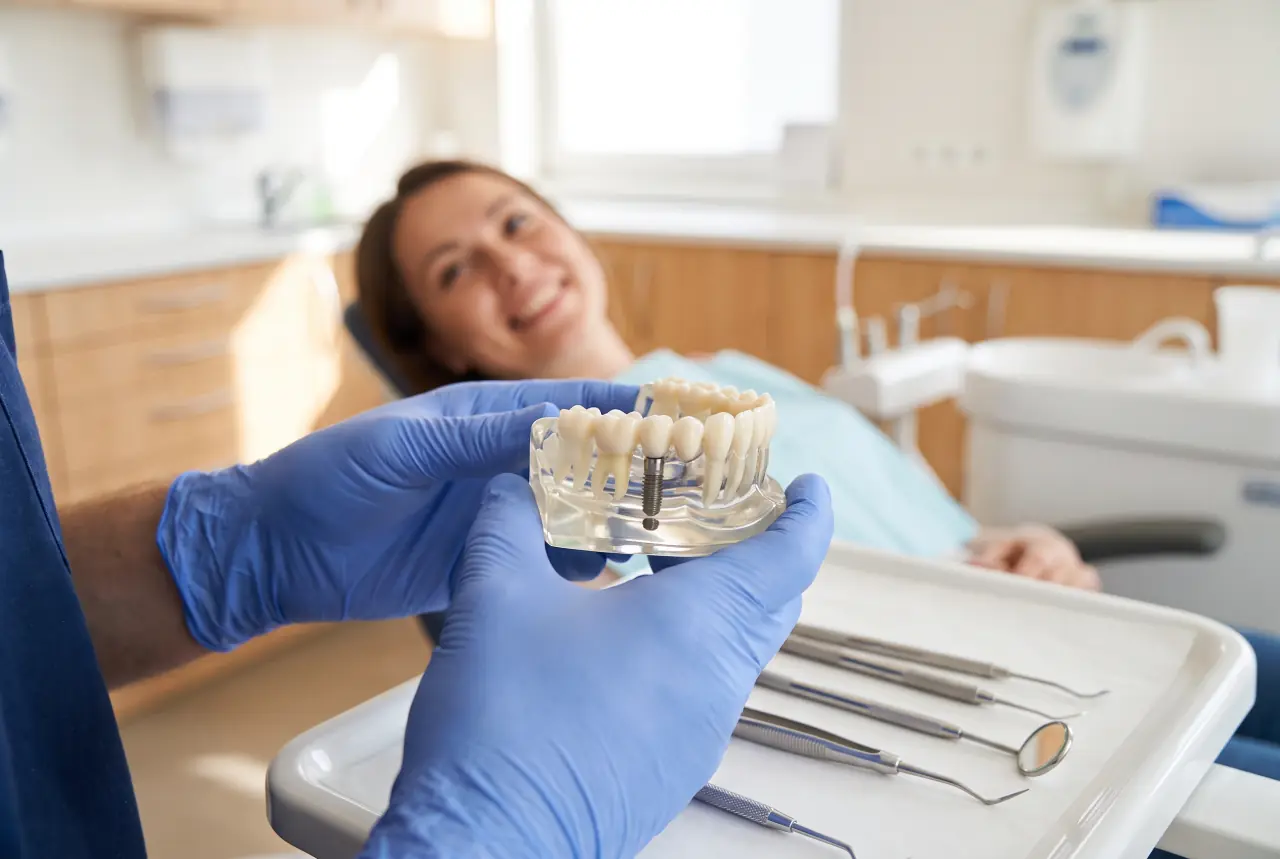
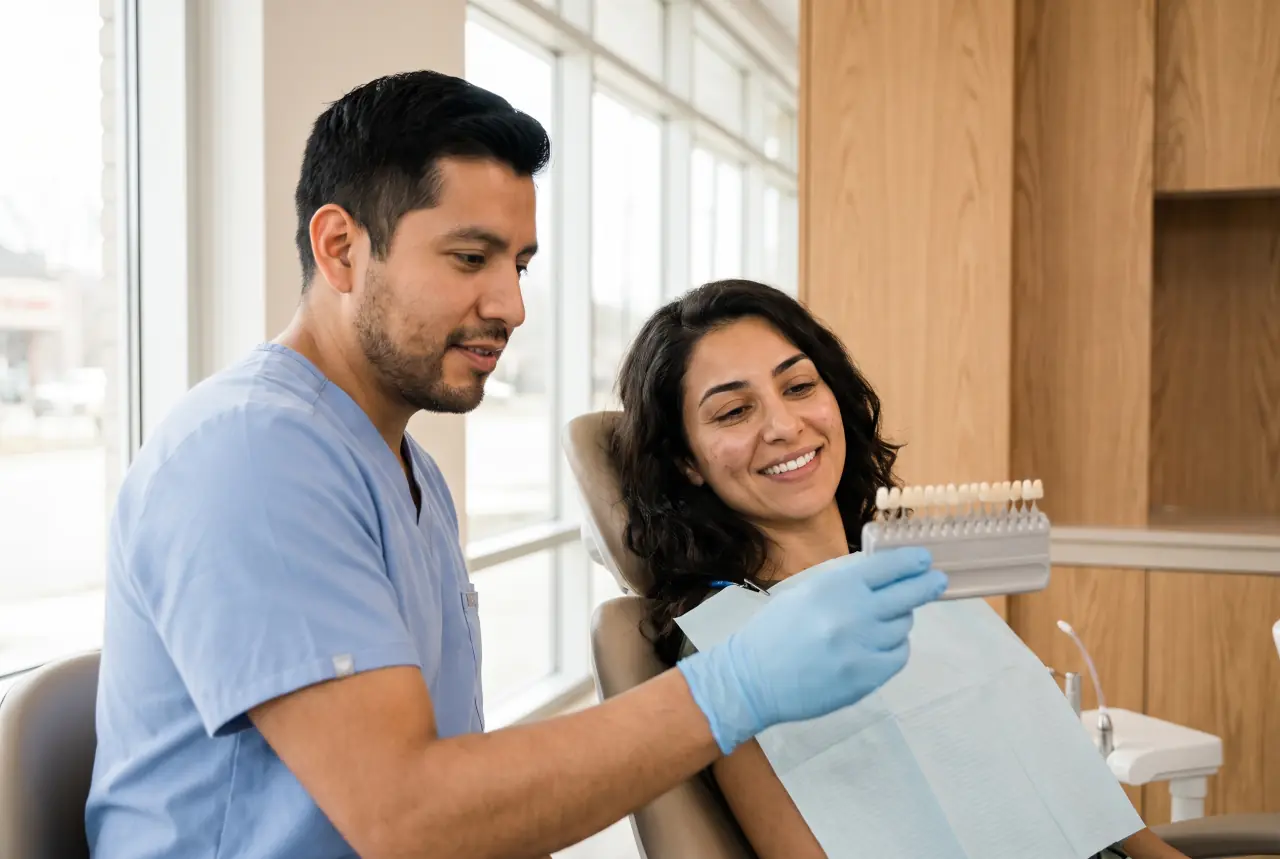
Veneers in Mexico can cost much less than in the U.S., and the decisions that shape your result are ones you can make before any tooth is prepared. Start with what each tooth will get: a veneer covers only the front surface, while a crown covers the whole tooth and needs more of it removed. A licensed dentist should examine you, treat any decay or gum disease first, and put the plan in writing, tooth by tooth.
Porcelain veneers usually take 2 visits, with lab time in between. Because a small amount of enamel is removed to place them, they’re a long-term commitment: they need daily care and may need repair or replacement over the years.
At a glance
- Price
- Priced per tooth, below U.S. ranges; see the price table
- Visits
- Porcelain: usually 2, with lab time in between. Composite may need fewer
- Reversible?
- No. Enamel is removed to place a veneer, so plan for daily care and possible repairs over the years
- How long they last
- Normally around 8 to 10 years if properly cared for, in a British dental hospital’s guide
- Veneer or crown?
- A veneer covers the front of a tooth; a crown covers all of it and needs more tooth removed
- Check first
- The dentist’s professional license number (cédula profesional), in Mexico’s public registry
Key takeaways
- Get the plan in writing, tooth by tooth: veneer or crown, which material, how much tooth comes off, and why.
- Have any decay or gum disease treated first, and mention clenching, grinding or a deep overbite at your exam.
- Ask whether whitening, bonding or aligners could give you the result with less tooth removed.
- Look up the dentist’s professional license number in Mexico’s public registry before you travel.
- Get a written schedule that allows for lab time and a bite check, and agree who repairs a veneer that chips once you’re home.
In this guide
- What are veneers? Porcelain vs. composite
- Are veneers permanent, and how long do they last?
- Veneers vs. crowns: what will each tooth get?
- Are your teeth and gums ready for veneers?
- Could whitening, bonding or aligners do the job instead?
- How much are veneers in Mexico?
- How many days do you need in Mexico for veneers?
- How to check a dentist in Mexico
- Questions to ask the dentist before you agree
- Before you go: checklist
- Warning signs after veneers or crowns
- Frequently asked questions
- Sources
What are veneers? Porcelain vs. composite
Veneers are thin, custom-made coverings for the front of teeth. They can improve teeth that are chipped or broken, stained, crooked or misshapen, and can mask gaps (American Dental Association, ADA). Each is a thin layer of porcelain or natural-colored material fitted over the front of the tooth, similar to how a false fingernail is applied (NHS).
There are two main types, and each has its benefits (ADA):
| Porcelain veneer | Composite veneer | |
|---|---|---|
| What it is | A thin shell custom-made in a dental lab to fit the front of the tooth | Tooth-colored filling material bonded and sculpted on the tooth |
| Enamel removed | A small amount from the front and sides | May need less |
| Visits | Impression or 3D scan, lab work, maybe a temporary, then fitting | May need fewer visits |
| Strengths and limits | Strong, long-lasting and natural-looking | Easier to fix if damaged, but not as stain- or wear-resistant |
| Price | Tends to be the more expensive of the two | Tends to be the less expensive of the two |
Composite veneers are a form of direct composite bonding: tooth-colored resin is stuck to the tooth, often with minimal, if any, visible removal of tooth tissue. Carefully planned and done, bonding can be an excellent, minimally invasive choice (General Dental Council blog). This blog and another on crowns, both written for dental professionals by the lead clinical adviser for fitness to practise at the General Dental Council (GDC), the UK’s dental regulator, draw on complaints he has reviewed; the council itself doesn’t set clinical guidance. Many complaints about bonding come from patients not being made fully aware of composite’s limits: it is more porous than enamel and prone to staining, and it loses its shine, wears, chips and can come unstuck, so it needs polishing, repair and, in time, replacement. Knowing that at the start lets you ask how often yours will need care, and at what cost.
Are veneers permanent, and how long do they last?
Why it matters: veneer treatment is not reversible, because enamel is removed to place a veneer, so the plan you agree to is one you’ll look after for years (ADA).
For the tooth underneath, the change is permanent. For porcelain, the dentist removes a small amount of enamel from the front and sides of each tooth to prepare it for bonding (ADA); some veneers need the front of the tooth drilled away a little, but not all do (NHS). Composite is sometimes described as the reversible option. It can technically be removed, but getting all of it off without altering or damaging enamel is extremely difficult, and calling bonding “reversible” risks misleading patients (GDC blog).
Dental sources give ranges, not promises. A crown or veneer that is properly cared for should normally last around 8 to 10 years, depending on regular dental check-ups, good brushing and flossing, and a low-sugar diet (Leeds Dental Institute, an NHS dental hospital). Most crowns should last at least 5 years and can last as long as 15 to 20 years (MedlinePlus). We found no official figure for how long composite veneers last.
What that means for your plans:
- Upkeep, not a one-time purchase. A veneer may chip, crack, wear down or loosen over time, and your dentist may need to re-bond, repair or replace it. You can still get cavities under or around a veneer (ADA).
- Replacement over a lifetime. With lifespans like these, a veneer placed in your 20s or 30s could need replacing more than once.
In one case the council’s adviser reviewed, repeated composite repairs led to porcelain veneers, which failed because there wasn’t enough enamel, and then to full crowns, which also failed; by then, a lot of healthy tooth had been lost unnecessarily. When treatment fails, taking a step back is often necessary and may mean involving other dental professionals (GDC blog), so if a repair keeps failing, get another dentist’s view before agreeing to more invasive work.
How to check: before you agree, ask the dentist:
- What upkeep your veneers will need, and how often they want to see them.
- What a repair, re-bonding or replacement would cost, and whether the work is covered for a set period (GDC).
- Whom to contact if something needs fixing once you’re home.
Tell your dentist at home about the plan before you go; they’ll need to know it in case of later complications (GDC). Once your veneers are in, these habits help them last (ADA):
- Don’t bite your nails or chew on hard objects or foods.
- Wear a mouthguard for sports or activities that could injure your mouth.
- Go easy on coffee, tea and red wine, which may stain or discolor a veneer.
- Brush with fluoride toothpaste twice a day and clean between your teeth daily.
Veneers vs. crowns: what will each tooth get?
Why it matters: a crown needs more tooth removed than a veneer, and the best option is often one that preserves as much natural tooth as possible (Leeds guide).
A crown is a cap that completely covers a real tooth, and the tooth has to be shaped so the crown can be fixed on (NHS). Crowns can make a tooth stronger, protect a weak tooth from breaking, restore a broken one and attach bridges (ADA). A crown can fall off if the core of the tooth holding it is too weak; if the nerve is affected, the tooth may need a root canal, or it may have to be pulled and replaced with an implant (MedlinePlus; see dental implants in Mexico).
How much tooth comes off is the key difference. Veneers usually involve removing some tooth structure, but not as much as for a crown (Leeds guide). Crown preparation is invasive: for tooth-colored crowns, it may involve the irreversible removal of up to 60% to 70% of the tooth structure above the gum line, by volume. Irreversible damage to the pulp, the tooth’s nerve and blood supply, is a recognized complication, estimated at 4% to 8% within 10 years of treatment (GDC crowns blog). That’s a general estimate, not a prediction for you, and your dentist can explain what it means for your teeth. A minor chip on a moderately filled molar does not, in itself, always justify a full-coverage crown (GDC crowns blog).
| Veneer | Full-coverage crown | |
|---|---|---|
| Covers | The front surface only | The whole visible tooth above the gum line |
| Tooth removed | Usually some, but not as much as for a crown; not every veneer needs it | The tooth is shaped to take the crown |
| Reversible? | No: enamel is removed to place it | No: the removal is irreversible |
| Common reasons | Chips, stains, gaps, misshapen teeth | Too little tooth left to hold a filling; a broken, worn, cracked, discolored or badly shaped tooth; bridges; implants (MedlinePlus) |
Crowns are still a valuable part of restorative dentistry and can offer excellent long-term outcomes when fundamental principles are followed (GDC crowns blog). The question for any plan is whether each tooth needs one.
What UK dental bodies said about “Turkey teeth”
In the UK, “Turkey teeth” has become shorthand for full-mouth smile makeovers bought abroad. By 2025 the trend had taken off over the previous 5 years, with social media an important driver; Turkey isn’t the only destination, though it has become the poster child. Posts in one online group about clinics in Turkey showed super-white smiles with a minimum of 24 zirconia units, or implant-supported full arches. The “before” photos often showed sound teeth that whitening or simple orthodontic treatment could have improved dramatically, and some showed gum disease and decay that needed attention first (British Dental Association blog, 2025). Most of the work described is crowns, and as the blog’s author, chair of the Northern Ireland Council of the British Dental Association (BDA), put it, 24 cheap crowns you don’t need aren’t value.
A 2022 survey of 1,000 UK dentists by the BDA looked at dental treatment abroad in general, without naming a country. Of them, 94% had examined patients who had traveled abroad for dental treatment, and 86% of those had treated cases that developed problems afterward (BDA survey, 2022). The figures describe what dentists reported, not how often treatment abroad leads to problems or what will happen in your case. Each finding points to a step you can take:
- 87% named crowns as the treatment most likely to need follow-up work, closely followed by implants at 85%. Ask why each crown in your plan is needed.
- Several reported concerns about over-prepared teeth, where more of a tooth was removed than necessary, and ill-fitting crowns. Ask how much will come off each tooth, and why.
- Others worried that treatment had gone ahead despite untreated gum disease, which was likely to raise the risk of crowns and implants failing. Have it treated first; see whether your teeth and gums are ready.
- Some reported extensive “smile makeover” work on previously healthy teeth, which would need a lifetime of costly maintenance or could even lead to losing teeth and needing dentures. Ask whether a less invasive option would get you there.
The lesson isn’t about any one country’s dentists. The BDA blog’s author writes that there are good dentists in countries popular for dental tourism, but that patients can’t tell which ones they are (BDA blog). What you can control is the plan: veneer or crown, which teeth, and why. If a plan would replace every tooth in a jaw with a bridge on implants, read our guide to All-on-4 in Mexico first.
How to check: ask for the plan in writing, tooth by tooth, before any tooth is prepared:
- A veneer or a crown for each tooth, the material, and why.
- How much tooth will be removed from each one.
- For each crown, whether a tooth-colored filling, a porcelain veneer on a front tooth where the bite isn’t heavy, or a partial-coverage restoration such as an onlay could work instead (Leeds guide; GDC crowns blog).
- For a plan that covers many teeth or a full arch, a second opinion from your dentist at home, who can advise on your options and whether the treatment is necessary (NHS checklist).
Think carefully before booking if you meet a hard sell, a lack of information, pressure to decide quickly, no discussion of possible complications or no mention of aftercare (NHS checklist). If you aren’t satisfied with the answers you’re given, you don’t have to commit to anything that day (GDC).
Are your teeth and gums ready for veneers?
Why it matters: placing veneers over unhealthy teeth may worsen existing dental problems, so any decay or gum disease is treated first (ADA).
Talk through your dental history, expectations and any reservations with your treating dentist; they’ll help you decide whether veneers are right for you (ADA). These can change the plan:
- Clenching, grinding or a deep overbite. Veneers may not be a good choice (ADA). If you grind or clench and get a crown, you may need to wear a bite splint or mouth guard at night to protect it (MedlinePlus).
- For crowns: a crown may not be suitable with poor oral hygiene, high decay rates, active and extensive gum disease, clenching or grinding, minimally restored teeth (teeth with few or small fillings), or for young patients (Leeds guide).
- For composite: bonding may not suit people with bruxism (grinding or clenching), unrealistic expectations, poor oral hygiene or limited commitment to maintenance (GDC blog).
How to check: before you travel:
- Talk to your dentist at home first; they may be able to advise based on your dental history (GDC).
- Have your full medical history ready. The dentist assessing you should ask for it, along with your general health, past serious illnesses, any chronic condition, whether you smoke, and past surgery or general anesthetic (GDC).
- Ask whether decay or gum disease will be treated first, and how that changes your schedule.
- Mention clenching, grinding or a deep overbite, and ask how the plan allows for it.
A dentist who wants to treat decay or gum problems before placing veneers, even if that means another trip, is following the order the American Dental Association describes. If a plan skips that step, it’s a good moment for a second opinion (NHS checklist).
Could whitening, bonding or aligners do the job instead?
Why it matters: unlike bonding, a porcelain veneer needs a small amount of enamel removed to make room for the shell, so a gentler option is worth ruling in or out first (ADA).
Bleaching, composite bonding and orthodontics are minimally invasive ways to improve a smile (BDA blog). Which fits your teeth is your dentist’s call, but each is worth asking about:
- Whitening, if color is the main issue. It can only lighten the color of natural teeth, and the effect may last around 3 years if you follow your dentist’s advice; a dentist should check that your teeth and gums are healthy first (NHS). A veneer’s shade is picked to match your natural teeth (ADA), so ask whether to whiten before that choice is made.
- Bonding, for chips, small gaps or shape. It’s often done with little or no visible removal of tooth, and it needs regular upkeep (see porcelain vs. composite).
- Braces or clear aligners, for crooked or crowded teeth. Removable aligners or clear brackets can straighten them (ADA). In the 2022 survey of UK dentists, one reported a young man who had 21 full crowns inappropriately placed for what was clearly an orthodontic case (BDA survey, 2022).
How to check: tell the dentist what bothers you most, whether it’s color, chips, gaps or crooked teeth, and ask:
- Which options fit, and how much tooth each one removes.
- Whether to whiten first, before a veneer shade is chosen.
- For a mock-up, digital smile design or wax-up before any tooth is prepared. Visual aids like these may help you understand what is realistically achievable (GDC blog).
How much are veneers in Mexico?
Why it matters: veneers are priced per tooth, so your total depends on how many teeth the plan covers, which treatment each gets and what the quote includes.
| Treatment | Tijuana (USD) | United States (USD) |
|---|---|---|
| Porcelain veneers, per tooth | $400 – $800 | $1,000 – $2,500 |
Uriym’s indicative ranges from its dental price catalog, reviewed September 7, 2026. They are not quotes and cover the listed treatment only, without taxes, travel or third-party charges.
For a full smile, multiply by the number of teeth in your plan. If composite veneers, crowns or treatment before veneers are part of it, ask for each to be priced separately. Veneers are considered cosmetic dentistry, so insurance may not cover them unless they’re deemed medically necessary (ADA). Follow-up care for complications after treatment abroad can be expensive and might not be covered by your health insurance, so review your policy and plan for the possibility of paying for extra care yourself (CDC).
How to check: confirm costs in advance, when possible (U.S. Embassy in Mexico). Ask for a written estimate that lists:
- The number of teeth, and which ones.
- A veneer or a crown for each tooth, and the material.
- The exam, X-rays and scans or impressions.
- Any treatment needed first, such as fillings or gum care.
- Tooth preparation.
- Temporaries while the lab works.
- Lab fees, and which lab.
- The try-in, adjustments and bite check before final bonding.
- Follow-up visits, and what happens if a veneer chips or comes loose: repair, re-bonding or replacement, for how long, and at whose cost.
- Who pays for extra flights, hotel and remedial work if you’re unhappy with the result (GDC).
Also allow for exchange rates, a possibly longer stay and the cost of possible return trips (NHS checklist). For costs outside the dental chair, such as travel, time off and follow-up at home, see what a medical tourism quote should include.
How many days do you need in Mexico for veneers?
Why it matters: the lab time between visits shapes how long you stay, or whether you make 2 trips.
It depends on the material, the number of teeth and the dentist’s lab. The usual steps for porcelain:
- Exam and planning. A qualified dentist should assess you before you get a treatment plan and cost estimate (GDC). Where needed, X-rays, scans and photos may be taken to support an accurate diagnosis and plan (GDC blog).
- Treatment first, if needed. Decay or gum disease is treated before veneers, which can mean a separate visit or trip.
- Preparation. The dentist removes a small amount of enamel to prepare each tooth for bonding, then takes an impression or 3D scan so a dental technician can custom-make veneers to fit (ADA). You may wear temporary veneers until yours are ready.
- Lab time. In one dental hospital’s guide to crowns and veneers, the first visit ends with an impression sent to the lab and a temporary crown to protect the tooth; the permanent crown is ready to fit 2 weeks or so later (Leeds guide). Some dentists can scan a tooth and make a crown in their own office (MedlinePlus).
- Try-in and bonding. The dentist checks the fit and shape, makes any adjustments, cleans the teeth and bonds the veneers (ADA).
- Bite check. It may take a few days to get used to a veneer; tell your dentist if your bite doesn’t feel right so they can correct it (ADA). Bite problems are a common source of complaints after crowns (GDC crowns blog), so it helps to be nearby for this check.
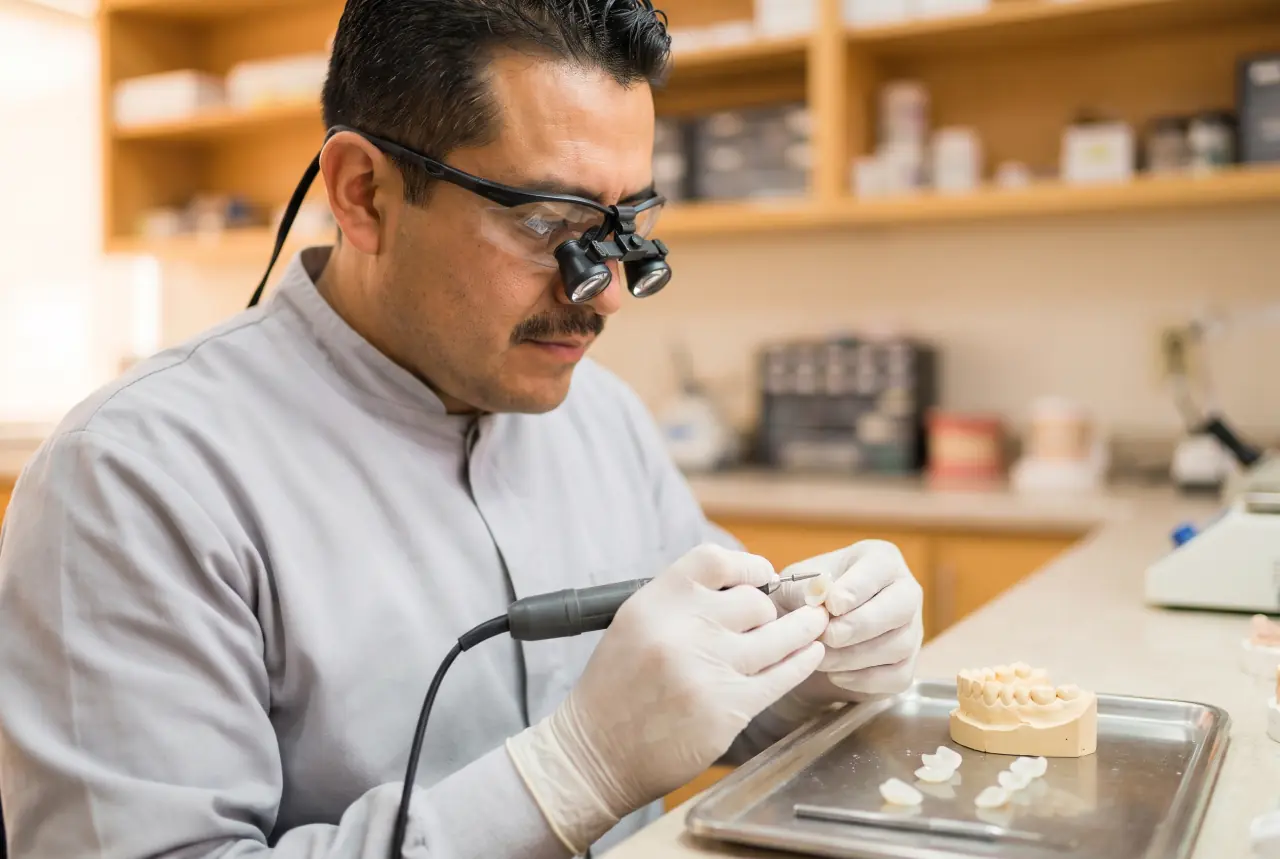
Composite veneers are bonded and sculpted on the tooth instead, hardened with a special light so they bond to it, then smoothed and polished to look like your natural teeth (ADA).
We found no official source that sets a number of days for travelers. Stay in the country where you were treated for a suitable length of time to recover before traveling home (NHS checklist).
How to check: ask the dentist for a written schedule before you book flights:
- How many days between preparation and fitting, and where the lab is.
- When they want to see you after bonding to check your bite.
- Whether treatment needed first means a separate trip.
Before you fly home, get copies of all your records, including X-rays, scans and the material used on each tooth, translated into English if needed, so a dentist at home can see what was done (CDC). If you’re treated in Tijuana, each visit may mean a border crossing; see crossing the border to Tijuana.
How to check a dentist in Mexico
Why it matters: veneers should be placed only by a licensed dentist (ADA), and in Mexico you can confirm a license yourself before you travel.
In Mexico, a dentist’s license is a cédula profesional (professional license number), and the national registry of professionals run by the Ministry of Public Education (Secretaría de Educación Pública, SEP) has a public lookup (cédula lookup, in Spanish). Veneer services from unlicensed individuals may come with potential risks for infection and nerve damage, and an unlicensed person may unknowingly place veneers over unhealthy teeth (ADA).
Dental regulation is likely to vary by country, so it also helps to ask whether the dentist is regulated by a professional body and registered with it (GDC). Receiving care where you don’t speak the language fluently could lead to misunderstandings about your care, so decide ahead of time how you’ll communicate with the dentist (CDC).
A verified license is a strong starting point. It’s one part of a safe plan, alongside a written plan for each tooth and clear follow-up once you’re home. For other treatments, our guide to a dentist in Tijuana covers choosing one.
How to check:
- Ask for the full name of the dentist who will treat you, and look up their cédula profesional.
- Ask what qualifications they have, and how many times they’ve done this procedure (GDC).
- Ask whether the team speaks English, or whether there will be a translator.
- Check the clinic’s credentials too (CDC). For its health license and the State Department’s current travel advisory for Baja California and Jalisco, see how to check a doctor and clinic in Mexico.
Questions to ask the dentist before you agree
Ask as many questions as you need, even ones that seem blunt or obvious; the consultation is your chance to feel confident in your decision (GDC). Take this list with you:
- Is each tooth getting a veneer or a crown, and why that choice for that tooth?
- How much enamel or tooth will you remove from each tooth?
- Would whitening, bonding or aligners get me what I want with less tooth removed?
- Do I have decay, gum disease, grinding or a deep overbite that changes the plan?
- Which material will you use, which lab makes the veneers, and how long does the lab take?
- Can I see a mock-up or preview before any tooth is prepared?
- Who will do the work, what are their qualifications, and how many times have they done this procedure?
- Will the dental team speak English? If not, will there be a translator?
- What if a veneer chips, cracks or comes off after I get home? Who repairs it, for how long is that covered, and who pays for the travel?
- What aftercare do you provide, and whom do I contact after treatment?
- Will I get copies of my records, X-rays and the material details to take home?
- Can I have the plan and the price in writing?
Before you go: checklist
- Plans talked through with your dentist at home
- Any decay or gum disease treated, or scheduled first
- Plan in writing, tooth by tooth: veneer or crown, material, how much tooth comes off and why
- Whitening, bonding and aligners discussed as alternatives
- Itemized written estimate, including repair and replacement terms
- Dentist’s cédula profesional looked up
- Written schedule with lab time and a bite check; flights planned around it
- Insurance checked for follow-up care at home
- Copies of your records, X-rays and material details arranged before you fly home
- Current State Department travel advisory read; see how to check a doctor and clinic in Mexico
Warning signs after veneers or crowns
With any concern about new veneers or crowns, contact the dentist who treated you, and tell your dentist at home. After a crown, contact your dentist if you have (MedlinePlus):
- Swelling that is getting worse
- A bite that doesn’t feel right
- A lost temporary crown, or a tooth that feels out of place
- Pain that over-the-counter pain medicine doesn’t relieve
Once a permanent crown is in place, a tooth that still has its nerve may have some sensitivity to heat or cold, which should go away over time (MedlinePlus).
In an emergency, call 911, which works in the U.S. and in Mexico. English-speaking operators may be available in Mexico, but it’s best to have a Spanish speaker place the call (U.S. Embassy in Mexico).
Frequently asked questions
Do they shave your teeth for veneers?
Usually a little. For a porcelain veneer, the dentist removes a small amount of enamel from the front and sides of the tooth, and a composite veneer may need less (American Dental Association); not every veneer needs the tooth drilled (NHS). A crown takes more tooth than a veneer, so ask the dentist to say, tooth by tooth, which one you’re getting.
Can veneers be removed later?
The veneer itself can be repaired or replaced, but the treatment isn’t reversible, because enamel is removed to place it (American Dental Association). Composite is sometimes called the reversible choice, yet removing all of it without altering or damaging enamel is extremely difficult (General Dental Council blog). Settle the plan before any tooth is prepared, and treat veneers as a long-term commitment.
How many days do I need in Tijuana for veneers?
It depends on your dentist’s plan and where the lab is. Porcelain veneers usually take 2 visits: preparation with an impression or scan, then fitting once the lab has made them. In one dental hospital’s timeline for crowns and veneers, the permanent crown is ready 2 weeks or so after the first visit (Leeds Dental Institute), and some dentists can make crowns in their own office (MedlinePlus). Ask for the schedule in writing, including a bite check, before you book travel; see how many days to plan.
Are Turkey teeth veneers or crowns?
Mostly crowns, going by a British Dental Association blog: full arches of zirconia, often on teeth that whitening or orthodontics could have improved. A veneer covers only the front of a tooth; a crown covers all of it and needs more tooth removed. Ask for the plan tooth by tooth; see veneers vs. crowns.
Can you whiten veneers?
No. Whitening can only lighten the color of natural teeth, which is why it isn’t recommended for crowns, dentures or implants (NHS), and a veneer isn’t a natural tooth. The teeth beside it can darken with age, coffee, tea, red wine or smoking. If you want a whiter smile overall, ask your dentist whether to whiten first, before the veneer shade is chosen.
What happens if a veneer chips after I get home?
Contact the dentist who placed it first. Veneers can chip, crack, wear down or loosen and may need re-bonding, repair or replacement, and composite is easier to fix if damaged (American Dental Association). Before treatment, ask what aftercare the clinic provides, whether the work is covered for a set period, and who pays for extra flights, hotel and remedial work (General Dental Council). Tell your dentist at home about the work as well.
How much are porcelain veneers in Mexico?
Uriym’s indicative range for porcelain veneers is $400 to $800 per tooth in Tijuana, compared with $1,000 to $2,500 per tooth in the U.S. These ranges are indicative, not quotes. Your price depends on the exam, how many teeth are involved, the material and any treatment needed first, so ask for a written estimate, tooth by tooth, before you compare.
Does insurance cover veneers?
Possibly not. Veneers are considered cosmetic dentistry, so insurance may not cover them unless they’re deemed medically necessary (American Dental Association). Follow-up care for complications after treatment abroad can be expensive and might not be covered either (CDC). Check your policy before you travel; see what to budget for.
Sources
- Veneers American Dental Association (MouthHealthy)
- 8 Ways to Improve Your Smile American Dental Association (MouthHealthy)
- Dental treatments NHS
- Crowns Leeds Teaching Hospitals NHS Trust (Leeds Dental Institute)
- Dental crowns MedlinePlus, U.S. National Library of Medicine
- Going abroad for dental treatment General Dental Council
- Heavy is the Head: Complaints about dental crowns – sharing insights and learning (blog by Shamir B. Mehta) General Dental Council
- ‘Bonding boom’ - composite bonding insights for dental professionals (blog by Shamir B. Mehta) General Dental Council
- UK dentists picking up the pieces from dental tourism boom British Dental Association
- Northern Ireland: Navigating dental tourism British Dental Association
- Treatment abroad checklist NHS
- Teeth whitening NHS
- Medical Tourism: Travel to Another Country for Medical Care U.S. Centers for Disease Control and Prevention
- Cédula profesional (in Spanish) Secretaría de Educación Pública, Gobierno de México
- Message to U.S. Citizens: Winter Season (Snowbird) Travel U.S. Embassy & Consulates in Mexico
About this guide
The Uriym editorial team researched this guide from the 15 sources above, drafted it with AI assistance, and checked it claim by claim against those sources before publishing, last on . Our editorial standards explain how we choose sources, handle prices and make corrections.
Uriym is a healthcare navigation platform, not a medical provider. Its founder, Adriana Mendez, grew up in a family that traveled to Mexico for care and has done it herself for the past ten years. How Uriym works
This is general information, not medical, legal or financial advice: your treating provider decides what care is right for you. Rules, prices and advisories change, so check the official page before you act. Found something wrong or out of date? Email support@uriym.com.