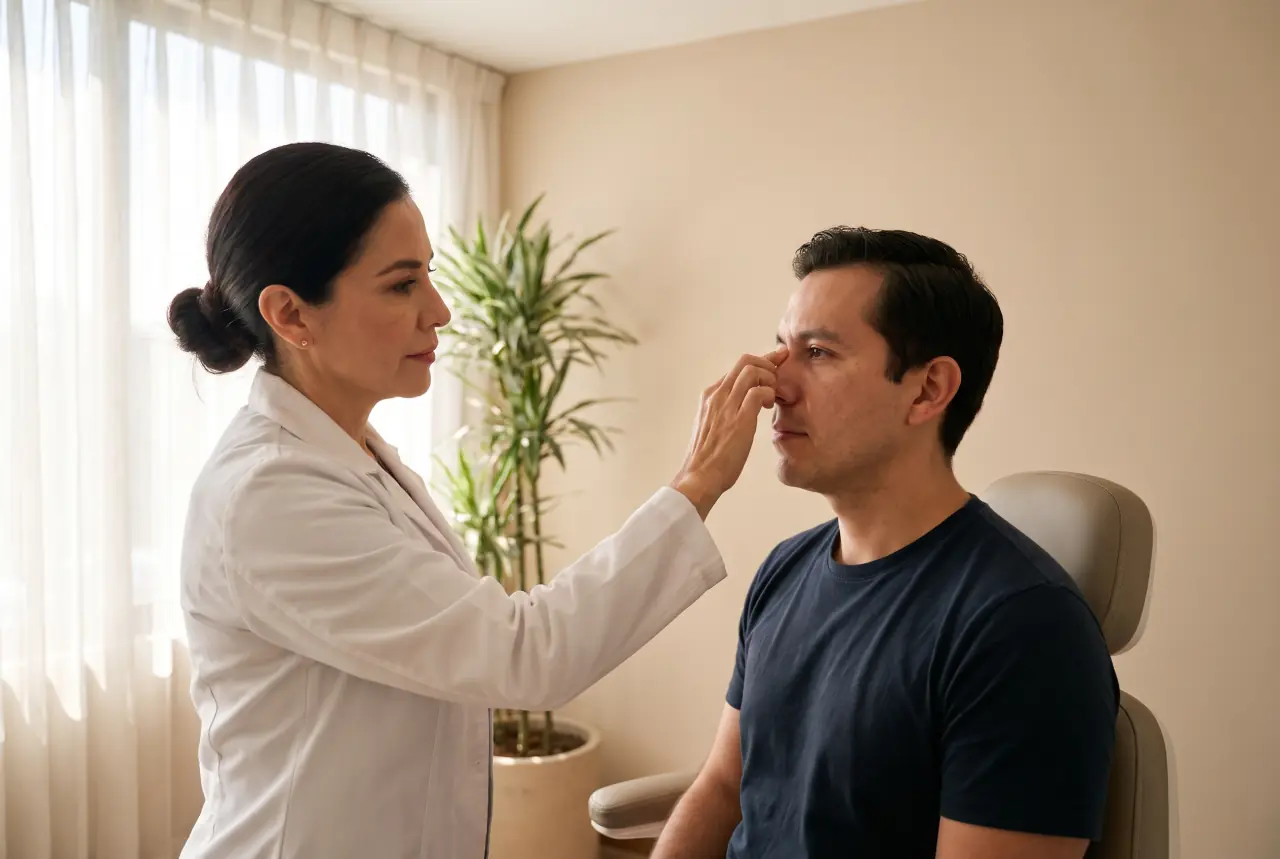
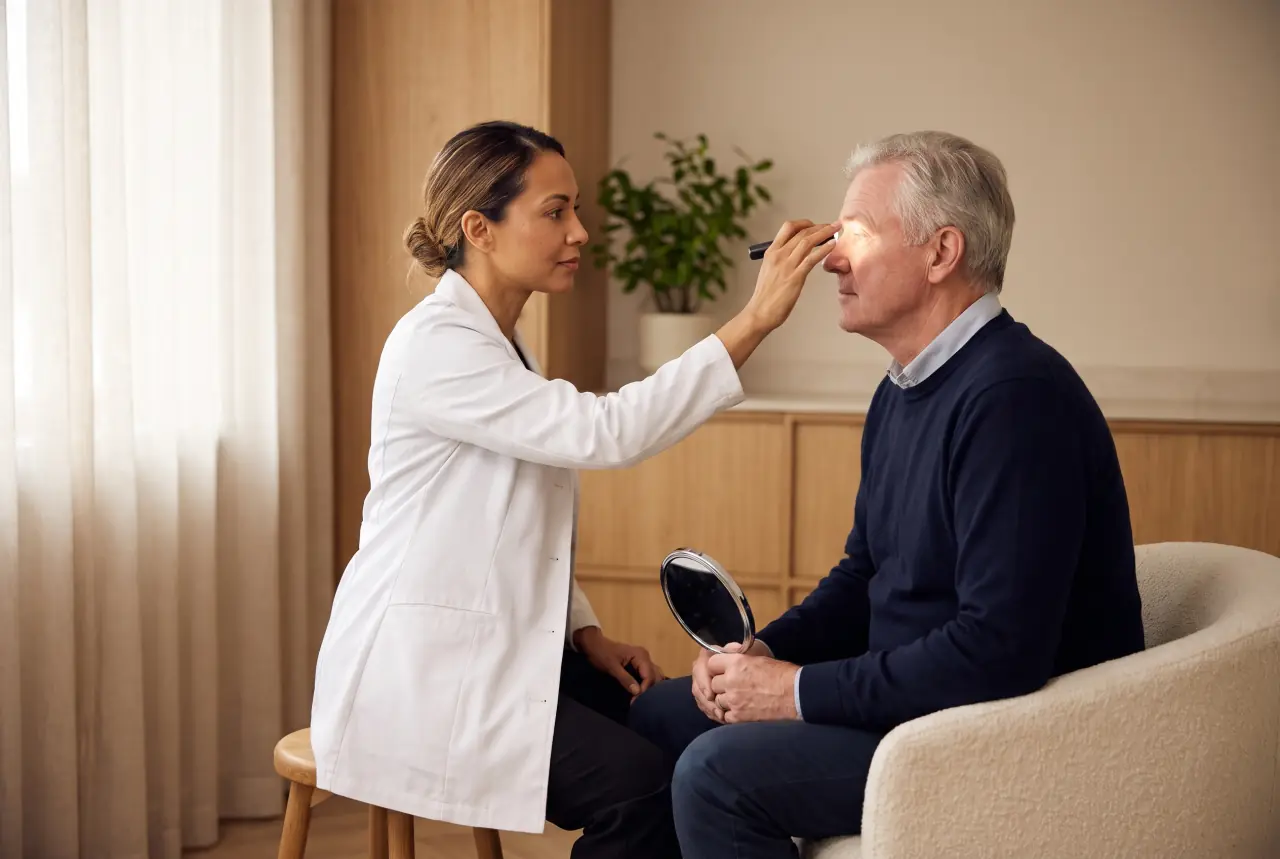
Eyelid surgery in Mexico, in Tijuana or another city, can be a sound plan when four things are settled before you pay a deposit: an examination has shown whether extra skin, puffy fat, a weak lid muscle or a low brow causes what you see; your eyes and health suit surgery; the surgeon’s licenses, council certificate and record with eyelids check out; and your stay covers the first night and the stitch check. You can look into each from home.
Eyelid surgery, or blepharoplasty, removes or repositions extra skin, muscle and fat in the upper lids, the lower lids or both, and it can improve vision that drooping upper-lid skin has blocked (American Academy of Facial Plastic and Reconstructive Surgery, AAFPRS, a U.S. professional society). Whether it suits you, and which approach, is your surgeon’s decision, and your doctor at home can help you think the plan through.
At a glance
- What it changes
- Extra skin, and sometimes fat and muscle, of the upper lids, the lower lids or both; it can also improve vision that drooping upper-lid skin blocks
- What it typically doesn’t do
- Lift sagging brows, remove crow’s feet, eliminate dark circles or correct significant hollowing under the eyes; other treatments may suit those better
- A weak lid muscle
- A droop from a stretched lid muscle, called ptosis, needs a different operation from removing skin
- The operation
- About an hour for the upper lids alone and around 2 to 3 hours for both; most people go home the same day
- Back to work
- Most people feel ready in 7 to 10 days, and about 2 weeks off is usual in British practice; stitches that need removing come out within a week
- Flying home
- Published guidance after cosmetic eyelid procedures is to wait 7 to 10 days; your surgeon sets your date
Key takeaways
- Have the cause of your heavy or puffy lids examined first, since extra skin, a stretched lid muscle and a low brow each call for a different treatment.
- If skin hangs into your line of sight, ask a U.S. eye doctor and your health plan whether surgery at home could be covered before you compare prices in Mexico.
- Tell your surgeon about dry eye, glaucoma, thyroid eye disease, contact lenses, recent eye surgery and every medicine and supplement, and ask how each changes the plan.
- Before you pay a deposit, look up your surgeon’s licenses and council certificate, and ask how many eyelid operations they do and to see results on eyes like yours.
- Get a written quote that lists the lids, the anesthesia, the facility, stitch removal, checkups and revision terms, and spend the first night near your surgeon.
In this guide
- What eyelid surgery can change, and what it can’t
- Droopy lids: extra skin, a weak muscle or a low brow
- Cosmetic or functional: when extra skin blocks your vision
- Your eyes and health: what to raise before you book
- The operation: upper, lower or both, and the anesthesia
- Risks of eyelid surgery, and what you can do about each
- Checking your surgeon: specialty, certificate and eyes like yours
- Recovery: cold compresses, stitches and the first two weeks
- How much does eyelid surgery in Mexico cost?
- How long to stay, flying home and crossing back
- Questions to ask your surgeon about eyelid surgery
- Before you go: checklist
- Warning signs after eyelid surgery
- Frequently asked questions
- Sources
What eyelid surgery can change, and what it can’t
Upper-lid surgery deals with heavy skin that hoods the eyes, and lower-lid surgery mainly with puffiness or bags (AAFPRS).
| Where | What the surgeon can do |
|---|---|
| Upper lids | Through a cut in the lid’s natural crease, remove extra skin, tighten muscle, and remove or reposition fat (American Society of Plastic Surgeons, ASPS); the scar usually sits in the fold (NHS) |
| Lower lids, from outside | Through a cut just below the lashes, remove extra skin and remove or reposition fat (ASPS) |
| Lower lids, from inside | Through a cut inside the lid, remove or redistribute fat with no skin removed (ASPS) and no visible scar outside (AAFPRS) |
Eyelid surgery typically doesn’t lift sagging brows, remove crow’s feet, eliminate dark circles, correct significant hollowing under the eyes or change your eyes’ shape or color. Suggested alternatives are a brow lift or a neurotoxin such as Botox for the brows, a neurotoxin or laser resurfacing for crow’s feet, lasers that target pigment or visible blood vessels for dark circles, and fillers or fat grafting for hollowing (AAFPRS). For injections, see what Botox and dermal fillers are; laser near the eyes has its own checks (who CO2 resurfacing suits), and a facelift works lower on the face (what a facelift can and can’t change).
Treatments without surgery can’t remove extra lid skin or move the fat pads beneath it, and for moderate to severe drooping skin or prominent bags, AAFPRS calls surgery the most effective and definitive option. The improvement may last 10 to 15 years, sometimes longer, as your face goes on aging (AAFPRS).
Droopy lids: extra skin, a weak muscle or a low brow
Why it matters: a heavy upper lid can come from extra skin, a stretched lid muscle or a sagging brow, and each one calls for a different treatment (ASPS; AAFPRS).
| What causes the droop | What it is | What treats it |
|---|---|---|
| Extra skin (dermatochalasis) | Loose, redundant skin and muscle of the lid (StatPearls, a review for clinicians) | Eyelid surgery |
| A weak or stretched lid muscle (ptosis) | In adults, usually aging, as the tendon of the muscle that raises the lid stretches or loosens; eye surgery such as a cataract operation; an injury; or muscle or nerve problems (American Society of Ophthalmic Plastic and Reconstructive Surgery, ASOPRS, a U.S. society of eyelid surgeons) | A different operation (ASPS), which in most cases tightens that muscle (ASOPRS) |
| A sagging brow | Relaxed forehead skin and eyebrows can make the upper lid look droopy (ASPS) | A brow lift, or a neurotoxin (AAFPRS) |
The causes can overlap: upper-lid surgery can include managing an underlying ptosis, and afterward the brows drop, which can reveal a sagging brow, especially in men (StatPearls). A droop can also be linked to a condition such as myasthenia gravis, which causes muscle weakness (ASOPRS). If yours began after a toxin injection, the Botox guide’s warning signs say what to do.
How to check: at your examination, ask:
- Is my droop from extra skin, the lid muscle, my brows, or a mix?
- If the muscle or brow is involved, which operation would you add, and is it quoted?
- If one lid began drooping recently, or the droop comes and goes, should I see an eye doctor first?
Cosmetic or functional: when extra skin blocks your vision
Why it matters: when upper-lid skin blocks your sight, surgery can count as medically necessary, and a U.S. health plan may then pay some or all of it, which changes the comparison with paying in Mexico.
Heavy upper-lid skin can droop far enough to block side vision and make reading or driving harder (ASOPRS). Surgery for that reason, called functional blepharoplasty, is considered medically necessary when droopy lids interfere with vision, and the surgeon tests whether that applies to you; insurance may then cover the cost if certain criteria are met, but cosmetic eyelid surgery is not covered (ASOPRS). Surgery to improve vision may be reimbursed in whole or in part; checking the degree of coverage with your insurer is up to you (AAFPRS; ASPS). A formal visual field test is sometimes used to show objectively how much of your upper field of vision is narrowed (StatPearls). Whether a U.S. plan pays anything for care in Mexico is a separate question, covered in does U.S. insurance cover care in Mexico.
How to check: if your lids get in the way of your sight, before you price surgery in Mexico:
- Ask an eye doctor at home whether your case counts as functional, and whether you need a visual field test.
- Ask your health plan, in writing, what it requires before it pays, and how much it would pay.
- Compare your share of the cost at home with a full written quote from Mexico.
Your eyes and health: what to raise before you book
Why it matters: dry eye, thyroid eye disease, recent eye surgery and some medicines change whether surgery suits you, how it’s planned and when, so your surgeon needs your full history.
England’s National Health Service (NHS) suggests talking the plan through with a family doctor first, since a medical condition may be affecting your eyelids or the operation may not suit you (NHS).
| If this applies to you | What the sources say | What to do |
|---|---|---|
| Dry eyes, or you use artificial tears | A reason for caution; with severe dry eye, the clinicians’ review advises counseling patients to avoid eyelid surgery, since even a moderate increase in how much of the eye is exposed can make the dryness significantly worse (StatPearls) | Say how often you use drops, and ask whether your blink, lid closure and tear film will be assessed |
| Glaucoma or another eye condition | Good candidates don’t have serious eye conditions such as untreated glaucoma (AAFPRS) | Ask the eye doctor treating it whether surgery fits |
| Thyroid eye disease | A reason for caution; with bulging eyes, eyelid surgery may leave the lids unable to close fully, causing problems with the cornea, the clear front of the eye, and with vision (StatPearls) | Ask the doctor treating it whether, and when, eyelid surgery fits your treatment |
| Aspirin, anti-inflammatory painkillers, blood thinners or herbal supplements | Many medicines and supplements can increase the risk of bleeding; in the clinicians’ review, a blood thinner is paused for a week before and up to a week after surgery only once the doctor who monitors it agrees that’s safe (StatPearls) | List everything, naming any aspirin, warfarin or apixaban (NHS), and change a blood thinner only as your prescribing doctor agrees |
| Contact lenses | Trouble wearing them may be linked to low tear production (Zhang et al., 2020) | Mention it, and plan on glasses for a while afterward (see recovery) |
| Eye surgery, including laser vision correction | Earlier eye surgery, refractive procedures included, can leave the eyes needing more lubrication (StatPearls); one review recommends waiting 6 to 12 months after recent eye surgery (Zhang et al., 2020) | Give your surgeon the type and date of each eye or eyelid operation |
| High blood pressure | A common factor among patients who bled behind the eye after cosmetic eyelid surgery (Hass et al., 2004) | Have it checked, and treated if needed, by your doctor at home before the trip |
| Smoking | It significantly impairs healing (AAFPRS) | Stop several weeks before surgery, on your surgeon’s timing |
How to check: list your eye conditions, drops, medicines, supplements and past eye surgery, and take it to your doctor at home, then to the consultation; lining up a doctor at home has the questions to ask.
The operation: upper, lower or both, and the anesthesia
Why it matters: which lids are operated on, and through which cut, decides where your scars sit, how long the operation takes and which risks weigh most for you.
Upper-lid surgery alone may take about an hour, lower-lid surgery 1 to 2 hours, and both together around 2 to 3 hours, usually as an outpatient under local anesthesia with intravenous sedation, which leaves you relaxed and sleepy, or under general anesthesia (AAFPRS). Most people go home the same day (NHS).
AAFPRS calls operating on upper and lower lids in one session very common (AAFPRS). A 2020 review on dry eye advises operating on the upper and lower lids separately to reduce dry eye, citing one study of 892 patients in which dry eye followed 31.3% of combined operations, against 12.9% of upper-lid and 21.4% of lower-lid operations alone (Zhang et al., 2020). These figures come from one study, not a prediction for you; ask your surgeon which plan suits your eyes.
How to check: ask which lids your surgeon would operate on, through which cut and why, how long you’ll be under anesthesia and who gives it; Mexico’s rules for that person are in anesthesia and where the operation happens.
Risks of eyelid surgery, and what you can do about each
Why it matters: most eyelid surgery risks come with steps you can take before and after the operation, and your surgeon should explain how likely each one is and how it would be treated (NHS).
For a sense of scale, a survey of ASOPRS members covering 269,433 cosmetic eyelid operations found bleeding in the eye socket after 0.055%, about 1 in 2,000, and that bleeding with permanent loss of vision after 0.0045%, about 1 in 22,000 (Hass et al., 2004). These are averages from surgeons’ recall, not a prediction for you; the steps that lower this risk are in the table.
| Risk | What it is | What you can do |
|---|---|---|
| Dry, irritated eyes | Reported rates after cosmetic eyelid surgery run from about 0 to 26.5%, and in one study 95% of patients with dry eye recovered fully within 8 weeks (Zhang et al., 2020) | Raise any dry eye beforehand, use drops and ointment as prescribed, and have your eyes examined if symptoms last over 2 weeks (Zhang et al., 2020) |
| Difficulty closing the eyes | Usually temporary (AAFPRS); almost everyone has some at first, settling within a few days (StatPearls) | Lubricate your eyes as directed, and raise lids that still don’t close fully at your checkup |
| A lower lid that pulls down or turns out | A pulled-down lower lid, which is often temporary (ASPS), or, rarely, a lower lid that droops away from the eye and turns outward (ectropion) (NHS). Because healing can pull the lid down or out, a 2020 review advises conservative skin removal there (Zhang et al., 2020) | Ask how your lower lids’ firmness will be tested (StatPearls) and how much skin, if any, will be removed |
| Uneven lids | Small differences are often seen; the clinicians’ review advises waiting for all the swelling to settle, and its authors rarely adjust before 2 months (StatPearls); removing more skin later is easier than fixing too much removed (ASOPRS) | Judge the result once the swelling has gone, and get an adjustment’s price and terms in writing |
| Scarring | Unfavorable scars; how scars settle is in recovery | Ask where each cut will run, see healed results on earlier patients, and follow your scar-care instructions |
| Bleeding behind the eye, and changes in vision | Temporary or even permanent changes in vision, with a very rare chance of blindness. Most bleeding in the eye socket started within 3 hours of surgery and the risk decreased significantly after 24 hours, though it can start days later; high blood pressure, aspirin around the operation, vomiting and more physical activity were common factors (Hass et al., 2004) | Control your blood pressure, change aspirin or blood thinners only as your doctors agree, ask how nausea will be treated, rest as instructed, spend the first night near your surgeon and learn the warning signs |
| Infection | Uncommon (ASOPRS), though infection-related problems are the most common complications among people who travel for care (CDC Yellow Book) | Use any antibiotic ointment as prescribed, keep your hands away from your eyes, and keep to the limits in recovery |
| Anesthesia | Anesthesia risks, including an allergic reaction (NHS) | Tell the team about allergies and every medicine, and check who gives your anesthesia |
| Needing another operation | Revision surgery may be needed | Agree realistic goals, and get revision terms in writing |
Unless another source is named, each risk is on the ASPS list for eyelid surgery.
How to check: ask which of these your surgeon sees most often, how each would be treated, and who would treat a problem once you’re back in the U.S.
Checking your surgeon: specialty, certificate and eyes like yours
Why it matters: plastic surgeons, facial plastic surgeons and eye surgeons trained in eyelid surgery all perform it, so the license and certificate you look up depend on how your surgeon trained.
Many specialists perform upper-lid surgery, from ophthalmologists, plastic surgeons and ear, nose and throat (ENT) surgeons to dermatologists and even general practitioners, and without careful screening of patients, complications may occur (StatPearls). In the U.S., AAFPRS members’ training typically includes a residency in ENT or plastic surgery, then a fellowship in facial plastic surgery (AAFPRS). ASOPRS members trained for 4 years in ophthalmology, the medical specialty of the eyes, then completed a fellowship in cosmetic and reconstructive surgery of the eyelids, eye sockets, tear ducts and face (ASOPRS).
In Mexico, match the check to your surgeon’s training:
- A plastic surgeon: the licenses and council certificate in how to check a plastic surgeon’s credentials, the list Mexico’s education ministry gives for aesthetic procedures.
- An ophthalmologist: licenses in medicine and in the specialty, and a current certificate from the Consejo Mexicano de Oftalmología, one of the councils in the catalog of CONACEM, the national committee of medical specialty councils (CONACEM, in Spanish).
- An ENT-trained surgeon: the ENT council, explained in checking your surgeon’s specialty and certificate.
As that list names the plastic surgery specialty, ask an ophthalmologist or ENT surgeon which license and certificate cover cosmetic eyelid surgery, and what eyelid training they’ve had. Verified licenses and a current certificate are a strong starting point; add the surgeon’s record: how many eyelid operations they’ve done, how many of their operations have had complications, what follow-up you’d get if something went wrong (NHS), and results on eyelids like yours, which help set realistic expectations (AAFPRS).
How to check:
- Get the surgeon’s full name, both cédula profesional (professional license) numbers and their certifying council.
- Look them up with checking a doctor’s license in Mexico, choosing the plastic surgery, ophthalmology or ENT council as it applies.
- Ask for the facility’s health license, using checking a clinic’s health license.
- Look up the licenses of whoever gives your anesthesia, and ask whether the surgeon who operates will see you at your checkups.
Recovery: cold compresses, stitches and the first two weeks
Why it matters: the stitch check and the worst of the bruising and swelling come within the first week or two, so they set your time near the surgeon, while scars take months to settle.
| When | What to expect |
|---|---|
| Going home | Someone drives you home and stays with you for at least the first night (AAFPRS) |
| The first few days | Head propped up on pillows when resting, a cold pack on the lids, and gentle cleaning with prescribed ointment or drops (NHS); eyes may feel sticky, dry, itchy or sensitive to light (AAFPRS). Discomfort is usually mild, eased with over-the-counter pain relievers, avoiding aspirin or ibuprofen unless advised (ASOPRS) |
| About a week | Stitches are removed within a week (ASPS), unless they’re the kind that dissolve (AAFPRS) |
| 1 to 2 weeks | Bruising and swelling may last up to 2 weeks (StatPearls). Most people feel ready for work and light activities in 7 to 10 days, and most surgeons recommend waiting at least 1 to 2 weeks before wearing contact lenses (AAFPRS); in UK practice, about 2 weeks off work is usual (NHS) |
| Weeks to months | Bruises and redness can take several weeks to fade, and scars may show and feel tight for a few months (NHS) |
Where sources differ, your surgeon’s written instructions come first.
While you heal, avoid strenuous activity, heavy lifting, bending over, swimming, and dusty or smoky places (AAFPRS), don’t rub your eyes, and wear sunglasses against sun and wind (NHS). Long stretches of reading, computer use or television reduce blinking and can make dry eye worse (Zhang et al., 2020), so ask how much screen time suits the first days.

How to check: ask for written instructions on drops, ointment, cold compresses and stitches, and on when you may wear contact lenses or makeup, drive, exercise and fly.
How much does eyelid surgery in Mexico cost?
Why it matters: what a surgeon charges for eyelid surgery depends on their experience, the procedure and the location (ASPS), and quotes differ in what they include, so compare them line by line.
For a U.S. reference, the average cost of cosmetic eyelid surgery is $3,359 for the upper lids and $3,876 for the lower lids in the latest statistics of the American Society of Plastic Surgeons, whose cost page gives no year for them. Those averages are only part of the total price, leaving out anesthesia, operating room facilities and other related expenses (ASPS).
Most health insurance doesn’t cover cosmetic surgery or its complications (ASPS); for vision, see cosmetic or functional. Some facilities abroad charge substantial fees for follow-up care on top of the base price, so find out which visits are included, and where (CDC Yellow Book).
How to check: ask each surgeon for an itemized written quote with these lines, then compare it with what a medical tourism quote should include:
| Line | What to ask |
|---|---|
| The lids | Upper, lower or both, and for the lower lids, a cut inside the lid or below the lashes? |
| Other procedures | Is ptosis repair, a brow lift or laser resurfacing included, each on its own line? |
| Anesthesia | Local anesthesia, sedation or general anesthesia, and who gives it? |
| Facility | Which facility, and does its health license cover surgery? |
| Tests and medicines | Which tests beforehand, and which drops, ointments and other prescriptions afterward? |
| Stitches and checkups | Is stitch removal included, and how many follow-up visits, where? |
| Revision | What would an adjustment or a second operation cost, and for how long after surgery? |
How long to stay, flying home and crossing back
Why it matters: the first night, the stitch check and your surgeon’s go-ahead to fly all fall within about the first week to 10 days, so they shape how long you stay.
None of the official or professional sources we read sets a number of days in Mexico after eyelid surgery, so your surgeon’s plan decides it; how long to stay in Tijuana and the facelift guide’s stay show how to build one. Plan around these:
- The first night. Bleeding behind the eye most often starts within hours of the operation (see risks), so spend it near your surgeon, with a companion, and ask how to reach the surgeon at any hour.
- Stitches. Ask whether yours dissolve or need a visit, and when.
- Flying. The published wait after laser treatments or cosmetic procedures on the face, eyelids or nose is 7 to 10 days, an ASPS recommendation cited by the U.S. Centers for Disease Control and Prevention (CDC Yellow Book). Your surgeon sets your date; see how soon you can fly, and tell your surgeon your blood clot risk factors.
- Driving and the border. In UK practice, you can’t drive for a number of days after the operation (NHS), so have someone else drive you back. For the wait on foot, see crossing back into the U.S. after a procedure.
- A quiet stay. Alcohol, strenuous exercise, sunbathing, swimming and long tours during recovery can slow or disrupt healing (CDC Yellow Book).
- Medicines and records. For drops and ointments you carry home, see medicine prescribed after a procedure. Ask for your records in English, including which lids were operated on and how, for any doctor who sees you later (CDC Yellow Book); coming home lists the rest.
How to check: ask your surgeon which checkups must happen in Mexico and the first day you could fly, then choose travel dates with a day or two to spare and tickets you can change.
Questions to ask your surgeon about eyelid surgery
- Is my droop from extra skin, a weak lid muscle, my brows or a mix, and what would you treat?
- Given my dry eye, glaucoma, thyroid, contact lenses or past eye surgery, do my eyes need checks first?
- Which licenses and council certificate do you hold, and what training have you had in eyelid surgery?
- How many eyelid operations do you do, and may I see results on eyes like mine?
- Who gives my anesthesia, what kind will it be, and where will I spend the first night?
- When do the stitches come out, and when may I fly, drive and wear contact lenses?
- If one lid ends up higher than the other, or a lower lid pulls down, what would you do, and what would it cost?
Before you go: checklist
- Cause of the droop or puffiness diagnosed, and the operation agreed
- Eye health reviewed at home: dry eye, glaucoma, thyroid and recent eye surgery
- Medicines and supplements listed, any blood-thinner change agreed by your doctors, and smoking stopped
- Surgeon’s licenses and council certificate looked up, and the facility’s health license seen
- Itemized quote, including anesthesia, stitch removal, checkups and revision terms
- A driver, and someone to stay with you the first night
- Glasses, sunglasses and your prescribed drops and ointment packed
- Changeable travel, timed to your surgeon’s go-ahead, and records requested
- Warning signs read, and your surgeon’s after-hours contact saved
Warning signs after eyelid surgery
In an emergency, call 911, which works in the U.S. and Mexico, then tell your surgeon.
| What you notice | What to do |
|---|---|
| Severe pain around the eye or pain that keeps getting worse, vision that gets worse or is lost, or an eye that bulges forward, sometimes with nausea and vomiting | These can be signs of bleeding behind the eye (retrobulbar hemorrhage), which needs treatment at once (StatPearls). Go to the nearest emergency room immediately, or call 911, then tell your surgeon (Guy’s and St Thomas’ NHS Foundation Trust) |
| An eye that becomes more red, or more discharge from it | Go to an eye department or the nearest emergency room immediately (Guy’s and St Thomas’), then tell your surgeon |
| Any other symptom you weren’t told to expect | Contact your surgeon or the clinic where you had the operation as soon as possible (NHS) |
| Dry, gritty or watery eyes that last more than 2 weeks | Ask your surgeon to examine your eyes and find the cause (Zhang et al., 2020) |
| Puffy, numb lids that are hard to close, irritated or watery eyes and bruising in the first weeks, and blurred vision for a few days | Common and temporary (NHS; Guy’s and St Thomas’); contact your surgeon if any gets worse instead of easing |
Because that bleeding can start days after surgery (see risks), the first row still applies once you’re home. Warning signs of a blood clot covers clots after the trip, and warning signs after you get home lists wound and fever signs.
Frequently asked questions
How much does eyelid surgery cost in Mexico?
Your price comes from the surgeon’s office, and what a surgeon charges depends on their experience, the type of procedure and the location (ASPS). As a U.S. reference, the American Society of Plastic Surgeons’ latest statistics put the average cost of cosmetic eyelid surgery at $3,359 for the upper lids and $3,876 for the lower lids, figures its cost page gives without a year, and those averages leave out anesthesia, operating room facilities and other related expenses (ASPS). Ask each surgeon for an itemized quote listing the lids, the anesthesia, the facility, medicines, stitch removal, follow-up visits and revision terms; what eyelid surgery costs has the questions to ask.
How long should I stay in Mexico after eyelid surgery?
As long as your surgeon’s plan needs; none of the official or professional sources we read sets a number of days. Plan to spend the first night near your surgeon, stay until your stitches are out or confirmed to dissolve, which is usually within a week (ASPS), and fly only once you’re cleared: the published wait after cosmetic eyelid procedures is 7 to 10 days (CDC Yellow Book). Book travel you can change; how long to stay explains each step.
Is eyelid surgery covered by insurance?
Sometimes, when it’s done for vision rather than appearance. Surgery is considered medically necessary when droopy lids interfere with vision, and insurance may then cover it if certain criteria are met, but cosmetic eyelid surgery isn’t covered (ASOPRS). Check the degree of coverage with your insurer (AAFPRS), and ask separately whether your plan pays for any care in Mexico; see cosmetic or functional.
How long does eyelid surgery last?
For years: the improvement may last 10 to 15 years, sometimes even longer, though your face keeps aging (AAFPRS). Touch-up surgery is rarely needed later (ASOPRS), so ask your surgeon what would prompt one and what it would cost. For what the operation does and doesn’t change, see what eyelid surgery can change.
Is eyelid surgery in Mexico safe?
Much of the answer depends on checks you can make before paying a deposit: the cause of your droop, the health of your eyes, the surgeon’s licenses and certificate, the facility’s license and where you’ll spend the first night. Every operation carries some risk, and eyelid surgery’s range from dry, irritated eyes to rare bleeding in the eye socket (ASPS; NHS); risks and what to do pairs each one with a step. The travel advisory, and what to do if something goes wrong, are in is it safe to get surgery in Mexico?
What is the difference between ptosis surgery and blepharoplasty?
Blepharoplasty removes extra skin, and sometimes fat, from the eyelids, while ptosis surgery raises a lid that droops because the muscle that lifts it has stretched, a different operation (ASPS) that in most cases tightens that muscle (ASOPRS). Upper-lid surgery can include managing an underlying ptosis (StatPearls), so an examination should show which you need; see droopy lids.
When can I wear contact lenses after eyelid surgery?
Most surgeons recommend waiting at least 1 to 2 weeks, so the first swelling can settle and the healing cuts aren’t irritated or exposed to bacteria (AAFPRS). Your own surgeon’s timing comes first, so pack glasses for the trip. If lenses have felt uncomfortable or dry before, mention it at your consultation, since that can be a sign of low tear production (Zhang et al., 2020).
Will eyelid surgery get rid of crow’s feet or dark circles?
Not crow’s feet, and typically not dark circles. Eyelid surgery mainly addresses extra skin and fat on the lids themselves; crow’s feet are wrinkles from muscle movement, typically treated with neurotoxin injections, and for dark circles, lasers that target pigment or visible blood vessels are the suggested option (AAFPRS). See what eyelid surgery can change and our guide to Botox and fillers in Tijuana.
Sources
- Who is a good candidate for eyelid surgery? American Society of Plastic Surgeons
- What are the steps of an eyelid surgery procedure? American Society of Plastic Surgeons
- What are the risks of eyelid surgery? American Society of Plastic Surgeons
- How much does eyelid surgery cost? American Society of Plastic Surgeons
- Eyelid Surgery (Blepharoplasty) American Academy of Facial Plastic and Reconstructive Surgery (professional society)
- Excess Eyelid Skin and Blepharoplasty (Upper Eyelid Lift Surgery) American Society of Ophthalmic Plastic and Reconstructive Surgery (professional society)
- Droopy Eyelids (Blepharoptosis or Eyelid Ptosis) American Society of Ophthalmic Plastic and Reconstructive Surgery (professional society)
- Why Choose an ASOPRS Surgeon American Society of Ophthalmic Plastic and Reconstructive Surgery (professional society)
- Eyelid surgery (page last reviewed September 15, 2023) NHS
- Upper Eyelid Blepharoplasty (StatPearls; Patel and Malhotra; last updated July 24, 2023) StatPearls Publishing, on NCBI Bookshelf, U.S. National Library of Medicine
- Incidence of postblepharoplasty orbital hemorrhage and associated visual loss (Hass et al., 2004; abstract on PubMed) Ophthalmic Plastic and Reconstructive Surgery (peer-reviewed journal)
- Cosmetic blepharoplasty and dry eye disease: a review of the incidence, clinical manifestations, mechanisms and prevention (Zhang, Yan and Fu, 2020; full text on PubMed Central) International Journal of Ophthalmology (peer-reviewed journal)
- Blepharoplasty: during and after your surgery (last reviewed December 2023) Guy’s and St Thomas’ NHS Foundation Trust
- Medical Tourism (CDC Yellow Book 2026) U.S. Centers for Disease Control and Prevention
- Catálogo de Consejos: Consejo Mexicano de Oftalmología (in Spanish) Comité Normativo Nacional de Consejos de Especialidades Médicas (CONACEM)
About this guide
The Uriym editorial team researched this guide from the 15 sources above, drafted it with AI assistance, and checked it claim by claim against those sources before publishing, last on . Our editorial standards explain how we choose sources, handle prices and make corrections.
Uriym is a healthcare navigation platform, not a medical provider. Its founder, Adriana Mendez, grew up in a family that traveled to Mexico for care and has done it herself for the past ten years. How Uriym works
This is general information, not medical, legal or financial advice: your treating provider decides what care is right for you. Rules, prices and advisories change, so check the official page before you act. Found something wrong or out of date? Email support@uriym.com.